




S&P Energy Recovery Ventilators


 --%3E %3Csvg version='1.1' id='No-RB' xmlns='http://www.w3.org/2000/svg' xmlns:xlink='http://www.w3.org/1999/xlink' x='0px' y='0px' viewBox='0 0 100 100' enable-background='new 0 0 100 100' xml:space='preserve'%3E %3Cpath fill='%23CECECE' d='M79.44,0.95H20.56C9.78,0.95,0.95,9.78,0.95,20.56v58.87c0,10.79,8.82,19.61,19.61,19.61h58.87 c10.79,0,19.61-8.83,19.61-19.61V20.56C99.05,9.78,90.22,0.95,79.44,0.95z M65.38,58.24l9.38,29.58L49.69,69.78L24.5,87.82 l9.34-29.6L8.8,39.6l30.73-0.17c0,0,6.98-19.61,10-28.93c0.54,1.36,9.88,29.1,9.88,29.1H91.2L65.38,58.24z'/%3E %3C/svg%3E)
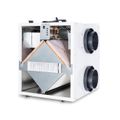



S&P Energy Recovery Ventilators are Soler & Palau's line of ERVs that bring in fresh outdoor air while recovering heat and moisture from the stale air being exhausted, using an enthalpic air-to-air energy exchange core. The core keeps the incoming and outgoing airstreams physically separated across many layers of an engineered resin material, so heat transfers by conduction and humidity transfers by moving water vapor without mixing the two airstreams. In winter, the core preheats and humidifies incoming cold, dry air using the warm air leaving the building, and in summer it precools and dehumidifies incoming warm, humid air using conditioned indoor air. Contractors specify S&P ERVs on tighter, more energy-efficient homes and light commercial buildings where mechanical ventilation is needed to meet code but a straight exhaust fan would waste too much conditioned air. Choosing the right model within the line generally comes down to matching airflow capacity and climate-specific defrost strategy to the building being served.
Subcategories
- TRLPe Low-Profile ERVs: The TRLPe series uses a compact, low-profile cabinet designed for tight mechanical spaces, paired with an EC motor and multi-speed control for residential and light commercial jobs. Installers specify it when ceiling or crawlspace clearance rules out a standard-height ERV cabinet. The energy exchange core still handles both heat and humidity transfer despite the smaller footprint. Confirming available install clearance before ordering avoids a fit problem on tight retrofit jobs.
- TRC/TRCe Total Recovery ERVs: TRC and TRCe models are built for commercial applications and use the energy exchange core without a mechanical or electrical defrost system, which the manufacturer states improves heat recovery efficiency and simplifies installation compared to units that need defrost cycling. Facility contractors specify these on commercial buildings needing continuous ventilation without defrost-related downtime. The EC motor option adds variable-speed control for demand-based ventilation. Confirming climate suitability against the no-defrost design is the main spec to check before selecting this line.
- TR Series ERVs for All Climates: The TR series is built to handle a wide range of climates using the same core energy exchange technology as the rest of the S&P ERV line. Contractors specify it on jobs spanning both cold, dry winters and hot, humid summers within the same building's ventilation design. HVI-certified models in this line meet third-party performance verification for airflow and recovery efficiency. Matching the specific model to the building's climate zone is the main selection factor within this series.
Buying Guide
Selecting an S&P Energy Recovery Ventilator starts with sizing airflow capacity to the building's ventilation requirement, typically based on square footage, occupancy, and any local mechanical ventilation code the project needs to meet. Climate matters as much as airflow: buildings in cold climates benefit most from the core's ability to preheat and humidify incoming winter air, while hot, humid climates benefit more from the precooling and dehumidifying effect on summer air, so confirming which S&P ERV model line fits the local climate profile is worth doing before ordering. Available installation space is the next major factor. The TRLPe series exists specifically for mechanical spaces too tight for a standard-height ERV cabinet, so measuring actual clearance before selecting a model avoids discovering a fit problem mid-installation. For commercial jobs, the TRC and TRCe lines skip the mechanical or electrical defrost system that some competing ERVs need in cold climates, which the manufacturer states simplifies installation and improves reliability, though contractors should still confirm that design fits the specific climate zone before specifying it. HVI-certified models across the S&P Energy Recovery Ventilator lineup carry third-party-verified airflow and recovery efficiency numbers, which helps when a project's mechanical ventilation calculations need to reference certified performance data rather than manufacturer claims alone. Confirming EC motor and control compatibility with the building's automation system, where one exists, is worth checking before the unit is ordered.
Frequently Asked Questions
What's the difference between an ERV and a standard exhaust fan?
An energy recovery ventilator brings in fresh outdoor air while recovering heat and moisture from the exhaust air stream, rather than just removing indoor air like a standard exhaust fan. The recovery process reduces how much conditioned air is wasted compared to straight exhaust ventilation. Tighter, more energy-efficient buildings benefit most from this approach since they need mechanical ventilation without giving up conditioning efficiency. Code requirements in many jurisdictions now call for mechanical ventilation that an ERV can satisfy more efficiently than a plain exhaust fan.
Do S&P ERVs need a defrost system in cold climates?
It depends on the model line. The TRC and TRCe series use a core design that the manufacturer states doesn't need a mechanical or electrical defrost system, while other lines in the catalog may specify defrost strategies suited to colder climates. Confirming the recommended climate range for a specific model before ordering avoids a mismatch. Contractors working in consistently cold climates should check this detail closely during model selection.
How does the TRLPe series differ from other S&P ERV models?
The TRLPe series uses a compact, low-profile cabinet built for mechanical spaces too tight for a standard ERV housing, while still using the same enthalpic energy exchange core as the rest of the line. It pairs an EC motor with multi-speed control for residential and light commercial applications. Installers specify it specifically when ceiling or crawlspace clearance rules out a taller cabinet. Airflow capacity should still be confirmed against the building's ventilation requirement regardless of cabinet size.
What does HVI certification mean for an ERV?
HVI certification means the model's airflow and energy recovery efficiency numbers have been independently verified rather than relying only on the manufacturer's own testing. Engineers specifying ventilation for code compliance often prefer HVI-certified models since the certified numbers can be referenced directly in mechanical calculations. Not every model in a manufacturer's lineup carries this certification. Checking for it before selecting a model is worth doing on any code-driven ventilation design.
Can one ERV handle both a cold winter climate and a hot humid summer?
The TR series is built specifically to handle a wide swing between cold, dry winters and hot, humid summers using the same core energy exchange design. Its ability to both preheat and humidify incoming winter air and precool and dehumidify incoming summer air comes from the same physical core, not separate mechanisms. Contractors in climate zones with significant seasonal swings often specify this series for that reason. Matching the specific model within the line to the project's climate zone is still worth confirming before ordering.
