




Filters
SORT
Product Availability –
Size –
PEX Size –
Review Score –
 --%3E %3Csvg version='1.1' id='Fill' xmlns='http://www.w3.org/2000/svg' xmlns:xlink='http://www.w3.org/1999/xlink' x='0px' y='0px' viewBox='0 0 100 100' enable-background='new 0 0 100 100' xml:space='preserve'%3E %3Cpath fill='%23F15C02' d='M79.44,0.95H20.56C9.78,0.95,0.95,9.78,0.95,20.56v58.87c0,10.79,8.82,19.61,19.61,19.61h58.87 c10.79,0,19.61-8.83,19.61-19.61V20.56C99.05,9.78,90.22,0.95,79.44,0.95z M65.38,58.24l9.38,29.58L49.69,69.78L24.5,87.82 l9.34-29.6L8.8,39.6l30.73-0.17c0,0,6.98-19.61,10-28.93c0.54,1.36,9.88,29.1,9.88,29.1H91.2L65.38,58.24z'/%3E %3C/svg%3E)
Price Range –
Stainless Steel PEX Crimp Drop Ear Elbows



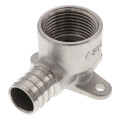
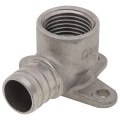

Stainless steel PEX crimp drop ear elbows are 90-degree fittings that anchor a shower valve, tub spout, or hose bibb rough-in to a stud or joist while transitioning PEX tubing to a female NPT threaded outlet. Built from 304 stainless steel to ASTM F1807, they carry NSF/ANSI 14, 61, and 372 listings along with cUPC and CSA B137.5 certifications for potable water, and hold a 200 psi pressure rating up to 400 degrees Fahrenheit. The integral ears let a plumber screw the fitting directly to framing before the wall is finished, so the threaded outlet stays in place while the valve or spout gets connected later. Stainless steel resists corrosion better than brass in hard or acidic water conditions, which is why plumbers working in tough water chemistry choose it over a standard brass drop ear elbow for the same rough-in job.
Subcategories
- 1/2 Inch Drop Ear Elbows: The half-inch size transitions half-inch PEX tubing to a half-inch female NPT threaded outlet and is the standard choice for a single shower head, hand shower, or lavatory rough-in. Built to ASTM F1807 from 304 stainless steel, it takes a standard crimp connection and holds a 200 psi rating up to 400 degrees Fahrenheit. The integral ears screw directly to a stud or blocking so the threaded outlet stays fixed while the valve or spout gets connected after the wall is finished. Plumbers reach for this size on most single-fixture bathroom rough-ins.
- 3/4 Inch Drop Ear Elbows: The three-quarter-inch size steps up to tub fillers and higher-flow valves that need a larger PEX supply line while still terminating in the same female NPT thread pattern. It shares the same 304 stainless steel construction, ASTM F1807 crimp connection, and 200 psi and 400-degree Fahrenheit ratings as the half-inch version. Commercial washrooms and larger residential bathrooms typically call for this size where flow demand is higher. Contractors often stock the half-inch and three-quarter-inch sizes together since a single bathroom rough-in commonly needs both.
- Reducing Drop Ear Elbows: Reducing drop ear elbows step down from a larger PEX supply line to a smaller threaded outlet, such as three-quarter-inch PEX to a half-inch FNPT connection. Plumbers use this configuration when the branch line feeding a fixture is sized larger than the fixture's own threaded connection calls for. Like the straight-through sizes, these are built from 304 stainless steel to ASTM F1807 and mount to framing through the same integral ears. Keeping one reducing size on the truck avoids swapping in a separate reducing coupling further up the line.
- NSF/ANSI Certified Elbows: Drop ear elbows carrying NSF/ANSI 14, 61, and 372 listings along with a cUPC listing are certified for potable water use, which matters since these fittings typically end up sealed inside a finished wall. The 304 stainless steel body is lead-free construction that meets those certifications across all available sizes. Confirming the specific certifications on a given elbow before installation is worth the extra minute, since not every drop ear elbow on the market carries the same listings. The certifications sit alongside the ASTM F1807 crimp rating on the same fitting.
Buying Guide
Size comes before finish or brand on a drop ear elbow, since a half-inch shower arm and a three-quarter-inch tub filler need different fittings even though both terminate in a similar NPT thread pattern. Confirming which size the fixture manufacturer specifies before rough-in matters, because swapping sizes after the wall is closed means cutting back into it. Certifications matter as much as size for anything installed behind a finished wall. Stainless Steel PEX Crimp Drop Ear Elbows built to ASTM F1807 and carrying NSF/ANSI 14, 61, and 372 listings along with a cUPC listing are certified for potable water use, and confirming those listings on the specific elbow before installation is worth the extra minute since a leak inside a wall often isn't found until it has caused damage. Material choice generally comes down to water quality and budget. Brass drop ear elbows cost less and work fine in typical municipal water, but 304 stainless steel resists corrosion better in hard or acidic water conditions. Checking the pressure and temperature rating, 200 psi and up to 400 degrees Fahrenheit for fittings in this category, against the system's operating conditions rounds out the decision. Reducing sizes, such as three-quarter-inch PEX stepping down to a half-inch threaded outlet, are worth keeping on hand for branch lines that run larger than the fixture connection they feed.
Frequently Asked Questions
What's the difference between a stainless steel and brass drop ear elbow?
Stainless steel drop ear elbows resist corrosion better than brass in hard or acidic water conditions, while both materials transition PEX tubing to a female NPT threaded outlet and mount to framing with the same integral ear tabs. Brass costs less and works fine in typical municipal water, so the choice often comes down to local water chemistry rather than the rough-in itself. Both are commonly built to ASTM F1807 with a 200 psi and 400-degree Fahrenheit rating.
What size drop ear elbow does a shower valve rough-in need?
Most single shower heads and hand showers use a half-inch PEX drop ear elbow, while tub fillers and higher-flow valves typically call for the three-quarter-inch size. Reducing versions that step down from three-quarter-inch PEX to a half-inch threaded outlet cover branch lines sized larger than the fixture connection. Checking the fixture manufacturer's rough-in instructions before installation confirms which size and thread pattern the valve or spout requires.
Are stainless steel drop ear elbows rated for potable water?
Stainless Steel PEX Crimp Drop Ear Elbows carrying NSF/ANSI 14, 61, and 372 listings along with a cUPC listing are certified for potable water use. Confirming those listings on the specific fitting before installation matters since these elbows typically end up sealed inside a finished wall. The 304 stainless steel, lead-free construction supports that potable water certification.
What pressure and temperature rating do these fittings carry?
Stainless steel PEX crimp drop ear elbows built to ASTM F1807 typically hold a 200 psi pressure rating up to 400 degrees Fahrenheit. The same rating applies across the half-inch, three-quarter-inch, and reducing sizes built to the same standard. Checking the rating against the system's actual operating pressure and temperature before installation keeps the connection within its design limits.
Why use ears instead of a standard elbow for a shower rough-in?
The integral ears on a drop ear elbow let a plumber screw the fitting directly to a stud or blocking before the wall is finished, keeping the threaded outlet from moving while the valve or spout gets connected later. A standard elbow without ears has no way to anchor to framing, so it relies entirely on the PEX tubing for support behind the wall. The anchoring difference is why drop ear elbows are the standard choice for shower, tub, and lavatory rough-in.
