



Water Heater Accessories
Water heater accessories are the supporting parts plumbers install alongside a water heater to protect the tank, meet code, and simplify future service. The category includes anode rods that slow tank corrosion. It also includes shutoff and service valves that control gas and water flow. Connectors tie the unit into the home's supply lines. Stands or risers support the tank properly. Choosing the right accessories for a given water heater model helps the unit run safely and extends its service life.
Many of these accessories address a specific code requirement or manufacturer recommendation rather than a general upgrade. An automatic gas shutoff valve, for example, is often required in seismic zones, while a dielectric service valve prevents corrosion where dissimilar metals connect. Local plumbing code and the water heater's installation requirements determine which accessories a given installation actually needs.




Subcategories
- Automatic Gas Shutoff Valves: Automatic gas shutoff valves cut gas supply to a water heater in response to excess movement or a detected gas leak. They are commonly required by code in earthquake-prone regions. Plumbers install them in the gas line ahead of the water heater's control valve. Some jurisdictions require a specific valve type, so local code should be checked before installation.
- Corro-Protec Powered Anode Rods: Corro-Protec powered anode rods use an external power source rather than a sacrificial metal core to protect a water heater tank from corrosion. The rod does not deplete over time the way a traditional anode rod does. Plumbers use them as a long-term alternative to standard anode rods, particularly in areas with water conditions that wear through sacrificial rods quickly. Installation still requires the correct rod length and fitting size for the tank.
- Dielectric Water Heater Service Valves: Dielectric water heater service valves isolate dissimilar metals, such as copper supply lines and a steel tank fitting, to reduce galvanic corrosion at the connection point. Plumbers install them at the inlet and outlet of the water heater during rough-in or replacement. Using the correct dielectric fitting at these connections is a common code requirement across many jurisdictions.
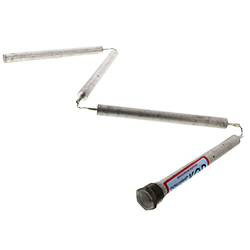
- Flexible Anode Rods: Flexible anode rods bend to fit into water heaters installed in low-clearance spaces where a rigid rod cannot be inserted straight down into the tank. They provide the same sacrificial corrosion protection as a standard anode rod while accommodating tight attic or closet installations. Rod material and length still need to match the tank manufacturer's specification.
- Furnace Risers: Furnace risers, also used with water heaters, connect the appliance to the vent or flue system to carry combustion byproducts safely out of the building. Plumbers and HVAC techs size risers to match the appliance's vent connection and the required vertical rise. Correct riser installation is necessary for safe venting and proper draft.
- Rough-In Water Heater Connectors: Rough-in water heater connectors join the supply and return lines to the water heater during initial installation, before the finished plumbing connections are made. Plumbers use them to establish the hot and cold water stub-outs at the correct height and spacing for the water heater being installed. Getting rough-in connector placement right avoids rework once the finished water heater is set.
Buying Guide
Selecting water heater accessories starts with identifying the specific water heater model and its manufacturer's installation requirements. Tank diameter, top clearance, and existing anode rod length all affect which anode rod, connector, or valve will actually fit the unit.
Local code requirements often dictate which water heater accessories are mandatory rather than optional. Automatic gas shutoff valves, dielectric fittings, and specific venting components may be required in a given jurisdiction regardless of the water heater brand or model being installed.
Water quality in the service area affects anode rod selection. Areas with water that is hard on standard sacrificial anode rods may be better served by a powered anode rod. It does not deplete the same way and can reduce how often the rod needs replacing.
Installation clearance is a practical concern that gets overlooked until the accessory does not fit. A flexible anode rod solves a problem a rigid rod cannot in a low-clearance closet or attic installation, so measuring the space before ordering parts saves a return trip.
Keeping a basic stock of common water heater accessories covers most replacement and new-installation calls without a special order. Useful items include anode rods in standard lengths, dielectric fittings, and rough-in connectors sized for typical residential installations.
Frequently Asked Questions
Do all water heaters need an automatic gas shutoff valve?
Not all installations require one, but many seismic zones mandate an automatic gas shutoff valve by code. Checking local plumbing and gas code before installation confirms whether one is required.
How is a powered anode rod different from a standard anode rod?
A powered anode rod uses an external electrical current to protect the tank instead of a sacrificial metal core that wears away over time. Because it does not deplete the same way, it typically needs less frequent replacement than a standard rod.
Why use a dielectric fitting at the water heater connections?
Dielectric fittings separate dissimilar metals, such as copper pipe and a steel tank fitting, to reduce galvanic corrosion at that joint. Many local codes require this type of fitting at water heater connections.
What is a flexible anode rod used for?
A flexible anode rod bends to fit into water heaters installed in tight spaces, such as a low attic or small closet. A straight rigid rod cannot be inserted in these spaces. A flexible anode rod provides the same corrosion protection as a standard rod.
Can rough-in water heater connectors be used with any water heater brand?
Not always. Rough-in connectors need to match the supply line spacing and connection type used during the initial plumbing rough-in. They should be selected based on the planned water heater's connection layout rather than assumed to fit universally.
Resources
Subcategories
- Automatic Gas Shutoff Valves: Automatic gas shutoff valves cut gas supply to a water heater in response to excess movement or a detected gas leak. They are commonly required by code in earthquake-prone regions. Plumbers install them in the gas line ahead of the water heater's control valve. Some jurisdictions require a specific valve type, so local code should be checked before installation.
- Corro-Protec Powered Anode Rods: Corro-Protec powered anode rods use an external power source rather than a sacrificial metal core to protect a water heater tank from corrosion. The rod does not deplete over time the way a traditional anode rod does. Plumbers use them as a long-term alternative to standard anode rods, particularly in areas with water conditions that wear through sacrificial rods quickly. Installation still requires the correct rod length and fitting size for the tank.
- Dielectric Water Heater Service Valves: Dielectric water heater service valves isolate dissimilar metals, such as copper supply lines and a steel tank fitting, to reduce galvanic corrosion at the connection point. Plumbers install them at the inlet and outlet of the water heater during rough-in or replacement. Using the correct dielectric fitting at these connections is a common code requirement across many jurisdictions.
- Flexible Anode Rods: Flexible anode rods bend to fit into water heaters installed in low-clearance spaces where a rigid rod cannot be inserted straight down into the tank. They provide the same sacrificial corrosion protection as a standard anode rod while accommodating tight attic or closet installations. Rod material and length still need to match the tank manufacturer's specification.
- Furnace Risers: Furnace risers, also used with water heaters, connect the appliance to the vent or flue system to carry combustion byproducts safely out of the building. Plumbers and HVAC techs size risers to match the appliance's vent connection and the required vertical rise. Correct riser installation is necessary for safe venting and proper draft.
- Rough-In Water Heater Connectors: Rough-in water heater connectors join the supply and return lines to the water heater during initial installation, before the finished plumbing connections are made. Plumbers use them to establish the hot and cold water stub-outs at the correct height and spacing for the water heater being installed. Getting rough-in connector placement right avoids rework once the finished water heater is set.
Buying Guide
Selecting water heater accessories starts with identifying the specific water heater model and its manufacturer's installation requirements. Tank diameter, top clearance, and existing anode rod length all affect which anode rod, connector, or valve will actually fit the unit.
Local code requirements often dictate which water heater accessories are mandatory rather than optional. Automatic gas shutoff valves, dielectric fittings, and specific venting components may be required in a given jurisdiction regardless of the water heater brand or model being installed.
Water quality in the service area affects anode rod selection. Areas with water that is hard on standard sacrificial anode rods may be better served by a powered anode rod. It does not deplete the same way and can reduce how often the rod needs replacing.
Installation clearance is a practical concern that gets overlooked until the accessory does not fit. A flexible anode rod solves a problem a rigid rod cannot in a low-clearance closet or attic installation, so measuring the space before ordering parts saves a return trip.
Keeping a basic stock of common water heater accessories covers most replacement and new-installation calls without a special order. Useful items include anode rods in standard lengths, dielectric fittings, and rough-in connectors sized for typical residential installations.
Frequently Asked Questions
Do all water heaters need an automatic gas shutoff valve?
Not all installations require one, but many seismic zones mandate an automatic gas shutoff valve by code. Checking local plumbing and gas code before installation confirms whether one is required.
How is a powered anode rod different from a standard anode rod?
A powered anode rod uses an external electrical current to protect the tank instead of a sacrificial metal core that wears away over time. Because it does not deplete the same way, it typically needs less frequent replacement than a standard rod.
Why use a dielectric fitting at the water heater connections?
Dielectric fittings separate dissimilar metals, such as copper pipe and a steel tank fitting, to reduce galvanic corrosion at that joint. Many local codes require this type of fitting at water heater connections.
What is a flexible anode rod used for?
A flexible anode rod bends to fit into water heaters installed in tight spaces, such as a low attic or small closet. A straight rigid rod cannot be inserted in these spaces. A flexible anode rod provides the same corrosion protection as a standard rod.
Can rough-in water heater connectors be used with any water heater brand?
Not always. Rough-in connectors need to match the supply line spacing and connection type used during the initial plumbing rough-in. They should be selected based on the planned water heater's connection layout rather than assumed to fit universally.