




Wayne Sewage Pumps

 --%3E %3Csvg version='1.1' id='No-RB' xmlns='http://www.w3.org/2000/svg' xmlns:xlink='http://www.w3.org/1999/xlink' x='0px' y='0px' viewBox='0 0 100 100' enable-background='new 0 0 100 100' xml:space='preserve'%3E %3Cpath fill='%23CECECE' d='M79.44,0.95H20.56C9.78,0.95,0.95,9.78,0.95,20.56v58.87c0,10.79,8.82,19.61,19.61,19.61h58.87 c10.79,0,19.61-8.83,19.61-19.61V20.56C99.05,9.78,90.22,0.95,79.44,0.95z M65.38,58.24l9.38,29.58L49.69,69.78L24.5,87.82 l9.34-29.6L8.8,39.6l30.73-0.17c0,0,6.98-19.61,10-28.93c0.54,1.36,9.88,29.1,9.88,29.1H91.2L65.38,58.24z'/%3E %3C/svg%3E)

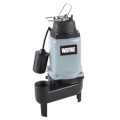

Wayne Sewage Pumps are built to move wastewater that carries solids from a basin. Wayne describes its sewage pumps as designed for liquid containing solids as large as 2 in. in diameter, so the pump has to be sized for what actually enters the pit. The SEL50 is a useful reference model. It's a 1/2 HP reinforced, corrosion-resistant thermoplastic pump with a combination 2 in. and 3 in. NPT discharge. Wayne rates it for a maximum flow of 10,000 GPH and 7,200 GPH at 10 ft of lift, and it uses a piggy-back tether float switch for automatic or manual operation. Horsepower, discharge size, float style, and basin diameter all decide whether a pump runs reliably in a given pit. Matching those details to the job before ordering helps avoid short cycling, clogged discharge lines, and return trips for contractors replacing or installing sewage pumps.
Subcategories
- Thermoplastic Sewage Pumps: Thermoplastic sewage pumps are built from reinforced, corrosion-resistant thermoplastic. Installers use them in sewage basins that collect wastewater with solids. The Wayne SEL50 is a 1/2 HP example with a combination 2 in. and 3 in. NPT discharge. Wayne designed it for sewage basins 18 in. in diameter or larger.
- Tether Float Sewage Pumps: Tether float sewage pumps use a mechanical float switch to control pump operation. Wayne says tether floats need a basin 14 in. or larger so the float has unobstructed travel. The SEL50 uses a piggy-back tether float switch for automatic or manual operation. Plumbers pick this style when the basin is wide enough for the float.
- 2 in. Solids Handling Sewage Pumps: Solids handling sewage pumps are designed for liquid that contains solids. Wayne describes its sewage pumps as handling solids as large as 2 in. in diameter, and the SEL50 is capable of handling 2 in. solids. Contractors choose them for basins that receive wastewater with solids.
- 1/2 HP Sewage Pumps: Horsepower sets how much flow and lift a sewage pump delivers, according to Wayne. The SEL50 is a 1/2 HP model with a 10,000 GPH maximum flow and 7,200 GPH at 10 ft of lift. Installers compare the performance chart to the lift a job requires, which Wayne puts near 25 ft for residential models.
Buying Guide
Start with the solids. Wayne designs its sewage pumps for liquid that contains solids as large as 2 in. in diameter, so confirm that the rated solids handling covers what the fixtures send to the pit. Next, match the discharge. The SEL50 has a combination 2 in. and 3 in. NPT discharge, and Wayne advises measuring both the basin diameter and the discharge pipe diameter before choosing a model.
Basin size and float style come third. The SEL50 is designed for sewage basins 18 in. in diameter or larger. Tether floats are mechanical switches that need a basin 14 in. or larger so the float has unobstructed travel. When the pit is smaller, Wayne lists control boxes as an alternative for manually operated pumps.
Performance comes next. When comparing Wayne Sewage Pumps, read each pump's performance chart instead of relying on maximum flow alone. The SEL50 is rated for 10,000 GPH maximum but 7,200 GPH at 10 ft of lift, a gap that matters on any installation with real elevation to cover. Wayne notes that more horsepower raises flow and lift, and it cites lift of approximately 25 ft for residential models.
Finally, confirm the details that vary by job: automatic or manual float operation, the basin that's already installed, and the discharge piping that's already in place. A short checklist of solids size, discharge size, basin diameter, and required lift catches most mismatches before a pump reaches the job site.
Frequently Asked Questions
What size solids can Wayne sewage pumps handle?
Wayne describes its sewage pumps as designed for liquid containing solids as large as 2 in. in diameter. The SEL50 is a Wayne sewage pump capable of handling 2 in. solids. Check the specification of the individual pump before ordering for a specific application.
What discharge size does the Wayne SEL50 sewage pump have?
The Wayne SEL50 sewage pump has a combination 2 in. and 3 in. NPT discharge. Wayne advises measuring the discharge pipe diameter before choosing a model. Matching the pump discharge to the existing piping avoids rework.
How big does the basin need to be for a Wayne sewage pump?
The Wayne SEL50 sewage pump is designed for sewage basins 18 in. in diameter or larger. Wayne says tether floats need a basin 14 in. or larger for unobstructed travel. Smaller basins may call for a control box with a manually operated pump, according to Wayne.
How much flow does a Wayne sewage pump deliver at 10 ft of lift?
The Wayne SEL50 sewage pump is rated for a maximum flow of 10,000 GPH and 7,200 GPH at 10 ft of lift. Flow drops as lift increases, so read the performance chart for the actual elevation on the job. Wayne cites lift of approximately 25 ft for residential models.
What float switch does the Wayne SEL50 sewage pump use?
The Wayne SEL50 sewage pump uses a piggy-back tether float switch for automatic or manual operation. Tether floats are mechanical switches. Wayne lists control boxes as an alternative for manually operated sewage pumps in smaller basins.
