


'/%3E%3C/svg%3E)
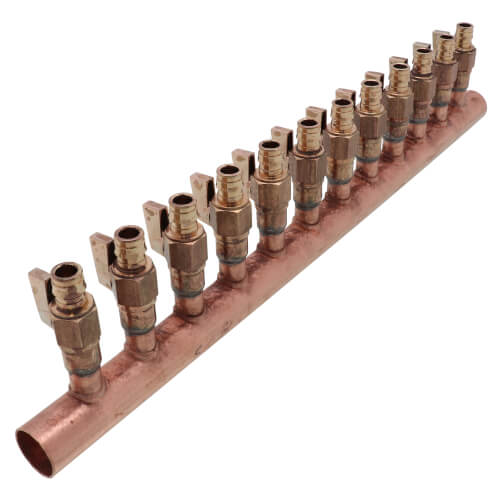
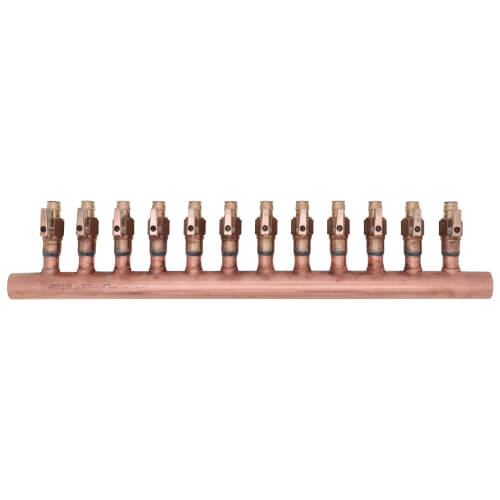
1" Copper Manifold w/ 1/2" ProPEX Ball Valve, 12 Outlets (Lead Free Brass)
 --%3E %3Csvg version='1.1' id='Fill' xmlns='http://www.w3.org/2000/svg' xmlns:xlink='http://www.w3.org/1999/xlink' x='0px' y='0px' viewBox='0 0 100 100' enable-background='new 0 0 100 100' xml:space='preserve'%3E %3Cpath fill='%23F15C02' d='M79.44,0.95H20.56C9.78,0.95,0.95,9.78,0.95,20.56v58.87c0,10.79,8.82,19.61,19.61,19.61h58.87 c10.79,0,19.61-8.83,19.61-19.61V20.56C99.05,9.78,90.22,0.95,79.44,0.95z M65.38,58.24l9.38,29.58L49.69,69.78L24.5,87.82 l9.34-29.6L8.8,39.6l30.73-0.17c0,0,6.98-19.61,10-28.93c0.54,1.36,9.88,29.1,9.88,29.1H91.2L65.38,58.24z'/%3E %3C/svg%3E)
 --%3E %3Csvg version='1.1' id='With-RB' xmlns='http://www.w3.org/2000/svg' xmlns:xlink='http://www.w3.org/1999/xlink' x='0px' y='0px' viewBox='0 0 100 100' enable-background='new 0 0 100 100' xml:space='preserve'%3E %3Cpath fill='%23FBC8B4' d='M79.44,0.95H20.56C9.78,0.95,0.95,9.78,0.95,20.56v58.87c0,10.79,8.82,19.61,19.61,19.61h58.87 c10.79,0,19.61-8.83,19.61-19.61V20.56C99.05,9.78,90.22,0.95,79.44,0.95z M65.38,58.24l9.38,29.58L49.69,69.78L24.5,87.82 l9.34-29.6L8.8,39.6l30.73-0.17c0,0,6.98-19.61,10-28.93c0.54,1.36,9.88,29.1,9.88,29.1H91.2L65.38,58.24z'/%3E %3C/svg%3E)


MANUALS (2)
Product Highlights


Description
Wirsbo 1" Copper Valved Manifolds (type L copper) feature 1/2" ProPEX outlets. A soldered valve connection allows for simple and easy isolation of individual loops. Sections can sweat together to extend the number of outlets using a standard 1" copper coupling. Do not exceed accepted flow rates for 1" nominal copper. Both 1" ends are copper pipe size and will require a copper end cap, coupling or transition fitting to make the proper system connection.
Uponor's lead-free brass transition fittings, valves and wall boxes carry the NSF us-pw-G marking for lead-free compliance to meet state lead-free legislation, and exceed the U.S. Safe Drinking Water Act. Now you can combine lead-free brass fittings with Uponor's PEX tubing, EP offering and ProPEX Out-of-the-Wall Support System for a complete lead-free solution from the inlet to the faucet. The new lead-free offerings feature Uponor's unique ProPEX fitting system for strong, durable connections without the need for torches, glues, solvents or gauges.
Specs
| Loop Size: | 1/2" |
|---|---|
| Number of Outlets: | 12 |
| Supply Size: | 1" |
| Supply Connection: | Sweat (FTG x FTG) |
| Loop Connection: | Expansion PEX |
| Material: | Copper |
| Fitting System Compatibility: | Expansion PEX |
| Tubing Compatibility: | PEX |
| Warranty: | 10 Year |
| Max Temp (F): | 210°F at 150 psi |
| Max Flow (GPM): | 21 |
| Standards Met: | ASTM F877 CAN/CSA B137.5 |

Questions?
You May Also Need
Product Reviews
Most Liked Positive Review
Nice Kit
Most Liked Negative Review
Ball valves leak---
Convenient, but had some leaks
For this price this should be perfect. LEAKY !!!!!!!!
Leaky valves
Some ball valves leak
Leaky valves
Awesome product.
Awesome manifolds.
Excellent product
Excellent Product
Excellent product!
Product Q&A
14 QuestionsQ: Are the valves on the manifold replaceable ? part number and cost?
Asked by Duck 9 years ago
Add your answer
Verified Reply- SupplyHouse StaffThe valves are sweat onto the manifold by Uponor in the factor. They may be replaced if properly desoldered. Part number LF4805050
Q: Does the valves on this manifold have Full Port Ball Valve: Allows water to flow freely through valve?
Asked by Danny 10 years ago
Add your answer
Verified Reply- SupplyHouse StaffThis manifold has standard port ball valves.
Q: With Manifold #LF2500400, can I use Copper Coupling #WP0-16-12 on one end to Copper Adapter Brass Ball Valve #LF4807575 and Copper 90° Elbow #WP7-16-12 on the other end also to a Copper Adapter Brass Ball Valve #LF4807575? I wish to use the straight end for water in and the 90° for water out for a longer run - 35'. Also, is using 1/2" for all of my shorter runs and 3/4" for the longer run going to be ok? End of long run is a toilet and one sink. Thank you.
Asked by FreeBrrd 12 years ago
Add your answer
Verified Reply- SupplyHouse StaffThe coupling and elbow you mentioned will connect to the LF2500400 manifold, but not to the LF4807575 ball valve. The ball valves are designed to connect directly to 3/4" copper pipe or street adapters. Since we do not carry any single fittings that could accomplish what you are trying to do, we would recommend using a piece of 3/4" copper pipe between each valve and the fittings you mentioned. The pipe sizes you mentioned sound reasonable to us. Toilets and sinks generally have much lower flow demands than fixtures such as baths, showers, and washing machines.
Q: What kind of bracket or mounting device is recommended to mount/secure these on a wall?
Asked by Home Builder 12 years ago
Add your answer
I used the one inch plastic "C" shaped brackets from Menards. Use a drywall screw to screw the bracket into some wood and then snap the manifold into the brackets. Greg Scott Infrasupport Corporation
It should depend on where one is mounting this. My mount was on a concrete block wall. A wooden base board was secured with concrete screws and the manifold was mounted to the board using copper brackets. It is important to avoid dis-similar metals to reduce potential electrolysis/deterioration of the manifold. It would also be possible to hang this by joist hangers from floor joists. Using plastic hangers also prevents damage. The weak point of that method is that once the manifold is fully connected, all PEX piping must be also well supported to prevent rotation by gravity, although some support is called for in any case. Alan Springett aka Rockwater
I did not mount it, because it stays firm in the place fixed by all that pex tubing
standard copper tubing or pex straps.
I used copper brackets and mounted it to a ¾" piece of plywood attached to the 2x4 studs.
Once I had the fittings soldered onto each end, I used 1" copper pipe straps to secure the manifold to the wall.
Standoff copper pipe bell shaped hangers (from Lowe's) work well. I've also used copper U-shaped pipe brackets or copper plumber's tape in a pinch. The key is to use copper so there's no corrosion between dissimilar metals.
Personally, I have not found any type of mounting device to secure this manifold to a wall. What I used was electrical conduit straps to fasten mine to the wall. Make sure if you do this that you put some sort of "cushion" between the strap and the manifold so it will not wear through the copper. Good luck!
Q: Will these connections work with standard crimp rings?
Asked by Mroverman 13 years ago
Add your answer
no, you must use the special wirsbo uponor expander with their plastic rings
No, they will not work with clamp rings. You need to use an expander tool. If you are going to do a lot of connections. I would buy a manual expansion tool. I think it's the best connection . You need to use type a pex and rings
No, I don't believe they will. These fittings are larger in diameter than the types that use crimp rings. I suggest using expandable pex with expander rings.
No, you must use the wirsbo uponor rings and special expansion tool
A ProPex manifold has ProPex fittings and that requires the use of PEX A tubing (AquaPex). This tubing requires an expander tool (I bought the Milwaukee) with ProPex reinforcing rings. I believe the PEX A tubing and ProPex fittings are the wrong diameter for the crimp ring connection system. There is a great tutorial video on PexSupply home page at the bottom. Bob Stallard Sent from my iPad
No. I would not do it. Propex fittings seems bigger than crimp one. I dont think you would be able to fit pipe and ring on, not to mention crimping it.
Q: Is there any plastic or rubber or any material that can melt in the valves when you sweat solder the 1" ends? Do you have to pull the valves apart before soldering them to avoid melting the material? If so how do you pull them apart? Thanks
Asked by Quest replacer 14 years ago
Add your answer
I did not disassemble valves. I put wet rug over closest valve while soldering and I kept all of them in open position. Cheers.
No there are no plastic or rubber material in the valves. The valves are soldered on the manifold. When I soldered my manifold I opened the valves so the heat didnt biuld up to much in them.
The valves are all brass, no plastic. However, I would wrap a water soaked rag around the valve & its solder joint closest to the joint you are soldering ... that will keep where the valve is soldered to the manifold from getting too hot.
There is no danger of melting the valve packing during normal soldering operations. The valve packing is a high temperature material and not subject to melting at normal soldering temperatures. It is always good practice to use a damp rag wrapped around the valve assembly or 1" header pipe just downstream of the soldering point or use a heat blocking paste as a "heat dam" when soldering near potentially heat sensitive components.
To prevent the problem from happening, I "gently" clip a vice grip type tool on the nearest valve stem to the solder joint, and to the 1" manifold beyond the first valve before soldering and for five minutes (or until "quenching" the joint in water) to serve as a "heat sink" that absorbes excess heat BEFORE it gets to the delicate parts. Be careful to apply "just enough" heat to melt the solder, and ALWAYS use liberal amounts of flux. It may take a little more heat than normal since heat goes to the vice grips (not the valve innards). WEAR GLOVES: the vice grips will be hot if not quenched! MS
As far as I know the valves are all metal.. I have soldered a few and had no problems. Wouldn't hurt to take a damp towel and wrap the manifold except for the end to be soldered. And watch that you direct the heat away from the valves. Don't forget to wipe the joint after soldering.
I did not take the valves apart to sweat the manifold. Wet a rag or two and wrap it around the nearest couple of valves before sweating. In God We Trust! In Government We Don't!
i soldered mine without taking anything apart and they are fine. solder it all together before attaching any pex lines to it as any pex should be at least 18 inches from where you're soldering.
Seems counterintuitive, but surely you don't disassemble a perfectly good valve to solder it into the system. I suppose you are supposed to control the heat on the valve body and since solder has such a low melting point, I bet the teflon seals are designed to be able to withstand that low temperature. I think you could get carried away with the flame and do some damage, but I don't think you're supposed to have to disassemble the valve.
Q: Since the manifold has all 1/2" outlets, is the expectation that all faucets in the house get 1/2"? The PEX installation guide seemed to recommend 3/8" for most faucets (the main exception being shower/baths), so would it be better to reduce those lines or just stick with 1/2" for everything?
Asked by Keith 14 years ago
Add your answer
Verified Reply- PexSupply Staff3/8" piping is sufficient for faucets and most other fixtures, but it's generally easier to stick with 1/2" everywhere. It's tough to find 3/8" manifolds or fittings to connect to fixtures.
The home run to each fixture to the manifold would be done in 1/2" pipe. You would order the valves for the sinks and toilets at 3/8x1/2". You want the max amount of water to the fixture that you can. Hope that helped Sent from my iPhone
All of the runs will be made with 1/2" Pex, then under the faucet, you would use a 1/2" Pex to 3/8" adapter and reduce it there. If you ran 3/8" all the way, you would suffer more pressure loss as there would be more friction in the smaller tubing.
In my system I ran all 1/2 inch lines to shut off where it was reduced to the 3/8 inch for sinks and toilets. It's easy to find 1/2 inch to 3/8 shut offs.
Just run 1/2 PEX-a for everything. It delivers better pressure. And besides, the tubing is the cheap part of an install.
I installed this type manifold in my house with a PEX re-pipe, and also in a friends house when his copper piping also started showing Type I corrosion issues. I put all the bathrooms off just one of the 1/2" manifold valves. From this 1/2" valve I went up to 3/4" for the long run, and then went back to 1/2" where it broke off the 3/4" bathroom header to each bathroom. I only run about 50 - 60 psi supply pressure behind a regulating valve, and didn't notice any flow drop since the PEX sweeps versus hard 90's in rigid piping. My friend runs 100 psi supply with no regulating valve, and was worried about flow drop through the 1/2" manifold valves versus how it was run in 3/4" to 1/2" in the rigid copper. He even got buckets and timed how long it took to fill it with his old rigid piping versus after the PEX was put in. It was better for his main bath that was run in 3/4" PEX where it goes through the floor just like in copper. We installed his laundry room in all 1/2" PEX at about 40' from one of the 1/2" manifold valves to the utility sink, and he lost like 5 seconds on the fill time. Original copper line to the laundry was about 30' of 3/4" copper and the balance 1/2". You don't have to stay with 1/2" off the manifold just because it's 1/2". You can always go to 3/4" and then back to 1/2" in PEX to maintain or gain flow. If you go 1/2" all the way you may or may not notice a difference, but the bucket test showed on a long run it lost some flow rate. Good Luck!
The reason they recommend 3/8 for the faucets and 1/2 for the shower and bath is for a pretty simple reason. I just finished building a new house and I ran 3/8 just in hot water to every faucet and 1/2 for all the cold and hot to the bath and showers. Simple reasoning is that you have less water in a 3/8 line than a 1/2 so when you turn on a faucet it doesnt take as long to get hot water to your faucet since the 3/8 line isnt storing as much water. Therfore in the long run you waste less water wating for hot water to get to your faucet and that saves $$ if you pay for you water. Especially if the faucets are a long ways away from yuor water heater. Because you have a lot of water just sitting in the line that needs to be ran out to get hot water Faucets are so low flow that 3/8 lines doesnt effect the water flow. Now showers and bath call for a higher flow therefore you need to run 1/2 line to them. All in all it saves on water and also energry to heat your water.
Stick with 1/2" until you get to your destination points.
It really depends on water pressure, adding an air pocket tube to the top of the manifold is a good idea as well, showers that most people like that seem like fire hoses are usually 1" as long as you loop you manifold the pressure will equal out, check out one of the Holmes on homes episodes where they do this it is a great visual aide, I have done several homes all 1/2" and had no pressure issues, but like I said some people like that fire hose effect and 1" will give you that even with a well and pressure tank. Sent from my iPad
I ran all 1/2" home runs, have more volume with 1/2"
Q: One of the answers on this product was that all manifolds come with fittings on them, but specifications say they are bare on the ends. What size fitting is on the ends?
Asked by Anonymous 14 years ago
Add your answer
If it's like the one I bought (a while ago, and mine only had 6 outlets) the 10 valved outlets have 1/2" ProPex fittings, but there are two other ends that are just standard 1" copper pipe with no fittings. That allows you to solder on whatever connector you need to hook up to your water supply (my supply was 3/4" ProPex, so I soldered on a 1" -> 3/4" copper fitting, then a 3/4" ProPex fitting). It also allows you to either cap off the other end, chain on more manifolds, solder on a water-hammer arrestor, or whatever.
Both ends are indeed bare 1" copper pipe ends. No fittings.
One inch ends
It looks just like the one I purchased, you need to use your Uponor Wisbro expander tool with 1/2" expansion head and supply your own 1/2" propex ring to seal. I added a single 1/2 ball valve to the end and capped it to give me one extra port if I ever needed it. Hope that helps, mine is working great after about 2 years, and it's nice to be able to isolate any line for a repair if needed. Good Luck!
The main copper pipe is 1" - both ends therefor are 1". On some models, one side is female, one male, but I imagine on the 10 outlet units most all are male on both sides. The way that these sorts of manifold should be installed is with the feed coming from the center for min drop and most even flow. So, if you are just using one manifold, you would feed water from both open ends. Or you can use 2 smaller manifolds and use a TEE in the middle and feed that way. BTW, this is by far the best method to install PEX. As long as you have enough flow and pressure to the manifold, no drop at any tap Good luck!
The 1" pipe is bare on both ends. Each of the 10 valves integrates a 1/2" propex fitting.
None, both ends are open. Hope this helps. .
1/2" pex fittings for propex expander
The 1/2" outlets have 1/4-turn brass ball valves on them. The 1" copper portion of the manifold is open at each end, so you need to attach the supply at one end and, on the other end, a cap (to end it), coupling (to another manifold) or connections for a hose bib (to drain the entire line).
Q: I am trying to complete a gut-out rehab on a house. I am planning for 12 cold water ports and around 8 hot water ports. I will complete the kitchen and a bathroom in phase 1. That works out to be half of the ports. Can I start out with a 6-port manifold for cold and a 4-port manifold for hot (just big enough to support phase 1) and when I am ready to continue add another 6-port and 4-port for phase 2?
Asked by chris 14 years ago
Add your answer
Verified Reply- PexSupply StaffYou can. There would be no issues with that strategy or with placing various manifolds around the house. Keep in mind that this is a ProPEX manifold, so it only works with PEX-A tubing and an expansion tool.
Q: can this be used with a hydronic heating system for radiators. supply temp of 180 degrees from a gas boiler
Asked by nick 15 years ago
Add your answer
Verified Reply- PexSupply StaffYes, you can use this manifold as long as your design can use 1/2" PEX to feed your radiators. You will need one manifold for the supply and one manifold for the return.