




'/%3E%3C/svg%3E)
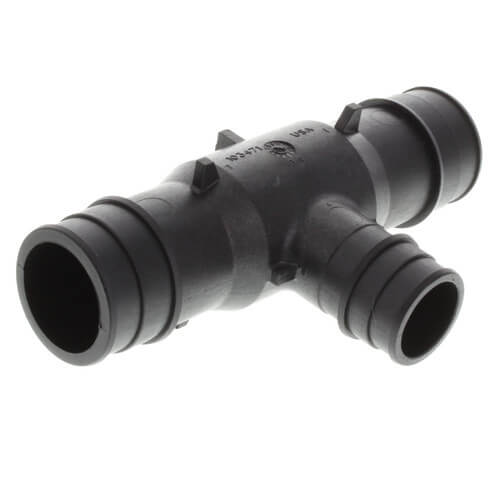
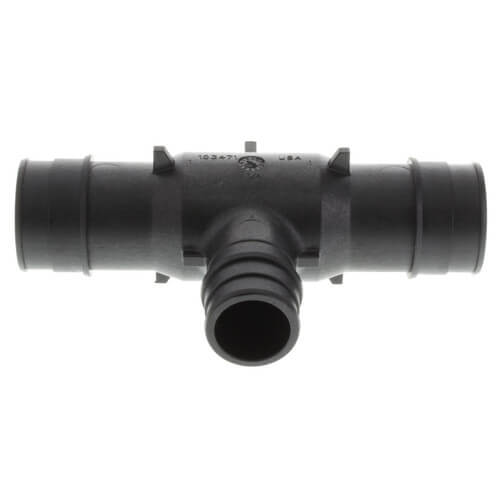
1" x 1" x 1/2" ProPEX EP Reducing Tee
 --%3E %3Csvg version='1.1' id='Fill' xmlns='http://www.w3.org/2000/svg' xmlns:xlink='http://www.w3.org/1999/xlink' x='0px' y='0px' viewBox='0 0 100 100' enable-background='new 0 0 100 100' xml:space='preserve'%3E %3Cpath fill='%23F15C02' d='M79.44,0.95H20.56C9.78,0.95,0.95,9.78,0.95,20.56v58.87c0,10.79,8.82,19.61,19.61,19.61h58.87 c10.79,0,19.61-8.83,19.61-19.61V20.56C99.05,9.78,90.22,0.95,79.44,0.95z M65.38,58.24l9.38,29.58L49.69,69.78L24.5,87.82 l9.34-29.6L8.8,39.6l30.73-0.17c0,0,6.98-19.61,10-28.93c0.54,1.36,9.88,29.1,9.88,29.1H91.2L65.38,58.24z'/%3E %3C/svg%3E)


MANUALS (2)
Product Highlights


Description
Specs
| Size: | 1" x 1" x 1/2" |
|---|---|
| Material: | Engineered Plastic |
| PEX Size: | 1/2" 1" |
| Application: | Plumbing Heating |
| Warranty: | 25 Year (Limited) |
| Standards Met: | ASTM F1960 NSF ASTM F877 |
| Fitting System Compatibility: | Expansion PEX |
| Tubing Compatibility: | PEX |
| Max Pressure (PSI): | 150 |
| Max Operating Temp: | 210ºF |
| Max Temp (F): | 320ºF |


Questions?
You May Also Need
Product Reviews
Most Liked Positive Review
What a break thru in easy plumbing!!
Most Liked Negative Review
 --%3E %3Csvg version='1.1' id='With-RB' xmlns='http://www.w3.org/2000/svg' xmlns:xlink='http://www.w3.org/1999/xlink' x='0px' y='0px' viewBox='0 0 100 100' enable-background='new 0 0 100 100' xml:space='preserve'%3E %3Cpath fill='%23FBC8B4' d='M79.44,0.95H20.56C9.78,0.95,0.95,9.78,0.95,20.56v58.87c0,10.79,8.82,19.61,19.61,19.61h58.87 c10.79,0,19.61-8.83,19.61-19.61V20.56C99.05,9.78,90.22,0.95,79.44,0.95z M65.38,58.24l9.38,29.58L49.69,69.78L24.5,87.82 l9.34-29.6L8.8,39.6l30.73-0.17c0,0,6.98-19.61,10-28.93c0.54,1.36,9.88,29.1,9.88,29.1H91.2L65.38,58.24z'/%3E %3C/svg%3E)
I would buy it again
Reducing Tee
No leaks
Great service
Good Quality
Good product from Uponor
I wouild buy this product again.
Exactly what I needed
I would by this again.
I would buy it again
I would buy this product again
Product Q&A
6 QuestionsQ: We are planning on using the EP Tee in a Propylene Glycol cooling system running 27 degree F glycol through the lines. Is this temperature ok for these fittings?
Asked by JASON 9 years ago
Add your answer
Verified Reply- SupplyHouse StaffUponor states that no tubing product is freezeproof, but Uponor PEX-a tubing and their fittings are extremely resistant to freeze damage.
Q: when the size is called out what order is it in
Asked by aboutoplumb 14 years ago
Add your answer
The last measurement is the bottom of the "T", the part that branches off.. For the ProPEX EP Reducing Tee, 3/4" PEX x 1/2" PEX x 3/4" PEX this is going to have 3/4" going into 1/2" with 3/4" coming off the side. Jon
The first two numbers are the run and the third is the branch
The first two sizes quoted are for the "run (straight through)" of the tee and the third size is for the branch.
3/4 x 1/2 x 3/4 That is stated as end X side x end The fitting when looked at like a T the base is the middle number 1/2 in this case and the top ends are list first and last.
Straight thru flow first, then branch,. i.e. for the example shown, 3/4 x 1/2 x 1/2. Or if straight thru is same in and out, simply main size x branch size, e.g. 3/4 x 1/2 (not shown).
I like to think out it as Input x Output x Tap, with Tap being the perpendicular port on the Tee, also remember that the orientation for your application may dictate what you consider Input vs Output. . . but here's a more technical description if you need additional clarification. http://www.plumbingfittingsdirect.com/diagrams/tees.html Hope that helps, michael
The order is end of the "T" x the other end of the "T" x the side of the "T"
Q: Can I put this in a slab
Asked by Jim 14 years ago
Add your answer
Yes.
You should not put the tees under the slab Sent from my iPhone
You can put it in concrete but it is not to code or recommended. All fittings and pipes ought to be installed so repair and replacement is possible. Running pex through concrete can be done by putting in a larger diameter rigid piece of PVC and after the concrete is set then pull your pex through it. Try to layout your pex and fittings to keep all the fittings in walls or areas that are accessible. When I run pex under concrete I put it in rigid PVC. You'll never develop a reputation as a good plumber if you leave nightmares for those who follow you. Paul
Yes, but to be covered under their warrantee you must cover each joint with shrink tape to prevent concrete in joint area.
Hydro static test first then pour your concrete.
Q: i do need this for 1/2 in. pex line? or do i need 3/8 fitting?
Asked by myers 15 years ago
Add your answer
Verified Reply- PexSupply StaffThis item (Q4755050) works with 1/2" PEX, but keep in mind that it is only compatible with PEX-A tubing and expansion-style fittings.
Q: Is this product ok to use on heating systems
Asked by gerry 16 years ago
Add your answer
Verified Reply- PexSupply StaffThey are designed for plumbing systems, however they will work in a heating system.
Q: Hi, Is this product suited for use in potable water systems?
Asked by 16 years ago
Add your answer
Verified Reply- PexSupply StaffYes it is.