




Filters
SORT
Product Availability –
Brand –
Size –
Review Score –
 --%3E %3Csvg version='1.1' id='Fill' xmlns='http://www.w3.org/2000/svg' xmlns:xlink='http://www.w3.org/1999/xlink' x='0px' y='0px' viewBox='0 0 100 100' enable-background='new 0 0 100 100' xml:space='preserve'%3E %3Cpath fill='%23F15C02' d='M79.44,0.95H20.56C9.78,0.95,0.95,9.78,0.95,20.56v58.87c0,10.79,8.82,19.61,19.61,19.61h58.87 c10.79,0,19.61-8.83,19.61-19.61V20.56C99.05,9.78,90.22,0.95,79.44,0.95z M65.38,58.24l9.38,29.58L49.69,69.78L24.5,87.82 l9.34-29.6L8.8,39.6l30.73-0.17c0,0,6.98-19.61,10-28.93c0.54,1.36,9.88,29.1,9.88,29.1H91.2L65.38,58.24z'/%3E %3C/svg%3E)
Price Range –
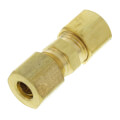
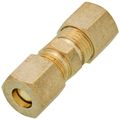
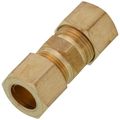
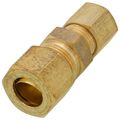
Compression Unions









 --%3E %3Csvg version='1.1' id='No-RB' xmlns='http://www.w3.org/2000/svg' xmlns:xlink='http://www.w3.org/1999/xlink' x='0px' y='0px' viewBox='0 0 100 100' enable-background='new 0 0 100 100' xml:space='preserve'%3E %3Cpath fill='%23CECECE' d='M79.44,0.95H20.56C9.78,0.95,0.95,9.78,0.95,20.56v58.87c0,10.79,8.82,19.61,19.61,19.61h58.87 c10.79,0,19.61-8.83,19.61-19.61V20.56C99.05,9.78,90.22,0.95,79.44,0.95z M65.38,58.24l9.38,29.58L49.69,69.78L24.5,87.82 l9.34-29.6L8.8,39.6l30.73-0.17c0,0,6.98-19.61,10-28.93c0.54,1.36,9.88,29.1,9.88,29.1H91.2L65.38,58.24z'/%3E %3C/svg%3E)
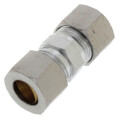
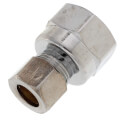
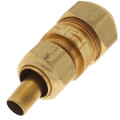
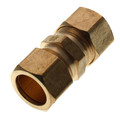

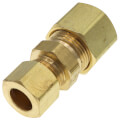
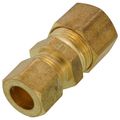
Compression Unions are mechanical pipe fittings that join two sections of tubing without soldering, brazing, or welding, making them a practical option for repairs, retrofits, and tight spaces where open flame isn't practical. The Jones Stephens compression unions carried in this line use a lead-free brass body with a nut and ferrule on each end that bite down on the tube as the nuts are tightened, forming a mechanical seal around the outside diameter. Sizes run from 1/8" OD up to 7/8" OD, covering the smaller tubing sizes common in appliance and fixture supply work as well as the larger diameters used on branch lines. Because the joint relies on compression rather than a permanent bond, a union can be taken apart and reassembled if a line needs service again down the road. For contractors working on occupied properties or older systems where torch work raises safety concerns, compression unions offer a fast, code-friendly way to complete a joint while keeping the connection serviceable for future repairs.
Subcategories
- Brass Compression Unions: Brass compression unions use a lead-free brass body with a nut and ferrule on each end that compress around the tube as the fitting is tightened. Plumbers and HVAC technicians rely on this style to join copper or similar soft tubing without a torch. Jones Stephens brass unions in this line cover sizes from 1/8" OD up to 7/8" OD. Lead-free construction makes the fitting appropriate for domestic water lines.
- Chrome-Plated Compression Unions: Chrome-plated compression unions use the same nut-and-ferrule design as the standard brass line but add a polished chrome finish for fittings that stay visible after installation. Plumbers typically pick this finish for exposed supply lines under sinks, toilets, and other fixtures where appearance matters. Chrome plating sits over a brass body, so the mechanical seal works the same as an unplated fitting. Sizing matches the standard brass line, covering both small and larger tube diameters.
- Small-Bore Compression Unions (1/8" to 3/8" OD): Small-bore compression unions cover the 1/8" to 3/8" OD range, sized for narrow-gauge tubing used on appliance and fixture supply connections. A smaller OD means the compression nut and ferrule only need to seal a narrow tube wall, keeping the finished fitting compact enough for tight spaces. Installers reach for this range on supply lines that don't carry high flow volumes. Both brass and chrome-plated finishes are available at these sizes.
- Large-Bore Compression Unions (1/2" to 7/8" OD): Large-bore compression unions span 1/2" to 7/8" OD, matching the larger copper tube sizes used on branch and main runs. The wider OD range supports higher flow volumes than small-bore unions, making it a fit for bigger water lines or longer tubing runs. Installation follows the same compression method across the range, so technicians just match the nut and ferrule size to the tube OD. Brass and chrome-plated versions are both available at these larger sizes.
Buying Guide
Start by confirming the tube outside diameter on both sides of the joint; compression unions are sized to OD, not nominal pipe size, so a quick caliper or spec check prevents ordering the wrong nut and ferrule size. Next, decide between brass and chrome-plated finishes. Brass works for any concealed run, while a chrome-plated union makes sense anywhere the fitting will be visible, such as under a sink or behind an access panel. Material compatibility matters too: confirm the fitting is rated for the tubing and fluid in the line, and check for a lead-free marking on any job touching domestic water supply. Compression Unions don't require soldering or special tools beyond two wrenches, which makes them a reasonable stock item for service trucks handling repair calls where a torch isn't practical or allowed. Because the connection is mechanical rather than permanent, factor in that a union can loosen over time if not tightened to spec, so following the torque or turn guidance on the fitting packaging helps avoid callbacks. For larger branch or main repairs, size toward the higher end of the available range, from 1/2" up to 7/8" OD, to match typical copper tube found in residential and light commercial plumbing. Stocking a mix of small-bore and large-bore unions in both finishes covers most repair scenarios a plumbing or HVAC crew will run into on a given day.
Frequently Asked Questions
What's the difference between a compression union and a soldered coupling?
A compression union joins two tube ends mechanically, using a nut and ferrule that bite down on the tube as it's tightened, while a soldered coupling relies on heat and solder to bond the joint permanently. Compression unions can be taken apart for service, which soldered joints can't. The tradeoff is that a compression joint depends on correct tightening rather than a fused connection.
Do compression unions work on both copper and plastic tubing?
Compression unions in this category are built around a lead-free brass body designed for copper and similar rigid or semi-rigid tubing sized to the same OD range. Checking the tubing material against the fitting's rated compatibility before installation avoids a mismatched seal. Mixing incompatible materials at the ferrule can lead to a leak under pressure.
What sizes do compression unions come in?
The compression unions carried in this line run from 1/8" OD up to 7/8" OD, covering small appliance tubing as well as larger branch line sizes. Matching the union's OD rating to the tube being joined is the main sizing step. Both brass and chrome-plated finishes are available across this size range.
Can a compression union be reused after it's taken apart?
A compression union can often be reassembled after disconnection, though the ferrule can deform slightly once it's been compressed onto a tube. Reusing the same ferrule on the same tube typically still seals correctly, but swapping in a new tube at that spot may call for a fresh ferrule. Inspecting the ferrule for cracks or excessive deformation before reuse helps avoid a future leak.
When should a chrome-plated compression union be used instead of brass?
A chrome-plated compression union works the same mechanically as a standard brass union, but the finish holds up better cosmetically in a visible location such as under a sink or near an access panel. Brass is the more common choice for concealed runs where appearance doesn't matter. Either finish can be selected based on whether the joint will be seen after the job is finished.
