




Filters
SORT
Product Availability –
Number Of Outlets –
Review Score –
 --%3E %3Csvg version='1.1' id='Fill' xmlns='http://www.w3.org/2000/svg' xmlns:xlink='http://www.w3.org/1999/xlink' x='0px' y='0px' viewBox='0 0 100 100' enable-background='new 0 0 100 100' xml:space='preserve'%3E %3Cpath fill='%23F15C02' d='M79.44,0.95H20.56C9.78,0.95,0.95,9.78,0.95,20.56v58.87c0,10.79,8.82,19.61,19.61,19.61h58.87 c10.79,0,19.61-8.83,19.61-19.61V20.56C99.05,9.78,90.22,0.95,79.44,0.95z M65.38,58.24l9.38,29.58L49.69,69.78L24.5,87.82 l9.34-29.6L8.8,39.6l30.73-0.17c0,0,6.98-19.61,10-28.93c0.54,1.36,9.88,29.1,9.88,29.1H91.2L65.38,58.24z'/%3E %3C/svg%3E)
 --%3E %3Csvg version='1.1' id='With-RB' xmlns='http://www.w3.org/2000/svg' xmlns:xlink='http://www.w3.org/1999/xlink' x='0px' y='0px' viewBox='0 0 100 100' enable-background='new 0 0 100 100' xml:space='preserve'%3E %3Cpath fill='%23FBC8B4' d='M79.44,0.95H20.56C9.78,0.95,0.95,9.78,0.95,20.56v58.87c0,10.79,8.82,19.61,19.61,19.61h58.87 c10.79,0,19.61-8.83,19.61-19.61V20.56C99.05,9.78,90.22,0.95,79.44,0.95z M65.38,58.24l9.38,29.58L49.69,69.78L24.5,87.82 l9.34-29.6L8.8,39.6l30.73-0.17c0,0,6.98-19.61,10-28.93c0.54,1.36,9.88,29.1,9.88,29.1H91.2L65.38,58.24z'/%3E %3C/svg%3E)
EP Opposing-Port Multi-Port Tees


 --%3E %3Csvg version='1.1' id='No-RB' xmlns='http://www.w3.org/2000/svg' xmlns:xlink='http://www.w3.org/1999/xlink' x='0px' y='0px' viewBox='0 0 100 100' enable-background='new 0 0 100 100' xml:space='preserve'%3E %3Cpath fill='%23CECECE' d='M79.44,0.95H20.56C9.78,0.95,0.95,9.78,0.95,20.56v58.87c0,10.79,8.82,19.61,19.61,19.61h58.87 c10.79,0,19.61-8.83,19.61-19.61V20.56C99.05,9.78,90.22,0.95,79.44,0.95z M65.38,58.24l9.38,29.58L49.69,69.78L24.5,87.82 l9.34-29.6L8.8,39.6l30.73-0.17c0,0,6.98-19.61,10-28.93c0.54,1.36,9.88,29.1,9.88,29.1H91.2L65.38,58.24z'/%3E %3C/svg%3E)

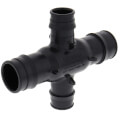
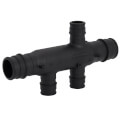
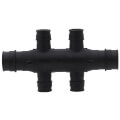
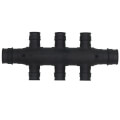
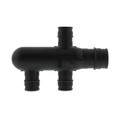
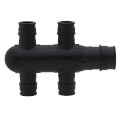


EP Opposing-Port Multi-Port Tees are Uponor ProPEX fittings that split a single PEX line into multiple outlets positioned on opposite sides of the fitting body, simplifying radiant and plumbing manifold layouts that need to feed several runs from one location. Built from EP, Uponor's engineered polymer rated for demanding hot-water applications, each tee works with the ProPEX expansion system and requires a ProPEX tool for installation, with ProPEX rings sold separately. The lineup includes both branch-style tees, which terminate a mainline into several outlets, and flow-through tees, which let the mainline continue past the fitting while branching off a smaller connection. A confirmed branch model, the 4-outlet 3/4-inch tee, illustrates the fitting's role in distribution points where several short runs originate from a single supply line. For installers running hydronic or domestic PEX systems through tight mechanical spaces, an opposing-port layout cuts down on separate tees and couplings needed to reach runs on both sides of a manifold or trunk line.
Subcategories
- Branch Opposing-Port Tees: Branch opposing-port tees terminate a mainline into several outlets arranged across the fitting body rather than continuing the line past the connection point. The 4-outlet, 3/4-inch version, identified as Q2347550, is a confirmed example used where multiple short runs need to originate from one distribution point. Radiant manifold stations and multi-fixture plumbing branches are common settings for this style. ProPEX expansion is required for every connection, so a compatible tool stays part of the installation kit.
- Flow-Through Opposing-Port Tees: Flow-through opposing-port tees let the mainline continue past the fitting while adding a branch outlet, rather than ending the run at the tee. The 3-outlet, 3/4-inch version, identified as Q2337557, uses 3/4-inch ProPEX inlets with 1/2-inch branch outlets positioned opposite each other. Installers use this style mid-run when a branch needs to split off without interrupting the trunk line's continued path. Keeping the mainline intact through the fitting reduces the number of separate tees needed along a long run.
- Outlet Configuration Options: EP Opposing-Port Multi-Port Tees come in a range of outlet counts, including confirmed 3-outlet and 4-outlet versions, to match the number of runs needed at a given distribution point. Selecting the outlet count up front avoids combining multiple smaller tees to reach the same number of connections. Outlet size can differ from the mainline size, as seen in the flow-through tee's 3/4-inch inlet paired with 1/2-inch branch outlets. Matching outlet size to the downstream PEX run keeps transitions consistent across a manifold station.
Buying Guide
Selecting the right EP Opposing-Port Multi-Port Tees starts with deciding between a branch style, which terminates a mainline into multiple outlets, and a flow-through style, which lets the mainline continue past the fitting while adding a branch connection. Branch tees suit a true distribution point, such as the end of a manifold run where several short runs need to originate together, while flow-through tees fit mid-run situations where a trunk line needs to keep going after a branch splits off. Outlet count comes next: confirmed configurations include 3-outlet and 4-outlet versions, so matching the count to the number of downstream runs avoids combining extra fittings to reach the same distribution. Outlet size also varies by model; the flow-through tee pairs a 3/4-inch mainline connection with 1/2-inch branch outlets, so confirming both the mainline and branch sizes against the existing PEX run prevents a mismatched transition. Every connection on an EP Opposing-Port Multi-Port Tee uses the ProPEX expansion method, so a compatible ProPEX tool needs to be on hand before starting, and ProPEX rings should be ordered separately since they are not included with the fitting. Built from EP, a polymer rated for demanding hot-water service, these tees suit both radiant heating manifolds and domestic PEX distribution. Confirming outlet count, outlet size, and tool compatibility before ordering keeps a manifold installation moving without a mid-job supply run.
Frequently Asked Questions
What is the difference between a branch and a flow-through opposing-port tee?
A branch tee terminates a mainline into multiple outlets at a single distribution point, while a flow-through tee lets the mainline continue past the fitting while adding a branch connection. Branch tees suit the end of a manifold run, while flow-through tees fit mid-run branch points. Both styles use the ProPEX expansion method for every connection.
What material are EP Opposing-Port Multi-Port Tees made from?
The tees are built from EP, Uponor's engineered polymer rated for demanding hot-water applications. Material selection supports use in both radiant heating manifolds and domestic PEX distribution lines. ProPEX expansion fittings paired with this material require a compatible ProPEX tool for installation.
Are ProPEX rings included with the tee?
No, ProPEX rings are sold separately from the tee itself. A ProPEX expansion tool is also required to complete each connection, since the fitting relies on the ProPEX method rather than crimp or compression connections. Ordering rings alongside the tee avoids a delay once installation begins.
What outlet sizes are available on a flow-through tee?
A confirmed flow-through configuration pairs a 3/4-inch mainline connection with 1/2-inch branch outlets positioned opposite each other. Outlet sizing can vary by model, so confirming both mainline and branch size against the existing PEX run matters before ordering. Mismatched sizing at a branch point creates an awkward transition that needs an extra fitting to resolve.
Where are opposing-port multi-port tees typically installed?
Radiant heating manifold stations and multi-fixture plumbing branches are common settings for this fitting style. A central distribution point benefits from a tee that splits a single line into two separate runs from one location rather than relying on several individual tees. Choosing branch or flow-through style depends on whether the mainline needs to end or continue at that point.
