




Filters
SORT
Product Availability –
Diameter (Inches) –
R-value –
Review Score –
 --%3E %3Csvg version='1.1' id='Fill' xmlns='http://www.w3.org/2000/svg' xmlns:xlink='http://www.w3.org/1999/xlink' x='0px' y='0px' viewBox='0 0 100 100' enable-background='new 0 0 100 100' xml:space='preserve'%3E %3Cpath fill='%23F15C02' d='M79.44,0.95H20.56C9.78,0.95,0.95,9.78,0.95,20.56v58.87c0,10.79,8.82,19.61,19.61,19.61h58.87 c10.79,0,19.61-8.83,19.61-19.61V20.56C99.05,9.78,90.22,0.95,79.44,0.95z M65.38,58.24l9.38,29.58L49.69,69.78L24.5,87.82 l9.34-29.6L8.8,39.6l30.73-0.17c0,0,6.98-19.61,10-28.93c0.54,1.36,9.88,29.1,9.88,29.1H91.2L65.38,58.24z'/%3E %3C/svg%3E)
Price Range –
Fab 6-T Fabriflex Acoustical Ducting (Insulated)


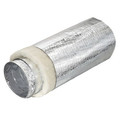



Fab 6-T Fabriflex Acoustical Ducting (Insulated) is a 6 inch diameter flexible duct built to cut airflow noise without adding a separate silencer to the run. Its core is a CPE liner mechanically locked to a corrosion resistant galvanized steel helix, wrapped in fiberglass insulation and covered with a flame retardant polyethylene vapor barrier rated at 0.10 perm. The duct carries a pressure rating of 10 inch water gauge positive and 5 inch water gauge negative, with a rated velocity of 5500 feet per minute, covering typical residential and light commercial static pressures. Contractors specify this acoustical duct on branch runs near bedrooms, conference rooms, or any space where duct borne fan and airflow noise needs to drop before it reaches the room. Available in R4.2, R6, and R8 insulation levels, the product lets an installer match thermal performance to attic, crawlspace, or plenum conditions while keeping the same acoustic core across every option.
Subcategories
- R4.2 Insulated Duct: The R4.2 option is the lightest insulation level in the Fab 6-T line, suited to short runs inside conditioned space where thermal loss isn't the main concern. Installers pick this level when the acoustic core is the priority and the duct stays inside already conditioned ceilings or chases. It still uses the same CPE core and galvanized steel helix as the higher R value options. Lower insulation thickness also keeps the duct's outside diameter smaller for tight ceiling cavities.
- R6 Insulated Duct: The R6 option adds a thicker fiberglass wrap for runs that pass through semi conditioned spaces such as mechanical rooms or interior chases. Contractors use this middle tier when a run needs more thermal protection than R4.2 offers but doesn't sit in a fully unconditioned attic or exterior wall. The vapor barrier permeance stays at 0.10 perm regardless of the insulation level chosen. R6 duct balances thermal performance against the larger outside diameter that comes with thicker insulation.
- R8 Insulated Duct: The R8 option carries the thickest insulation in the line, built for runs through unconditioned attics or other spaces exposed to outside temperature swings. Installers reach for R8 when local energy code requires higher insulation values on ducts outside the building envelope. The pressure rating and 5500 feet per minute velocity rating hold the same across R8 as the lower insulation tiers. Choosing R8 over a lower R value trades a larger duct diameter for better thermal performance in exposed runs.
Buying Guide
Selecting Fab 6-T Fabriflex Acoustical Ducting (Insulated) for a job starts with where the run travels, not just the noise problem it's solving. A duct that passes through an unconditioned attic or exterior wall needs the R8 insulation level to meet most energy codes, while a run confined to conditioned space can often use R4.2 and save on outside diameter. Check the static pressure the fan or air handler will push through the run against the duct's rating of 10 inch water gauge positive and 5 inch water gauge negative, since exceeding that rating on a return or long branch run can deform the flexible core over time. Confirm the rated velocity of 5500 feet per minute covers the airflow the branch is designed to carry, particularly on higher volume commercial runs. Because this duct ships compressed to fit its packaging, plan for the full 25 foot length to require stretching out during installation rather than assuming the box already holds a taut run; a duct pulled tight loses less static pressure than one left bunched in a joist bay. In humid climates, the vapor barrier's 0.10 perm rating helps limit condensation on the duct's exterior, so it's worth checking against local humidity conditions on top of the insulation level. Match the 6 inch diameter to the takeoff or boot size before ordering, since resizing after installation means cutting into finished duct.
Frequently Asked Questions
What is the pressure rating on Fab 6-T Fabriflex Acoustical Ducting?
The duct is pressure rated to 10 inch water gauge positive and 5 inch water gauge negative. Staying inside that rating keeps the flexible core from deforming on long branch runs or return sections. Exceeding the rating is one of the more common causes of sagging or crushed duct discovered during a service call.
Which R value should be used in an unconditioned attic?
R8 is the highest insulation level available in this line and is built for runs through unconditioned attics or other spaces exposed to outside temperatures. Lower levels like R6 or R4.2 suit runs that stay inside conditioned or semi conditioned space. Local energy code often dictates the minimum R value required outside the building envelope.
Does Fab 6-T duct need to be stretched out during installation?
The duct ships compressed to fit its packaging and needs to be unpackaged and stretched to reach its full 25 foot length. Leaving it bunched up in a joist bay or chase reduces airflow and increases static pressure loss. Pulling the run taut before securing it is a standard part of installing this product.
What velocity is Fab 6-T Fabriflex Acoustical Ducting rated for?
The duct carries a rated velocity of 5500 feet per minute. Confirming the branch's designed airflow stays under that velocity protects the duct from excess wear, particularly on higher volume commercial runs. Residential branch runs typically operate well under this ceiling.
How does the vapor barrier on this duct help with condensation?
The vapor barrier is rated at 0.10 perm, which limits moisture movement through the duct's exterior covering. The rating helps control condensation on runs through humid attics or crawlspaces. Checking local humidity conditions alongside the insulation level chosen helps prevent moisture problems over time.
