




Filters
SORT
Product Availability –
Brand –
Size –
Material –
Review Score –
 --%3E %3Csvg version='1.1' id='Fill' xmlns='http://www.w3.org/2000/svg' xmlns:xlink='http://www.w3.org/1999/xlink' x='0px' y='0px' viewBox='0 0 100 100' enable-background='new 0 0 100 100' xml:space='preserve'%3E %3Cpath fill='%23F15C02' d='M79.44,0.95H20.56C9.78,0.95,0.95,9.78,0.95,20.56v58.87c0,10.79,8.82,19.61,19.61,19.61h58.87 c10.79,0,19.61-8.83,19.61-19.61V20.56C99.05,9.78,90.22,0.95,79.44,0.95z M65.38,58.24l9.38,29.58L49.69,69.78L24.5,87.82 l9.34-29.6L8.8,39.6l30.73-0.17c0,0,6.98-19.61,10-28.93c0.54,1.36,9.88,29.1,9.88,29.1H91.2L65.38,58.24z'/%3E %3C/svg%3E)
Price Range –
Flex/AC/MC 90° Elbow Squeeze Connectors





 --%3E %3Csvg version='1.1' id='No-RB' xmlns='http://www.w3.org/2000/svg' xmlns:xlink='http://www.w3.org/1999/xlink' x='0px' y='0px' viewBox='0 0 100 100' enable-background='new 0 0 100 100' xml:space='preserve'%3E %3Cpath fill='%23CECECE' d='M79.44,0.95H20.56C9.78,0.95,0.95,9.78,0.95,20.56v58.87c0,10.79,8.82,19.61,19.61,19.61h58.87 c10.79,0,19.61-8.83,19.61-19.61V20.56C99.05,9.78,90.22,0.95,79.44,0.95z M65.38,58.24l9.38,29.58L49.69,69.78L24.5,87.82 l9.34-29.6L8.8,39.6l30.73-0.17c0,0,6.98-19.61,10-28.93c0.54,1.36,9.88,29.1,9.88,29.1H91.2L65.38,58.24z'/%3E %3C/svg%3E)

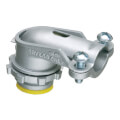
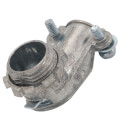
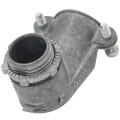
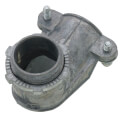
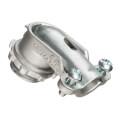
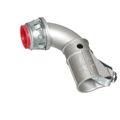
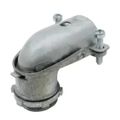
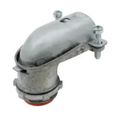
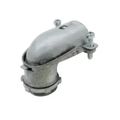

Flex/AC/MC 90° Elbow Squeeze Connectors are the fittings electricians use to terminate flexible metal conduit, armored cable, or metal clad cable into a box or panel at a right angle without bending the cable itself. The RACO 2202-8 in the line is a 1/2 inch trade size connector built from malleable iron with an uninsulated throat and a zinc-electroplated finish for corrosion protection, and it carries a cULus listing for use with flexible metal conduit and AC/MC cable. Larger trade sizes extend the same 90 degree squeeze design up through 3 inch connectors for feeder size cable runs. A squeeze connector's angled body saves space inside a crowded panel or junction box where a straight connector would force the cable into a tight radius bend at the termination point.
Subcategories
- 1/2 inch and 3/4 inch Squeeze Connectors: The 1/2 inch and 3/4 inch squeeze connectors, including the RACO 2202-8 at 1/2 inch, cover the most common branch circuit sizes for flexible metal conduit and AC/MC cable terminations. Built from malleable iron with an uninsulated throat and a zinc-electroplated finish, this size range is cULus listed for residential and light commercial panel and box connections. Electricians reach for these sizes most often when running lighting circuits, receptacle circuits, and small appliance whips. The compact 90 degree body fits tight panel knockouts where a straight connector would crowd the enclosure.
- 2-1/2 inch and 3 inch Squeeze Connectors: Larger 2-1/2 inch and 3 inch squeeze connectors, such as the RACO 2210 and 2212, handle feeder size flexible metal conduit and AC/MC cable runs that carry higher amperage loads. These larger connectors are uninsulated versions built for the same FMC/AC/MC cable types as the smaller trade sizes. Electricians use them on service feeders and larger equipment whips where a bigger cable diameter needs a corresponding larger connector body. The 90 degree angle still saves space inside a panel even at the larger trade sizes.
- Insulated Squeeze Connectors: Insulated squeeze connectors add a plastic throat liner inside the connector body to protect conductor insulation from abrasion where it enters the fitting. Southwire manufactures insulated zinc 90 degree squeeze box connectors, including a 2-1/2 inch size, for FMC/AC/MC cable terminations. Jobs with stricter code requirements around conductor protection at the termination point call for the insulated version over the standard uninsulated throat. Matching insulated versus uninsulated to the job's requirements avoids a failed inspection over a missing throat liner.
Buying Guide
Match the connector's trade size to the flexible metal conduit or armored cable actually being terminated, since a squeeze connector has to close down fully around the cable's outer armor to hold it securely and maintain grounding continuity. Trade sizes for Flex/AC/MC 90° Elbow Squeeze Connectors run from 1/2 inch up through 3 inch, covering everything from a lighting whip to a feeder size cable run. Confirm whether the job requires an insulated throat, since some code jurisdictions and inspectors call for the plastic liner wherever conductor insulation could abrade against a bare metal edge inside the connector. Malleable iron connector bodies with a zinc-electroplated finish resist corrosion better than an unfinished body, which matters in damp basements, exterior panels, and industrial environments. Check that the connector carries a cULus listing for the specific cable type being terminated, since a listing for AC cable doesn't automatically cover MC or FMC unless stated on the connector itself. Pick the 90 degree squeeze style specifically when panel or box clearance is tight and a straight connector would force the cable into too sharp a bend at the knockout. Squeeze style connectors close by hand pressure alone, without a separate locknut or set screw step, which speeds up terminations on jobs with many whips to land in a single panel.
Frequently Asked Questions
What's the difference between a straight connector and a 90 degree squeeze connector?
A straight connector runs the cable directly through the knockout in line with the conduit, while a 90 degree squeeze connector turns the cable at a right angle exactly where it enters the box. Tight panel or junction box clearance is the main reason to pick the 90 degree style over a straight one. Squeeze connectors close around the cable by hand pressure rather than requiring a separate locknut step.
Do these connectors work with both AC cable and MC cable?
Flex/AC/MC 90° Elbow Squeeze Connectors carry a cULus listing covering flexible metal conduit along with AC and MC cable types when the listing states that coverage on the specific connector. Checking the listing on the connector itself matters, since not every connector in the broader flex fitting market covers all three cable types. Matching the connector's listed cable types to the job's actual cable avoids a rejected inspection.
When is an insulated throat required on a squeeze connector?
An insulated throat adds a plastic liner that protects conductor insulation from abrading against the connector's metal edge as the cable passes through. Some code jurisdictions and inspectors require the insulated version wherever that abrasion risk exists at the termination point. Southwire and other manufacturers offer insulated zinc versions specifically to meet that requirement.
What sizes do Flex/AC/MC 90 degree squeeze connectors come in?
Sizes run from 1/2 inch trade size connectors like the RACO 2202-8 up through 3 inch connectors such as the RACO 2212, covering everything from small lighting whips to feeder size cable runs. Matching the connector's trade size to the cable's outer armor diameter keeps the squeeze closing down fully for a secure termination. Checking trade size against the cable spec sheet before ordering avoids a connector that won't close properly.
Why choose a squeeze connector over a set screw connector for a 90 degree termination?
Squeeze connectors close around the cable by hand pressure alone, without a separate locknut or set screw step, which speeds up terminations on jobs with many whips landing in one panel. Set screw connectors take longer to install but can suit larger or heavier cable in some applications. Panel and box space usually decides the choice, since the 90 degree squeeze body fits tighter knockout spacing than a bulkier set screw fitting.
