




Filters
SORT
Product Availability –
Brand –
Product Type –
Cutting Capacity –
Review Score –
 --%3E %3Csvg version='1.1' id='Fill' xmlns='http://www.w3.org/2000/svg' xmlns:xlink='http://www.w3.org/1999/xlink' x='0px' y='0px' viewBox='0 0 100 100' enable-background='new 0 0 100 100' xml:space='preserve'%3E %3Cpath fill='%23F15C02' d='M79.44,0.95H20.56C9.78,0.95,0.95,9.78,0.95,20.56v58.87c0,10.79,8.82,19.61,19.61,19.61h58.87 c10.79,0,19.61-8.83,19.61-19.61V20.56C99.05,9.78,90.22,0.95,79.44,0.95z M65.38,58.24l9.38,29.58L49.69,69.78L24.5,87.82 l9.34-29.6L8.8,39.6l30.73-0.17c0,0,6.98-19.61,10-28.93c0.54,1.36,9.88,29.1,9.88,29.1H91.2L65.38,58.24z'/%3E %3C/svg%3E)
 --%3E %3Csvg version='1.1' id='With-RB' xmlns='http://www.w3.org/2000/svg' xmlns:xlink='http://www.w3.org/1999/xlink' x='0px' y='0px' viewBox='0 0 100 100' enable-background='new 0 0 100 100' xml:space='preserve'%3E %3Cpath fill='%23FBC8B4' d='M79.44,0.95H20.56C9.78,0.95,0.95,9.78,0.95,20.56v58.87c0,10.79,8.82,19.61,19.61,19.61h58.87 c10.79,0,19.61-8.83,19.61-19.61V20.56C99.05,9.78,90.22,0.95,79.44,0.95z M65.38,58.24l9.38,29.58L49.69,69.78L24.5,87.82 l9.34-29.6L8.8,39.6l30.73-0.17c0,0,6.98-19.61,10-28.93c0.54,1.36,9.88,29.1,9.88,29.1H91.2L65.38,58.24z'/%3E %3C/svg%3E)
Price Range –
PVC Pipe & Tubing Cutters


 --%3E %3Csvg version='1.1' id='No-RB' xmlns='http://www.w3.org/2000/svg' xmlns:xlink='http://www.w3.org/1999/xlink' x='0px' y='0px' viewBox='0 0 100 100' enable-background='new 0 0 100 100' xml:space='preserve'%3E %3Cpath fill='%23CECECE' d='M79.44,0.95H20.56C9.78,0.95,0.95,9.78,0.95,20.56v58.87c0,10.79,8.82,19.61,19.61,19.61h58.87 c10.79,0,19.61-8.83,19.61-19.61V20.56C99.05,9.78,90.22,0.95,79.44,0.95z M65.38,58.24l9.38,29.58L49.69,69.78L24.5,87.82 l9.34-29.6L8.8,39.6l30.73-0.17c0,0,6.98-19.61,10-28.93c0.54,1.36,9.88,29.1,9.88,29.1H91.2L65.38,58.24z'/%3E %3C/svg%3E)



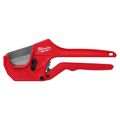


PVC pipe and tubing cutters make a clean, square cut through PVC pipe without the burrs or debris a hacksaw leaves behind, which matters because a ragged cut can keep a fitting from seating properly during solvent welding. Most styles use a sharp blade that shears through the pipe wall in one motion, either through a ratcheting mechanism that closes the blade in stages or a scissor-style handle that closes it in one squeeze. Ratchet-style cutters handle larger diameter pipe with less hand effort by breaking the cut into several smaller strokes, while scissor-style cutters work quickly on smaller diameter pipe and tubing in a single motion. A clean cut from a dedicated cutter also reduces the plastic shavings that a saw generates, which matters on a job where debris inside the pipe could interfere with a valve or fitting downstream. Keeping a cutter sized to the pipe diameters commonly used on a job saves time compared to switching to a saw for every cut.
Subcategories
- Ratchet-Style PVC Cutters: Ratchet-style cutters close the blade in stages through repeated squeezes of the handle, which lets them cut larger diameter PVC pipe without requiring as much hand strength per stroke. They're a common choice for pipe in the 1 to 2 inch range and larger, where a single-squeeze cutter would be difficult to close. The ratcheting mechanism also holds its position mid-cut if a break is needed.
- Scissor-Style PVC Cutters: Scissor-style cutters close in one motion, making them fast for smaller diameter pipe and tubing where a full ratcheting stroke isn't necessary. Plumbers doing repetitive cuts on smaller PEX or PVC tubing often prefer this style for speed. They work best on pipe within the cutter's rated diameter range rather than pushed past its limit.
- Guillotine-Style Tubing Cutters: Guillotine-style cutters use a straight blade that drops through the tubing in one stroke, typically used on softer tubing rather than rigid PVC pipe. They give a very clean, square cut that's useful when a fitting needs a precise face to seal against. This style is common for PEX and similar flexible tubing rather than schedule 40 or 80 PVC.
Buying Guide
Choosing between a ratchet-style and a scissor-style cutter mostly comes down to the pipe diameters handled on a regular basis. Ratchet-style cutters break a cut into several smaller strokes, which makes larger diameter PVC pipe manageable without excessive hand strain, while scissor-style cutters close in a single squeeze and work well for smaller pipe and tubing where speed matters more than mechanical advantage. Checking a cutter's rated diameter range before buying avoids trying to force it past its capacity, which can damage the blade or produce an uneven cut. Blade sharpness matters as much as cutter style, since a dull blade tends to crush or deform PVC rather than shearing it cleanly, leaving a rough edge that needs extra prep before solvent welding. Many cutters have replaceable blades, so budgeting for that replacement cost over the life of the tool is worth factoring in alongside the upfront price. For tubing rather than rigid pipe, a guillotine-style cutter gives a cleaner, more square cut than a ratchet-style cutter designed primarily for PVC pipe walls. A plumber working across both rigid PVC and flexible tubing on the same job may find it worth carrying both a ratchet-style pipe cutter and a smaller tubing cutter rather than trying to use one tool for everything. Keeping the blade clean and free of adhesive buildup from solvent cement also extends the life of any cutter style.
Frequently Asked Questions
What's the difference between a ratchet-style and scissor-style PVC cutter?
A ratchet-style cutter closes the blade in stages across several squeezes, making it easier to cut larger diameter pipe. A scissor-style cutter closes in one motion and works best on smaller pipe and tubing where speed is the priority. Picking the right style depends mostly on the typical pipe diameter handled on a given job.
Can a PVC cutter replace a hacksaw for every cut?
For pipe within the cutter's rated diameter range, yes, a dedicated cutter usually produces a cleaner cut faster than a hacksaw. Larger diameter pipe beyond a cutter's capacity, or cuts in tight spaces where a cutter can't open fully, may still call for a saw. Keeping both tools on the truck covers most situations.
Why does a clean cut matter for PVC solvent welding?
A ragged or uneven cut can keep the pipe from seating fully inside a fitting, which weakens the solvent weld and increases the chance of a leak. A dedicated cutter produces a square edge that seats properly without extra deburring. Cleaning up a burred edge with a knife or deburring tool helps if only a saw is available.
How is tubing cutting different from cutting rigid PVC pipe?
Flexible tubing like PEX generally cuts cleanest with a guillotine-style or scissor-style cutter designed for its softer wall, while rigid PVC pipe often benefits from a ratchet-style cutter built to shear a stiffer wall. Using a tubing cutter on rigid pipe can crush rather than cleanly cut it. Matching the tool to the material avoids a rough or crushed edge.
When should a PVC cutter's blade be replaced?
A blade that crushes or deforms the pipe instead of shearing it cleanly, or that requires noticeably more force than usual, is a sign it's dulling and due for replacement. Many cutters use a replaceable blade rather than requiring the whole tool to be swapped out. Keeping a spare blade on hand avoids a delay when the current one finally gives out.
