




Reducers
Reducers join two pipe sections of different diameters, covering copper press reducers that make the transition using a press tool along with other reducer couplings for applications outside the copper press system.
Selecting a reducer over a bushing is often the right call when the size difference between the two pipe sections is larger, since a full reducer coupling handles a greater diameter change more reliably. Matching the reducer's material to the surrounding pipe keeps the joint compatible and prevents galvanic corrosion.






Subcategories
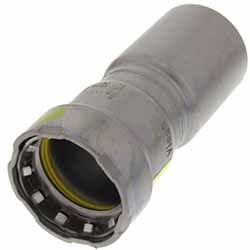
- Copper Press Reducers: Copper press reducers join two copper pipe sizes using a press tool rather than a torch, a common choice on jobs where open flame isn't permitted or where a faster connection speeds up the schedule.
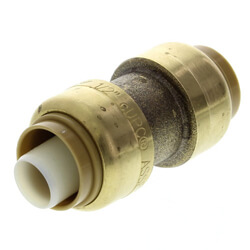
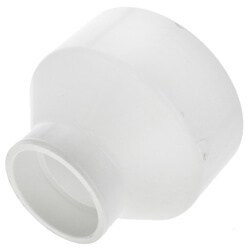
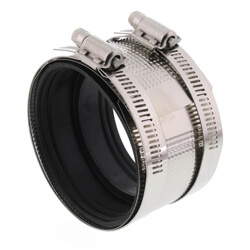
- Other Reducer Couplings: Reducer couplings outside the copper press category are covered here, including threaded, solder, and push-fit styles for transitioning between pipe sizes in materials like steel, PVC, or CPVC.
Buying Guide
Identify the two pipe sizes being joined and confirm which reducer size numbers refer to the larger end versus the smaller end, since labeling conventions differ slightly between manufacturers and materials.
Match the connection method, press, solder, threaded, or push-fit, to the tools and technique already in use on the rest of the run rather than introducing a second joining method partway through a job.
Choose concentric or eccentric based on orientation needs. Concentric reducers keep the pipe centered through the transition for most horizontal supply runs, while eccentric reducers keep one side flush, which matters on suction and drain lines.
Confirm pressure and temperature ratings for the specific material and connection type, since a reducer rated for a supply line application isn't necessarily rated for the same pressure in a drainage or vent application.
Check whether local code allows a reduction in this location at all, since some jurisdictions restrict how far a drain or vent line can be reduced in diameter before it affects venting or drainage capacity.
Frequently Asked Questions
What's the difference between a concentric and eccentric reducer?
A concentric reducer keeps the pipe centerline aligned through the size transition, while an eccentric reducer offsets to one side so the top or bottom stays flush, which matters most on suction lines and drainage runs.
Can copper press reducers be used on a job that also has soldered joints?
Press and soldered copper fittings can be used on the same run as long as each joint is fully seated and pressed or soldered correctly on its own, since the two methods aren't combined within a single joint.
How is reducer size labeled on the packaging?
Reducer sizing typically lists the larger pipe size first followed by the smaller size, though checking the manufacturer's labeling convention before ordering avoids confusion on less common size combinations.
Is a reducer allowed on a drain or vent line?
Reducing a drain or vent line is allowed in many cases but is subject to code limits on how much the diameter can decrease at a given point, so checking local plumbing code before installing is the safest approach.
What connection types are available for non-copper reducer couplings?
Threaded, solder, and push-fit connection styles are common outside the copper press category, with the right choice depending on the pipe material already installed and the tools available on the job.
Resources
Subcategories
- Copper Press Reducers: Copper press reducers join two copper pipe sizes using a press tool rather than a torch, a common choice on jobs where open flame isn't permitted or where a faster connection speeds up the schedule.
- Other Reducer Couplings: Reducer couplings outside the copper press category are covered here, including threaded, solder, and push-fit styles for transitioning between pipe sizes in materials like steel, PVC, or CPVC.
Buying Guide
Identify the two pipe sizes being joined and confirm which reducer size numbers refer to the larger end versus the smaller end, since labeling conventions differ slightly between manufacturers and materials.
Match the connection method, press, solder, threaded, or push-fit, to the tools and technique already in use on the rest of the run rather than introducing a second joining method partway through a job.
Choose concentric or eccentric based on orientation needs. Concentric reducers keep the pipe centered through the transition for most horizontal supply runs, while eccentric reducers keep one side flush, which matters on suction and drain lines.
Confirm pressure and temperature ratings for the specific material and connection type, since a reducer rated for a supply line application isn't necessarily rated for the same pressure in a drainage or vent application.
Check whether local code allows a reduction in this location at all, since some jurisdictions restrict how far a drain or vent line can be reduced in diameter before it affects venting or drainage capacity.
Frequently Asked Questions
What's the difference between a concentric and eccentric reducer?
A concentric reducer keeps the pipe centerline aligned through the size transition, while an eccentric reducer offsets to one side so the top or bottom stays flush, which matters most on suction lines and drainage runs.
Can copper press reducers be used on a job that also has soldered joints?
Press and soldered copper fittings can be used on the same run as long as each joint is fully seated and pressed or soldered correctly on its own, since the two methods aren't combined within a single joint.
How is reducer size labeled on the packaging?
Reducer sizing typically lists the larger pipe size first followed by the smaller size, though checking the manufacturer's labeling convention before ordering avoids confusion on less common size combinations.
Is a reducer allowed on a drain or vent line?
Reducing a drain or vent line is allowed in many cases but is subject to code limits on how much the diameter can decrease at a given point, so checking local plumbing code before installing is the safest approach.
What connection types are available for non-copper reducer couplings?
Threaded, solder, and push-fit connection styles are common outside the copper press category, with the right choice depending on the pipe material already installed and the tools available on the job.