




Refrigerant Copper Press Reducer Couplings

 --%3E %3Csvg version='1.1' id='No-RB' xmlns='http://www.w3.org/2000/svg' xmlns:xlink='http://www.w3.org/1999/xlink' x='0px' y='0px' viewBox='0 0 100 100' enable-background='new 0 0 100 100' xml:space='preserve'%3E %3Cpath fill='%23CECECE' d='M79.44,0.95H20.56C9.78,0.95,0.95,9.78,0.95,20.56v58.87c0,10.79,8.82,19.61,19.61,19.61h58.87 c10.79,0,19.61-8.83,19.61-19.61V20.56C99.05,9.78,90.22,0.95,79.44,0.95z M65.38,58.24l9.38,29.58L49.69,69.78L24.5,87.82 l9.34-29.6L8.8,39.6l30.73-0.17c0,0,6.98-19.61,10-28.93c0.54,1.36,9.88,29.1,9.88,29.1H91.2L65.38,58.24z'/%3E %3C/svg%3E)



 --%3E %3Csvg version='1.1' id='Fill' xmlns='http://www.w3.org/2000/svg' xmlns:xlink='http://www.w3.org/1999/xlink' x='0px' y='0px' viewBox='0 0 100 100' enable-background='new 0 0 100 100' xml:space='preserve'%3E %3Cpath fill='%23F15C02' d='M79.44,0.95H20.56C9.78,0.95,0.95,9.78,0.95,20.56v58.87c0,10.79,8.82,19.61,19.61,19.61h58.87 c10.79,0,19.61-8.83,19.61-19.61V20.56C99.05,9.78,90.22,0.95,79.44,0.95z M65.38,58.24l9.38,29.58L49.69,69.78L24.5,87.82 l9.34-29.6L8.8,39.6l30.73-0.17c0,0,6.98-19.61,10-28.93c0.54,1.36,9.88,29.1,9.88,29.1H91.2L65.38,58.24z'/%3E %3C/svg%3E)
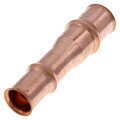

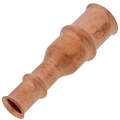

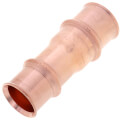


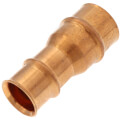


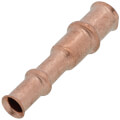
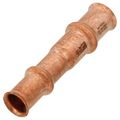
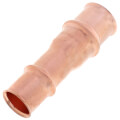
Refrigerant Copper Press Reducer Couplings are fittings that join two refrigerant copper lines of different diameters with a pressed mechanical joint instead of a brazed one. The RLS press fittings in this category are UL 207 listed and rated to 700 psi, and they're made from refrigerant-grade copper. A reducer coupling handles the size change in a line set, so a run can step from a larger trunk line to a smaller branch without a torch, nitrogen, or fire watch. RLS offers reducers alongside caps, couplings, elbows, flare couplings, and tees, and the press line covers sizes from 1/4 inch through 2-1/8 inch. Techs working on split systems, heat pumps, and VRF systems use these fittings where hot work is restricted or access is tight. The manufacturer says pressing a fitting takes about 10 seconds. For crews that want consistent, repeatable joints on size transitions, the right reducer coupling keeps the job moving and the line set clean.
Subcategories
- Split System and Heat Pump Reducers: Split system and heat pump reducers join refrigerant lines of different diameters in line sets. HVAC installers use them to change tube size without brazing. RLS rates its press fittings to 700 psi under UL 207. Refrigerant-grade copper construction matches the tubing in the run.
- VRF System Reducers: VRF installers use press reducers to change line size on refrigerant branches. RLS lists VRF systems among the applications for its press fittings. The press line is UL 207 and ISO 14903 certified by third parties. A pressed joint skips the torch, nitrogen, and fire watch that brazing requires.
- XL Size Reducers: XL reducers work with the larger sizes in the RLS press line, 1-5/8 inch and 2-1/8 inch. Crews working on larger commercial systems use them, and RLS says its XL line supports those systems. Confirm the large and small outlet sizes against the line set before ordering.
Buying Guide
Start with the two tube sizes the reducer has to join. Match the large end to the trunk line and the small end to the branch, and verify both against the copper in the field. RLS press fittings span sizes from 1/4 inch through 2-1/8 inch, so confirm the exact size pair on the part before ordering.
Next, check the system rating. RLS press fittings are UL 207 listed and rated to 700 psi, and the line carries ISO 14903 certification. Compare the system's refrigerant and working pressure with the fitting listing before committing to a press joint. RLS states its fittings suit modern refrigerants, including A2L types.
Then weigh the jobsite. Press joints fit places where brazing is a problem, such as hospitals, schools, clean rooms, mechanical closets, and tight retrofit spaces. The manufacturer says a pressed joint needs no torch, nitrogen, or fire watch. When comparing Refrigerant Copper Press Reducer Couplings, also confirm press tool and jaw compatibility with RLS before ordering.
Finally, plan the whole run. Count every size transition on the line set, then add the couplings, elbows, or tees the layout needs so the crew isn't waiting on a single fitting. Follow the manufacturer's installation instructions for each joint. Keeping a few extra reducers in the truck beats a second supply run.
Frequently Asked Questions
What pressure are refrigerant copper press reducer couplings rated for?
RLS refrigerant copper press reducer couplings come from a press line that is UL 207 listed and rated to 700 psi. The line is also certified to ISO 14903 by third parties. Confirm the rating against the system's working pressure before pressing.
Do refrigerant copper press reducer couplings need a torch or nitrogen?
No. Refrigerant copper press reducer couplings form a flame-free mechanical joint, so RLS says no torch, nitrogen, or fire watch is needed. Hot work permits and fire spotters drop out of the job as well.
What sizes do RLS press reducer couplings cover?
The RLS press fitting line runs from 1/4 inch through the XL sizes of 1-5/8 inch and 2-1/8 inch. Reducer couplings are part of that line alongside caps, couplings, elbows, flare couplings, and tees. Check the part listing for the exact size pair.
Can refrigerant copper press reducer couplings be used on heat pumps and VRF systems?
RLS lists heat pumps and VRF systems among the applications for its press fittings, and split systems are covered too. Refrigerant copper press reducer couplings from the line also support A2L refrigerants. Verify the specific refrigerant before pressing.
How long does it take to make a joint with a press reducer coupling?
Making a joint with refrigerant copper press reducer couplings is quick, since RLS says pressing a fitting takes about 10 seconds. RLS also says contractors can finish projects up to 60% faster than with traditional brazing. Actual job time depends on the run and the access.
