




Filters
SORT
Product Availability –
Review Score –
 --%3E %3Csvg version='1.1' id='Fill' xmlns='http://www.w3.org/2000/svg' xmlns:xlink='http://www.w3.org/1999/xlink' x='0px' y='0px' viewBox='0 0 100 100' enable-background='new 0 0 100 100' xml:space='preserve'%3E %3Cpath fill='%23F15C02' d='M79.44,0.95H20.56C9.78,0.95,0.95,9.78,0.95,20.56v58.87c0,10.79,8.82,19.61,19.61,19.61h58.87 c10.79,0,19.61-8.83,19.61-19.61V20.56C99.05,9.78,90.22,0.95,79.44,0.95z M65.38,58.24l9.38,29.58L49.69,69.78L24.5,87.82 l9.34-29.6L8.8,39.6l30.73-0.17c0,0,6.98-19.61,10-28.93c0.54,1.36,9.88,29.1,9.88,29.1H91.2L65.38,58.24z'/%3E %3C/svg%3E)
 --%3E %3Csvg version='1.1' id='With-RB' xmlns='http://www.w3.org/2000/svg' xmlns:xlink='http://www.w3.org/1999/xlink' x='0px' y='0px' viewBox='0 0 100 100' enable-background='new 0 0 100 100' xml:space='preserve'%3E %3Cpath fill='%23FBC8B4' d='M79.44,0.95H20.56C9.78,0.95,0.95,9.78,0.95,20.56v58.87c0,10.79,8.82,19.61,19.61,19.61h58.87 c10.79,0,19.61-8.83,19.61-19.61V20.56C99.05,9.78,90.22,0.95,79.44,0.95z M65.38,58.24l9.38,29.58L49.69,69.78L24.5,87.82 l9.34-29.6L8.8,39.6l30.73-0.17c0,0,6.98-19.61,10-28.93c0.54,1.36,9.88,29.1,9.88,29.1H91.2L65.38,58.24z'/%3E %3C/svg%3E)
Price Range –
Testo Combustion Instruments




 --%3E %3Csvg version='1.1' id='No-RB' xmlns='http://www.w3.org/2000/svg' xmlns:xlink='http://www.w3.org/1999/xlink' x='0px' y='0px' viewBox='0 0 100 100' enable-background='new 0 0 100 100' xml:space='preserve'%3E %3Cpath fill='%23CECECE' d='M79.44,0.95H20.56C9.78,0.95,0.95,9.78,0.95,20.56v58.87c0,10.79,8.82,19.61,19.61,19.61h58.87 c10.79,0,19.61-8.83,19.61-19.61V20.56C99.05,9.78,90.22,0.95,79.44,0.95z M65.38,58.24l9.38,29.58L49.69,69.78L24.5,87.82 l9.34-29.6L8.8,39.6l30.73-0.17c0,0,6.98-19.61,10-28.93c0.54,1.36,9.88,29.1,9.88,29.1H91.2L65.38,58.24z'/%3E %3C/svg%3E)
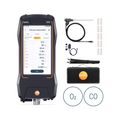
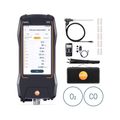
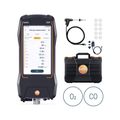
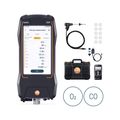


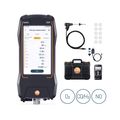
Testo Combustion Instruments are flue gas analyzers built for technicians who test, tune, and troubleshoot gas and oil-fired heating equipment. The testo 300 measures oxygen and carbon monoxide up to 4,000 ppm alongside draft, differential pressure, and differential temperature, using a probe rated to withstand temperatures up to 932°F. Larger commercial jobs call for more sensor range: the testo 300 Pro adds an H2-compensated CO sensor that reads up to 30,000 ppm plus a NO sensor for combustion analysis on multi-fuel appliances. Smaller residential service calls often move faster with the testo 310, a compact kit built around simultaneous O2, CO, CO2, and temperature readings. Technicians who service boilers, furnaces, and water heaters rely on these readings to confirm safe combustion, verify efficiency after a tune-up, and document compliance for inspectors. Choosing the right instrument comes down to matching sensor range and probe design to the fuel types and appliance sizes on the service route.
Subcategories
- testo 300 Combustion Analyzers: The testo 300 line targets heating technicians who need one tool for flue gas, draft, pressure, and temperature checks on residential and light commercial equipment. It measures oxygen and carbon monoxide up to 4,000 ppm and ships with a probe rated to 932°F, so it holds up on hot flue runs. Techs doing daily tune-ups and CO safety checks use this platform because it covers the core combustion parameters in one pass.
- testo 300 Pro Combustion Analyzers: The testo 300 Pro serves technicians who work on larger or multi-fuel systems that produce higher CO output. Its H2-compensated CO sensor reads up to 30,000 ppm, well beyond the standard 300's range, and it adds a dedicated NO sensor for tracking nitrogen oxide emissions. Commercial service crews and installers commissioning industrial burners lean on this tier when appliance size pushes past residential limits.
- testo 310 Combustion Analyzer Kits: The testo 310 is built as a compact residential kit for technicians who move between multiple small service calls in a day. It measures O2 and CO together with flue gas and ambient temperature in a single simultaneous readout. Its size and simplified interface suit furnace and water heater tune-ups where a full commercial-grade analyzer is not needed.
- testo 310 II Combustion Analyzers: The testo 310 II updates the 310 platform with simultaneous O2, CO, CO2, flue gas, and ambient temperature readings plus draught and pressure. It comes with a 180 mm probe with cone and a silicone hose for pressure measurement, along with particle filters for cleaner readings. Technicians who need CO2 alongside O2 and CO on residential combustion checks use this model over the standard 310.
Buying Guide
Picking the right combustion analyzer starts with the fuel types and appliance sizes on a service route. Technicians who only service residential gas furnaces, boilers, and water heaters can usually get by with a compact kit like the testo 310, since its O2, CO, and temperature readings cover standard efficiency and safety checks. Crews that also handle oil-fired equipment, larger commercial boilers, or multi-fuel burners need higher sensor ceilings and additional gas channels, which is where Testo Combustion Instruments like the testo 300 Pro come in with an H2-compensated CO sensor rated to 30,000 ppm and a NO sensor for tracking nitrogen oxide output.
Probe design matters as much as sensor range. A probe rated for high flue temperatures, such as the 932°F-rated probe on the testo 300, holds up on hot commercial flues where a lower-rated probe would fail. Technicians running frequent CO safety checks alongside tune-ups should prioritize instruments that read draft and differential pressure simultaneously with gas concentrations, since that combination confirms both combustion quality and venting performance in one test.
Kit contents also factor into the decision. Some models arrive with particle filters, pressure hoses, and printers built in, cutting down on separate accessory purchases. Matching probe length, temperature rating, and sensor range to the actual equipment mix on a route prevents under-buying a tool that can't handle the toughest job it will face.
Frequently Asked Questions
What's the difference between the testo 300 and testo 300 Pro?
The testo 300 covers standard residential and light commercial combustion testing, reading O2 and CO up to 4,000 ppm. The testo 300 Pro steps up to an H2-compensated CO sensor rated to 30,000 ppm and adds a NO sensor, making it suited to larger or multi-fuel commercial equipment that produces higher combustion byproducts.
Can a testo 310 handle commercial boiler testing?
The testo 310 is built as a compact kit for residential combustion checks, measuring O2, CO, flue gas, and ambient temperature. Commercial boilers and multi-fuel burners that generate higher CO levels call for a higher-range instrument like the testo 300 Pro instead.
How hot of a flue can these probes handle?
Probe temperature ratings vary by model. The probe supplied with the testo 300 is rated to withstand temperatures up to 932°F, which covers most residential and commercial flue runs.
What does the testo 310 II add over the original testo 310?
The testo 310 II adds simultaneous CO2 measurement alongside O2, CO, flue gas, and ambient temperature. It also includes a 180 mm probe with cone, a silicone hose for pressure readings, and particle filters for cleaner sampling.
Why does CO sensor range matter when choosing a combustion analyzer?
Higher CO sensor ranges matter because larger or poorly tuned appliances can produce combustion byproducts that exceed a standard sensor's ceiling. A unit like the testo 300 Pro, with its 30,000 ppm H2-compensated CO sensor, keeps reading accurately on jobs where a 4,000 ppm sensor would max out.
