



Filters
SORT
Product Availability –
Brand –
Application –
Programmability –
User Interface –
Mount –
Options –
Power Method –
Review Score –
 --%3E %3Csvg version='1.1' id='Fill' xmlns='http://www.w3.org/2000/svg' xmlns:xlink='http://www.w3.org/1999/xlink' x='0px' y='0px' viewBox='0 0 100 100' enable-background='new 0 0 100 100' xml:space='preserve'%3E %3Cpath fill='%23F15C02' d='M79.44,0.95H20.56C9.78,0.95,0.95,9.78,0.95,20.56v58.87c0,10.79,8.82,19.61,19.61,19.61h58.87 c10.79,0,19.61-8.83,19.61-19.61V20.56C99.05,9.78,90.22,0.95,79.44,0.95z M65.38,58.24l9.38,29.58L49.69,69.78L24.5,87.82 l9.34-29.6L8.8,39.6l30.73-0.17c0,0,6.98-19.61,10-28.93c0.54,1.36,9.88,29.1,9.88,29.1H91.2L65.38,58.24z'/%3E %3C/svg%3E)
Price Range –
Thermostats with Remote Sensors





 --%3E %3Csvg version='1.1' id='No-RB' xmlns='http://www.w3.org/2000/svg' xmlns:xlink='http://www.w3.org/1999/xlink' x='0px' y='0px' viewBox='0 0 100 100' enable-background='new 0 0 100 100' xml:space='preserve'%3E %3Cpath fill='%23CECECE' d='M79.44,0.95H20.56C9.78,0.95,0.95,9.78,0.95,20.56v58.87c0,10.79,8.82,19.61,19.61,19.61h58.87 c10.79,0,19.61-8.83,19.61-19.61V20.56C99.05,9.78,90.22,0.95,79.44,0.95z M65.38,58.24l9.38,29.58L49.69,69.78L24.5,87.82 l9.34-29.6L8.8,39.6l30.73-0.17c0,0,6.98-19.61,10-28.93c0.54,1.36,9.88,29.1,9.88,29.1H91.2L65.38,58.24z'/%3E %3C/svg%3E)


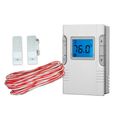


Thermostats with remote sensors measure temperature away from the thermostat's own location, letting a system respond to conditions in a room that isn't near the main control or that runs hotter or colder than the rest of the house. A wall-mounted thermostat placed in a hallway often reads a temperature that doesn't match a bedroom down the hall or a sunroom with heavy afternoon sun, and a remote sensor placed in that problem room lets the system correct for the difference instead of overcooling or overheating the rest of the space. Installers use this type of thermostat most often in homes with uneven temperatures between floors, additions with different insulation levels, or rooms that see heavy solar gain. Many models let the remote sensor take priority during certain hours, average with the main sensor, or serve a single zone directly, depending on how the homeowner wants comfort balanced across the home. For contractors troubleshooting a hot-and-cold-spot complaint, a remote sensor thermostat is often a simpler fix than rebalancing ductwork or adding zoning equipment.
Subcategories
- Wireless Remote Sensor Thermostats: Wireless models communicate with the remote sensor over a radio signal, avoiding the need to run a control wire between rooms. Installers favor this style in retrofit jobs where fishing wire through finished walls isn't practical. Battery life on the sensor itself is the main maintenance item, since a dead sensor battery drops that room out of the averaging or priority setting.
- Wired Remote Sensor Thermostats: Wired sensors connect back to the thermostat over low-voltage cable, giving a more permanent and interference-free connection than a wireless setup. New construction and major renovations are the best fit for this style, since wire can be run before walls close up. Techs favor wired sensors in commercial settings where reliability matters more than install flexibility.
- Multi-Zone Sensor Thermostats: Multi-zone models accept several remote sensors at once, letting each one represent a different room or zone rather than averaging into a single reading. Larger homes with multiple problem areas, such as a finished basement plus an upstairs bonus room, are the typical use case. Configuration usually happens through the thermostat's own menu or a companion app, letting the contractor assign priority schedules per sensor.
Buying Guide
Picking the right remote sensor thermostat starts with deciding between wired and wireless communication. Wireless sensors are the practical choice on retrofit jobs where running new wire isn't realistic, while wired sensors make more sense in new construction or renovation work where the wall is already open. Next, consider how many rooms actually need correction. A single problem room, such as a sunroom or a bonus room over a garage, only needs a basic single-sensor thermostat, while a home with several inconsistent zones benefits from a multi-sensor model that can track and prioritize more than one location at once. Look at how the thermostat handles competing sensor readings: some models average all sensors together, some let a schedule prioritize one room during specific hours, and some allow each sensor to control its own zone directly. Match that behavior to what the homeowner actually wants, since averaging isn't always the right call if one room is meant to be the priority during certain hours. Battery type and expected life matter for wireless sensors, since a dead sensor effectively removes a room from the system until it's replaced. Finally, confirm compatibility with the HVAC equipment already installed, since not every remote-sensor thermostat supports every combination of heat pump, gas furnace, or multi-stage equipment.
Frequently Asked Questions
Do remote sensor thermostats work with heat pumps?
Most remote sensor thermostats support heat pumps, but compatibility varies by stage count and auxiliary heat setup, so confirm the specific equipment match before installing. Check the thermostat's compatibility chart against the heat pump's stages and any backup heat source.
How many remote sensors can a typical thermostat support?
It depends on the model. Some support just one additional sensor, while others accept several for multi-zone tracking. Check the specific thermostat's documentation for its maximum sensor count before planning a multi-room installation.
What happens if a wireless remote sensor loses connection?
Most thermostats fall back to reading only the main built-in sensor if a remote sensor loses signal or its battery dies. It's worth checking sensor status periodically, since a homeowner may not notice a dropped connection until comfort complaints start again.
Can a remote sensor thermostat replace zoning equipment?
It can address some comfort complaints caused by hot or cold spots, but it doesn't physically redirect airflow the way a zoning damper system does. For significant airflow imbalances between rooms, zoning equipment may still be the better fix.
Where should a remote sensor be placed for the best reading?
Place it away from direct sunlight, supply vents, and exterior doors, at roughly the same height as a standard thermostat, so it reads the room's actual air temperature rather than a localized hot or cold spot.
