



'/%3E%3C/svg%3E)
 --%3E %3Csvg version='1.1' id='Fill' xmlns='http://www.w3.org/2000/svg' xmlns:xlink='http://www.w3.org/1999/xlink' x='0px' y='0px' viewBox='0 0 100 100' enable-background='new 0 0 100 100' xml:space='preserve'%3E %3Cpath fill='%23F15C02' d='M79.44,0.95H20.56C9.78,0.95,0.95,9.78,0.95,20.56v58.87c0,10.79,8.82,19.61,19.61,19.61h58.87 c10.79,0,19.61-8.83,19.61-19.61V20.56C99.05,9.78,90.22,0.95,79.44,0.95z M65.38,58.24l9.38,29.58L49.69,69.78L24.5,87.82 l9.34-29.6L8.8,39.6l30.73-0.17c0,0,6.98-19.61,10-28.93c0.54,1.36,9.88,29.1,9.88,29.1H91.2L65.38,58.24z'/%3E %3C/svg%3E)

MANUALS (5)
Product Highlights


Description
The HydroClaw Expansion Tank Support Bracket provides a safe and reliable option if you prefer to mount your expansion tank. This expansion tank bracket is easy to install and will hold any tank with a diameter of 11" nominal.
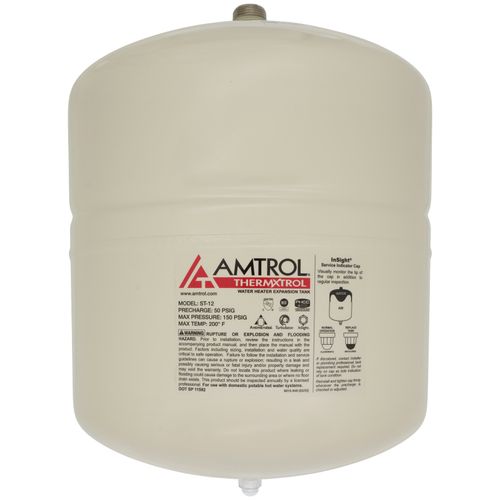
Amtrol ST-12 Advantages:
- Eliminates the waste of energy and water, thus saving money
- Protects the water heater and plumbing fixtures from premauture failure
- Reduces potential safety hazards associated with thermal expansion
- Prevents a dangerous pressure build-up in the system
- Prevents the relief valve from going off
- Therm-X-Trol brand is the #1 choice of Professional Installers
Specs
| Connection Type: | Threaded |
|---|---|
| Connection Size: | 3/4" |
| Tank Volume: | 4.4 Gallons |
| Max Accept. Factor: | 0.73 |
| Diameter (Inches): | 11" |
| Height (Inches): | 15.5" |
| Material: | Steel |
| Application: | Plumbing |
| Max Pressure (PSI): | 150 |
| Weight (lbs): | 9 lbs |
| Warranty: | 7 Year |
| Temperature Range (F): | 200°F MAX |

Questions?
Compare Similar Products
You May Also Need
Product Reviews
Most Liked Positive Review
Just as advertised
Most Liked Negative Review
 --%3E %3Csvg version='1.1' id='With-RB' xmlns='http://www.w3.org/2000/svg' xmlns:xlink='http://www.w3.org/1999/xlink' x='0px' y='0px' viewBox='0 0 100 100' enable-background='new 0 0 100 100' xml:space='preserve'%3E %3Cpath fill='%23FBC8B4' d='M79.44,0.95H20.56C9.78,0.95,0.95,9.78,0.95,20.56v58.87c0,10.79,8.82,19.61,19.61,19.61h58.87 c10.79,0,19.61-8.83,19.61-19.61V20.56C99.05,9.78,90.22,0.95,79.44,0.95z M65.38,58.24l9.38,29.58L49.69,69.78L24.5,87.82 l9.34-29.6L8.8,39.6l30.73-0.17c0,0,6.98-19.61,10-28.93c0.54,1.36,9.88,29.1,9.88,29.1H91.2L65.38,58.24z'/%3E %3C/svg%3E)
Failed in 4 years, may try a different brand next time.
Quality expansion tank
I would buy this again
Great Company
Great, but needs better packaging
yes
I will definitely buy this product again!!
I have a couple of issues....
Arrived quickly, functions perfectly.
Domestic HW Expansion Tank
Excellent product
Product Q&A
7 QuestionsQ: Hello. I have a closed loop boiler system with 3 zone valves. I currently have a domestic hot water coil in the boiler for my potable water. I am replacing the boiler in the spring and thinking about adding a boilermate to the system. (Only male in the house :) ) My question is that I already have a expansion tank on my closed loop system and replacing that with a normal expansion tank. Do I need to install this therm-x-trol expansion tank as well near the boilermate if I go that route? Thanks!
Asked by Chris 11 years ago
Add your answer
Verified Reply- Supplyhouse Staffusually yes, but i would consult a plumber.
Q: why cant I put air in the expansion tank?
Asked by cwh 12 years ago
Add your answer
The tank comes charged but not to the correct pressure. You have to measure your water pressure and put that amount of pressure in the tank before you mount it or connect to the water line. You might have a bad pump or you just might not be as strong as you think you are...LOL.
Hi. Chances are the internal bladder has broken and the expansion tank is filled with water. Therefore it will not take any air. It is unlikely the valve stem has failed, but possible. You could remove that and put in a replacement. Bicycle valve should work. If water comes out - the bladder is broken. BTW remember to turn off the water before playing around with the tank. My expansion tank bladder failed after 10-12 years of use. If yours is of similar age.... Rick
The expansion tank needs to have water shut off and pressure released before you can charge it to the correct pressure accurately. It sounds to me though like you are not properly opening the schrader valve when you connect to the tank. If it feels hard to push air through with a hand pump, then that is probably the problem.
The device comes pre-charged with the correct amount of air from the factory and is sealed. If you don't have the install instructions they are on the web and you can read this information. Good luck.
Q: WHAT DOES THE AIR IN THE TANK DO
Asked by BILLY 12 years ago
Add your answer
The air equalizes the pressure. There is a rubber bladder in there. The air provides a cushion that allows the water to expand. The pressure of the air should be equal to the pressure of the water. If there is no air in there, the tank just fills with water. You need the expansion tank because, if you are heating a lot of water, the hot water (and steam) will blow off your pressure relief valve without someplace to go.
There is a bladder between the water side and the air side. Let's assume that you have all the faucets closed. When the water pump runs it pushes water into the water side of the tank. As the volume of water increases in the tank it reduces the volume available to the air and thereby compresses the air. (Remember fluids essentially don't compress whereas gasses compress readily). The water pressure and the air pressure in the tank are the same pressure. When the water pump reaches its preset shutoff point, the tank has a large volume of water inside and a small volume of (compressed) air . Now, when you open a faucet the water flows from the tank without the water pump running. As the volume of water in the tank is reduced the air in the tank takes up a larger volume than it previously used and the pressure (air and water) is reduced slightly. As more and more water is expelled the pressure will eventually drop to the water pump's start-up pressure and the whole cycle repeats itself. Cumulatively this uses less electricity than a water pump running at high pressure each time you need a couple ounces of water.
Water in your plumbing system expands when the temperature increases. When the water in your hot water tank is heated to the recommended ~120 to 140 degrees F, that expansion can become significant and the resulting jump in pressure could damage your plumbing. The expansion tank is designed to accommodate the extra volume of water that results from thermal expansion. When the pressure drops from cooling, the air in the expansion tank pushes the extra water back into your water heater/plumbing. It is basically a pressurized overflow reservoir with a bladder separating the water and air.
The air tank contains an diaphragm that expands & contracts when the hot water is used. As water is heated it expands and this manages a more consistent pressure in the line otherwise the fixtures bear pressure fluctuations which cause accelerated wear, leaks, drips etc. hope that helps.
Q: I have a 75 gallon gas water heater. I used a watts water gauge to see that my usual water pressure is 60psi. I have a pressure reducing valve where water enters my house. Overnight, the red high-water mark shows 120psi when I check it in the morning. As soon as I open a HOT water faucet, the pressure drops to 60psi. On the next morning, I see the 120psi on the red high-water mark and open a COLD faucet and pressure drops from 120psi to 60psi. So opening HOT or COLD both relieve the pressure. So, I purchased an ST-12 and installed it on the cold water side of my water heater. I used a bicycle pump to pre-set the ST-12 to 58psi. Now when I wake up in the morning, the red high-water-mark shows 95psi(instead of 120psi). But 95psi is still seems too high! When I tap on the ST-12, it is hollow on the lower part of the tank. What max pressure should I expect after installing an ST-12? Do you think my pressure regulator valve is broken? Or is there something else that I'm missing?
Asked by PeterL 13 years ago
Add your answer
The tank needs to be on the hot water side. When the water is heated, it produces pressure. As for the preset pressure in the ST-12, if you set the pressure @ 58 psi, the tank will not start to adsorb the excess pressure from the water tank until the pressure reaches the preset pressure. Review the preset pressure setting as per instructions.
It makes sense that opening either hot or cold drops the pressure to the proper set point, which is, in your case 60 psi as determined by your incoming regulator. Both the hot and cold systems are effectively tied together at the tank so what your seeing is correct. What is not correct is your morning pressure. The pressure can be increased by only 2 ways, starting with a volume of water and then heating it or trying to force more water into the same volume. Do you know what your incoming pressure is? I suspect that it's 120 psi and that your pressure reg is not doing its job, allowing the outlet side to climb to match the inlet side over time and then when you open the outlet side, it quickly gets back to the proper set point. If your incoming pressure is less than 120, then you are getting a pressure increase by the heating and expansion as mentioned earlier. The X tank is taking up some of the pressure, as indicated by your 95 psi reading, my guess is that if you waited long enough, the system would get up to 120, even with the X tank. Remember that since water is not compressible, it takes very little leak by at the regulator to increase the pressure. Don't be fooled by tapping on the tank, they always appear to be empty when you do this, but they're not. Let me know how you make out. Jeff F.
Q: Is this a potable tank?
Asked by Rachale 13 years ago
Add your answer
Verified Reply- PexSupply StaffYes, this tank is designed for potable water plumbing applications.
No it is a pressure expansion tank for a hot water heating system. Joe <*))}}}}>><{{ Referrals Welcomed - no business too big or small
Yes, it is! My wife is using it in some of her cooking prep; I sometimes drink from it, too!
I believe that this is a bladder style expansion tank that is typically used for a boiler system. It could be used for potable water but I doubt that the pressure rating on it would make it very useful for water systems. These tanks usually only operate around 12 psi which is quite a ways from the ~ 60 psi which is what you would want for a potable water source. You would need to check the pressure specification for it. Also, this tank is very small which would mean that the supply pump would be cycling on an off quite often. The larger the better for a well system.
Q: The description states that the THERM-X-TROL ST-12 Expansion Tank should be used in an "open loop" setting. Why not a closed loop setting if the temperature it's used for is never higher than 140°, and the pressure is less than 60 psi?
Asked by norbrook 15 years ago
Add your answer
Verified Reply- PexSupply StaffAccording to the manufacturer, the ST series tank could be used in the described closed-loop system.
You really should be OK if you bleed some air off. It is pre-charged to 60psi, which means you wouldn't get any benefit from this. After all, the main purpose of these is to prevent the actuation of the pressure relief valve.
internal plastic liner for corrosion resistance in system with high oxygen. This would work fine in a closed system. . . but you don't need the extra protection for an O2 free system. There are cheaper ones for that. This is for potable water.
Q: I have a 50 gallon,60 psi water heater which requires a ST-5 expansion tank.Is it ok to use an ST-12 instead?
Asked by Prwtomastoras26 15 years ago
Add your answer
Verified Reply- PexSupply StaffYes, you can use an ST-12 tank. You can always go bigger with expansion tanks, just never smaller.