




Black Iron Pipe Fittings (Domestic)

Pipe Fittings & Nipples






| PRODUCT | SIZE | SINGLE UNIT | BOX UP & SAVE | STOCK STATUS | LIST | COMPARE | |
|---|---|---|---|---|---|---|---|
Added! $112.05 each Backorder Get it by Wed, Dec 23 - Tue, Jan 26 Backorder Get it by Wed, Dec 23 - Tue, Jan 26 | Backorder Get it by Wed, Dec 23 - Tue, Jan 26 Backorder Get it by Wed, Dec 23 - Tue, Jan 26 | ||||||
Added! $205.09 each Backorder Get it by Wed, Dec 23 - Tue, Jan 26 Backorder Get it by Wed, Dec 23 - Tue, Jan 26 | Backorder Get it by Wed, Dec 23 - Tue, Jan 26 Backorder Get it by Wed, Dec 23 - Tue, Jan 26 | ||||||
Added! $0.28 each BOX UP & SAVE 7% Added! $26.00 box of 100 $0.26 each (7% Saving) In Stock  Get 88 by Tue, Nov 24 In Stock Get 88 by Tue, Nov 24 | BOX UP & SAVE 7% Added! $26.00 box of 100 $0.26 each (7% Saving) | In Stock Get 88 by Tue, Nov 24 In Stock Get 88 by Tue, Nov 24 | |||||
Added! $0.32 each BOX UP & SAVE 6% Added! $30.00 box of 100 $0.30 each (6% Saving) In Stock Get 25 by Tue, Nov 24 In Stock Get 25 by Tue, Nov 24 | BOX UP & SAVE 6% Added! $30.00 box of 100 $0.30 each (6% Saving) | In Stock Get 25 by Tue, Nov 24 In Stock Get 25 by Tue, Nov 24 | |||||
Added! $0.47 each BOX UP & SAVE 9% Added! $43.00 box of 100 $0.43 each (9% Saving) In Stock Get 21 by Wed, Nov 25 In Stock Get 21 by Wed, Nov 25 | BOX UP & SAVE 9% Added! $43.00 box of 100 $0.43 each (9% Saving) | In Stock Get 21 by Wed, Nov 25 In Stock Get 21 by Wed, Nov 25 | |||||

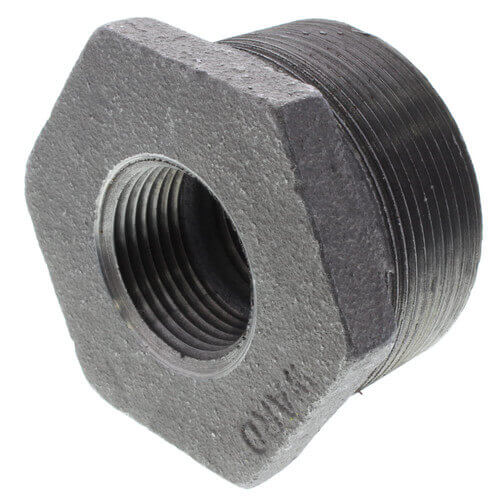
Black fittings are threaded malleable iron fittings, coated in a black oxide finish, used primarily to join black iron pipe in natural gas and propane distribution lines inside a building. The black oxide coating distinguishes these fittings from galvanized versions, which aren't recommended for fuel gas service because zinc coating can flake into the gas stream and clog regulators and valves over time. Fittings in this category include elbows, tees, couplings, unions, and caps sized to match standard iron pipe threads, and each connection relies on pipe dope or thread tape rated for gas service rather than a standard plumbing sealant. A gas line running to an appliance, water heater, furnace, or range, needs fittings sized correctly to the pipe diameter specified by the load calculation for that appliance. Because a gas fitting failure carries higher safety consequences than a water line leak, pressure testing every joint before putting a new gas line into service is standard practice rather than an optional step.
Subcategories
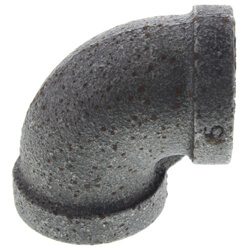
- Black Iron Elbows: Black iron elbows redirect a gas line around a corner or obstruction in 45-degree and 90-degree configurations, matching the same thread pattern used on straight black iron fittings. A 90-degree elbow is the more common choice in tight mechanical rooms where space for a wider-radius turn isn't available. Both angles use the same pipe dope or gas-rated thread tape as the rest of the run.
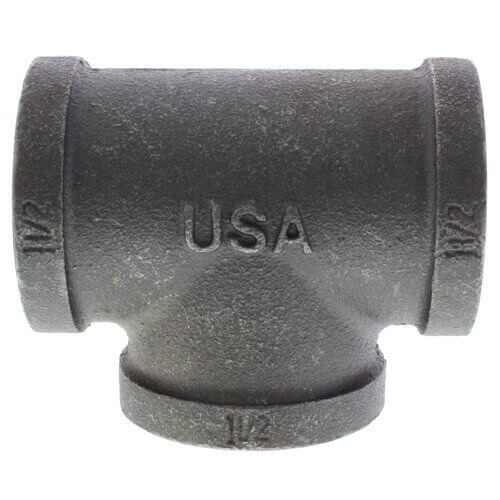
- Black Iron Tees: Black iron tees branch a gas line to a second appliance or run without breaking the main line into two separate pipe sections. A straight tee splits the flow evenly in three directions, while a reducing tee steps down to a smaller branch line sized for a lower-demand appliance. Sizing the branch correctly against the appliance's gas load keeps pressure consistent across the whole system.
- Black Iron Unions: Black iron unions let a section of gas pipe be disconnected and reconnected without cutting or re-threading the pipe, which is useful anywhere an appliance might need to be removed for service. They're typically installed just ahead of an appliance shutoff valve so the appliance connection can be broken independently of the rest of the line. A union relies on a ground joint seal rather than thread sealant alone, so matching halves from a compatible pipe size is necessary for a tight seal.
- Black Iron Couplings: Black iron couplings join two straight lengths of pipe into one continuous run, either matching two same-size pipe ends or, with a reducing coupling, stepping down to a smaller diameter mid-run. They're one of the most frequently used fittings on a gas line since nearly every run needs at least one splice between fixed lengths of pipe. Standard couplings don't allow disassembly the way a union does, so placement should account for any point where future service access matters.
Buying Guide
Selecting Black Fittings for a gas line starts with confirming the fitting is rated for fuel gas service rather than assuming any threaded iron fitting will do, since galvanized fittings aren't recommended for gas lines due to the risk of zinc flaking into the gas stream over time. Matching fitting size to the pipe diameter specified by the appliance's gas load calculation keeps pressure consistent from the meter to the appliance, and undersizing a branch line is a common cause of an appliance not receiving enough gas volume under full load. Threaded connections need pipe dope or tape rated specifically for gas service, since standard plumbing sealants aren't formulated to hold up against fuel gas over time. Unions belong at any point where an appliance might need to be disconnected for service, typically just ahead of the appliance shutoff valve, while permanent splices in a straight run are better served by a standard coupling. Every new gas line, and any line that's been opened for a repair or addition, needs a pressure test before the appliance goes back into service, since a fitting that looks properly assembled can still leak under actual operating pressure. Keeping a working stock of elbows, tees, couplings, and unions in the common pipe sizes used on residential gas work covers most day-to-day installation and repair calls without a special order mid-job.
Frequently Asked Questions
What's the difference between black iron fittings and galvanized fittings?
Black iron fittings have a black oxide finish and are rated for fuel gas service, while galvanized fittings have a zinc coating that isn't recommended for gas lines since the coating can flake into the gas stream over time and clog downstream regulators or valves. Galvanized fittings are generally reserved for water lines instead. Using the correct type for the application is a basic code requirement in most jurisdictions.
What kind of sealant should be used on black iron gas fittings?
Pipe dope or thread tape specifically rated for fuel gas service is required, since standard plumbing sealants aren't formulated to hold up against natural gas or propane over time. The sealant should be applied to the male threads only, leaving the fitting's first thread or two clear to avoid contaminating the gas stream. Following the sealant manufacturer's gas rating claim, rather than assuming any pipe dope works, avoids a joint that fails a pressure test.
Where should a union be placed on a gas line?
A union is typically installed just ahead of an appliance's shutoff valve so the appliance can be disconnected for service without cutting or re-threading the supply line. Placing a union at any other point where future disassembly might be needed, such as before a section that runs through a wall, also makes sense. Unions rely on a ground joint seal, so matching compatible halves is necessary for a tight connection.
How is a gas line's fitting size determined?
Fitting size follows the pipe diameter specified by the appliance's gas load calculation, which accounts for the total BTU demand of everything connected to that line and the length of the run. Undersizing a branch line is a common cause of an appliance not getting enough gas volume under full demand. A load calculation should be run for any new gas line addition rather than matching pipe size to whatever's already on hand.
Why is pressure testing required after installing black iron gas fittings?
A fitting that looks fully threaded and tight can still leak under actual operating pressure, and a gas leak carries higher safety consequences than a leak on a water line. Pressure testing checks every joint on the new or modified run before the appliance is put back into service. Most jurisdictions require this test as part of code compliance, not just as a best practice.
