




Filters
SORT
Product Availability –
Brand –
Size –
Review Score –
 --%3E %3Csvg version='1.1' id='Fill' xmlns='http://www.w3.org/2000/svg' xmlns:xlink='http://www.w3.org/1999/xlink' x='0px' y='0px' viewBox='0 0 100 100' enable-background='new 0 0 100 100' xml:space='preserve'%3E %3Cpath fill='%23F15C02' d='M79.44,0.95H20.56C9.78,0.95,0.95,9.78,0.95,20.56v58.87c0,10.79,8.82,19.61,19.61,19.61h58.87 c10.79,0,19.61-8.83,19.61-19.61V20.56C99.05,9.78,90.22,0.95,79.44,0.95z M65.38,58.24l9.38,29.58L49.69,69.78L24.5,87.82 l9.34-29.6L8.8,39.6l30.73-0.17c0,0,6.98-19.61,10-28.93c0.54,1.36,9.88,29.1,9.88,29.1H91.2L65.38,58.24z'/%3E %3C/svg%3E)
 --%3E %3Csvg version='1.1' id='With-RB' xmlns='http://www.w3.org/2000/svg' xmlns:xlink='http://www.w3.org/1999/xlink' x='0px' y='0px' viewBox='0 0 100 100' enable-background='new 0 0 100 100' xml:space='preserve'%3E %3Cpath fill='%23FBC8B4' d='M79.44,0.95H20.56C9.78,0.95,0.95,9.78,0.95,20.56v58.87c0,10.79,8.82,19.61,19.61,19.61h58.87 c10.79,0,19.61-8.83,19.61-19.61V20.56C99.05,9.78,90.22,0.95,79.44,0.95z M65.38,58.24l9.38,29.58L49.69,69.78L24.5,87.82 l9.34-29.6L8.8,39.6l30.73-0.17c0,0,6.98-19.61,10-28.93c0.54,1.36,9.88,29.1,9.88,29.1H91.2L65.38,58.24z'/%3E %3C/svg%3E)
Price Range –
No Hub Cast Iron Fittings (Domestic)





 --%3E %3Csvg version='1.1' id='No-RB' xmlns='http://www.w3.org/2000/svg' xmlns:xlink='http://www.w3.org/1999/xlink' x='0px' y='0px' viewBox='0 0 100 100' enable-background='new 0 0 100 100' xml:space='preserve'%3E %3Cpath fill='%23CECECE' d='M79.44,0.95H20.56C9.78,0.95,0.95,9.78,0.95,20.56v58.87c0,10.79,8.82,19.61,19.61,19.61h58.87 c10.79,0,19.61-8.83,19.61-19.61V20.56C99.05,9.78,90.22,0.95,79.44,0.95z M65.38,58.24l9.38,29.58L49.69,69.78L24.5,87.82 l9.34-29.6L8.8,39.6l30.73-0.17c0,0,6.98-19.61,10-28.93c0.54,1.36,9.88,29.1,9.88,29.1H91.2L65.38,58.24z'/%3E %3C/svg%3E)



No hub cast iron fittings are drain, waste, and vent fittings joined with banded no-hub couplings rather than the caulked hub-and-spigot joints found on older cast iron piping systems. The no-hub method clamps a neoprene gasket and stainless steel shield around the pipe ends with a tightening band, creating a seal without the lead-and-oakum joint historically used for hub-style cast iron. Domestic manufacturing refers to fittings produced in the United States, which some project specifications and public works contracts require over imported alternatives. This fitting style is common in commercial, institutional, and multi-family construction, where cast iron's sound-dampening and fire-resistance properties are valued for soil and waste stacks running through occupied spaces.
Subcategories
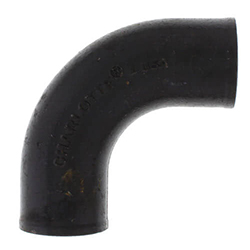
- No-Hub Bends & Elbows: Bends and elbows change the direction of a no-hub cast iron line, available in a range of degree angles to route piping around structural obstacles or transition between vertical stacks and horizontal branches. They connect using the same banded coupling method as straight fittings. Selecting the correct angle keeps the drainage system within code-required slope and flow requirements.
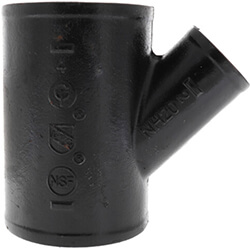
- No-Hub Tees & Wyes: Tees and wyes branch a no-hub cast iron line to add a second drainage path, with wye fittings offering a more gradual angle of entry that's often preferred for waste lines to reduce turbulence at the junction. Both come in a range of outlet sizes to match branch lines of different diameters. Choosing between a tee and a wye typically depends on the specific drainage code requirements for the application.
- No-Hub Couplings & Adapters: Couplings join two lengths of no-hub cast iron pipe or fitting using a neoprene gasket and stainless steel shield tightened with a clamping band. Adapters bridge no-hub cast iron to other pipe materials, such as PVC or copper, where a system transitions between materials. Matching the coupling or adapter size precisely to the pipe outside diameter is necessary for a proper seal.
- Cleanouts & Test Tees: Cleanouts provide access points along a no-hub cast iron line for clearing blockages without disassembling the piping system, while test tees serve a similar function during the plumbing inspection and testing process before a system is closed in. Both are typically placed at required intervals and direction changes per local plumbing code. Planning cleanout locations during rough-in avoids inaccessible access points once walls and floors are finished.
Buying Guide
Specifying no-hub cast iron fittings starts with confirming pipe size and matching it consistently across the run, since bends, tees, wyes, couplings, and cleanouts all need to correspond to the same nominal diameter as the pipe they're joining. Domestic manufacturing is often a project requirement rather than a preference, particularly on public works and government-funded construction where specifications call out domestically produced cast iron specifically, so confirming this requirement early avoids a costly substitution later in the project. Fitting selection between a tee and a wye for a given branch connection typically follows local plumbing code rather than contractor preference, since wye fittings offer a more gradual entry angle that many codes require for waste lines carrying solids.
Coupling selection deserves equal attention: no-hub couplings vary in band configuration and gasket material, and using an under-rated coupling on a line carrying frequent temperature swings or vibration can shorten its service life. Cleanout placement should be planned during the rough-in phase alongside the rest of the fitting layout, since code typically requires cleanouts at specific intervals and direction changes, and retrofitting one into finished walls or floors is considerably more disruptive than planning for it upfront. Contractors working on commercial and multi-family projects where cast iron's sound-dampening properties are a design factor should confirm the full fitting takeoff, not just the straight pipe run, matches the specified material and coupling standard before ordering.
Frequently Asked Questions
What's the difference between no-hub and hub-and-spigot cast iron fittings?
Hub-and-spigot cast iron uses a caulked joint, historically sealed with lead and oakum, where one pipe end's hub receives the spigot end of the next section. No-hub fittings instead use a banded coupling with a neoprene gasket and stainless steel shield clamped around abutting pipe ends. No-hub has largely replaced hub-and-spigot in new construction due to faster installation and no caulking required.
Why does domestic manufacturing matter for cast iron fittings?
Some project specifications, particularly on public works and government-funded construction, require domestically produced cast iron fittings rather than imported alternatives, often as a condition of the contract. Confirming this requirement during the specification phase avoids ordering fittings that don't meet the project's sourcing requirements. Domestic and imported no-hub fittings generally follow the same dimensional and performance standards otherwise.
When should I use a wye instead of a tee?
Wye fittings offer a more gradual angle of entry at the branch connection, which many plumbing codes require for waste lines carrying solids to reduce the chance of blockage at the junction. Tees are more commonly used on vent lines or other applications where that gradual entry isn't a code requirement. Local plumbing code is the deciding factor rather than general preference.
How many cleanouts does a no-hub cast iron system need?
Cleanout requirements are set by local plumbing code, which typically specifies intervals along horizontal runs and placement at direction changes to keep the system accessible for clearing blockages. Planning cleanout locations during the rough-in phase, before walls and floors are finished, avoids difficult retrofits later. A licensed plumber familiar with local code can confirm exact cleanout placement for a specific layout.
Are no-hub couplings a permanent connection?
No-hub couplings are mechanically clamped rather than permanently bonded, which means they can be loosened and removed for future repairs or modifications without cutting the cast iron pipe itself. That said, they're intended to remain tightened to the manufacturer's specified torque for the life of the installation, not adjusted routinely. This makes future access for repairs considerably easier compared to older caulked joints.
