




Commercial Packaged Units

 --%3E %3Csvg version='1.1' id='No-RB' xmlns='http://www.w3.org/2000/svg' xmlns:xlink='http://www.w3.org/1999/xlink' x='0px' y='0px' viewBox='0 0 100 100' enable-background='new 0 0 100 100' xml:space='preserve'%3E %3Cpath fill='%23CECECE' d='M79.44,0.95H20.56C9.78,0.95,0.95,9.78,0.95,20.56v58.87c0,10.79,8.82,19.61,19.61,19.61h58.87 c10.79,0,19.61-8.83,19.61-19.61V20.56C99.05,9.78,90.22,0.95,79.44,0.95z M65.38,58.24l9.38,29.58L49.69,69.78L24.5,87.82 l9.34-29.6L8.8,39.6l30.73-0.17c0,0,6.98-19.61,10-28.93c0.54,1.36,9.88,29.1,9.88,29.1H91.2L65.38,58.24z'/%3E %3C/svg%3E)
 --%3E %3Csvg version='1.1' id='Fill' xmlns='http://www.w3.org/2000/svg' xmlns:xlink='http://www.w3.org/1999/xlink' x='0px' y='0px' viewBox='0 0 100 100' enable-background='new 0 0 100 100' xml:space='preserve'%3E %3Cpath fill='%23F15C02' d='M79.44,0.95H20.56C9.78,0.95,0.95,9.78,0.95,20.56v58.87c0,10.79,8.82,19.61,19.61,19.61h58.87 c10.79,0,19.61-8.83,19.61-19.61V20.56C99.05,9.78,90.22,0.95,79.44,0.95z M65.38,58.24l9.38,29.58L49.69,69.78L24.5,87.82 l9.34-29.6L8.8,39.6l30.73-0.17c0,0,6.98-19.61,10-28.93c0.54,1.36,9.88,29.1,9.88,29.1H91.2L65.38,58.24z'/%3E %3C/svg%3E)
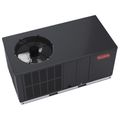
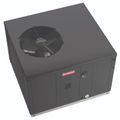

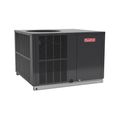
Commercial packaged units combine cooling, and often heating, into a single self-contained cabinet designed for rooftop or slab-level installation rather than a split system with separate indoor and outdoor components. Contractors specify them for restaurants, retail spaces, and light commercial buildings where roof or pad space is available and a single accessible unit simplifies service calls. Package units are available as heat pumps or as gas/electric combination units, with tonnage commonly ranging from 2 to 3.5 tons for smaller commercial spaces and SEER ratings in the 14 to 16 range on current models. R-410A is the refrigerant used across current packaged heat pump lines. Because everything sits in one cabinet, replacing a packaged unit is generally a more contained job than replacing a split system's separate condenser and air handler, which is part of why they remain common on small commercial roofs.
Subcategories
- Packaged Heat Pumps: Packaged heat pumps provide both heating and cooling from a single rooftop or ground-level cabinet using a reversing valve instead of a separate gas furnace. They're common on small commercial buildings without gas service, or where an all-electric system fits the building's utility setup. Units in this category commonly range from 2 to 3.5 tons with SEER ratings around 14 to 16 using R-410A refrigerant. Horizontal and multi-position cabinet styles let the same basic unit fit different roof curb or duct configurations.
- Gas/Electric Packaged Units: Gas/electric packaged units pair a gas furnace section with electric air conditioning in one cabinet, giving a building gas heat without a separate indoor furnace. Contractors specify them for buildings with existing gas service where a straightforward heating and cooling swap is needed on the roof. Tonnage and SEER ratings track closely with the packaged heat pump lineup, so the choice mainly comes down to available fuel type and existing ductwork. These units still need the same roof curb and duct transition work as a heat pump swap.
- Horizontal and Multi-Position Units: Horizontal units are built to sit on a roof curb with duct connections on the side, while multi-position units can be configured for horizontal, downflow, or other orientations depending on how the building's ductwork approaches the unit. Choosing the right configuration up front avoids extra transition ductwork or a custom curb adapter on installation day. Multi-position flexibility matters most on retrofit jobs where the existing curb and duct layout doesn't match a straight horizontal replacement.
Buying Guide
Start with fuel type and available utilities on the building. A building with gas service can run either a gas/electric packaged unit or a packaged heat pump, while an all-electric building only has the heat pump option available. Fuel type availability narrows the lineup before tonnage becomes the next decision.
Tonnage should match a load calculation for the space rather than a rule of thumb based on square footage alone, since the units available in this category run from roughly 2 to 3.5 tons for smaller commercial spaces. SEER rating affects both the operating cost over the equipment's life and, in some jurisdictions, whether the unit meets current code minimums, so confirming the rating against local requirements before ordering is worth the extra step.
Cabinet orientation is the other major decision. Commercial packaged units built for horizontal mounting expect side duct connections and a matching roof curb, while multi-position units can adapt to more than one duct approach, which is useful on a retrofit where the existing curb doesn't match a straight swap. Refrigerant type is standardized at R-410A across current models, so that's less of a differentiator than it once was. Whatever combination gets chosen, confirming the roof curb dimensions and duct transition against the specific model's spec sheet avoids a mismatch that turns a rooftop swap into a bigger job than planned.
Frequently Asked Questions
What's the difference between a packaged heat pump and a gas/electric packaged unit?
A packaged heat pump handles both heating and cooling electrically using a reversing valve, while a gas/electric unit pairs a gas furnace section with electric cooling in the same cabinet. The right choice mainly depends on whether the building has gas service.
What tonnage range do commercial packaged units come in?
Units built for smaller commercial spaces commonly run from about 2 to 3.5 tons. Sizing should follow a load calculation for the specific space rather than square footage alone.
What's the difference between a horizontal and a multi-position packaged unit?
A horizontal unit is built for side duct connections on a roof curb, while a multi-position unit can be configured for more than one orientation. Multi-position units are useful on retrofits where the existing curb and ductwork don't match a straight horizontal swap.
What refrigerant do current commercial packaged units use?
Current packaged heat pump and packaged unit lines use R-410A refrigerant. Confirming refrigerant compatibility still matters when replacing an older unit on an existing pad or curb.
What SEER ratings are available on commercial packaged units?
Current models commonly fall in the 14 to 16 SEER range. Confirming the rating against local code minimums before ordering avoids a mismatch on a permitted job.
