



Filters
SORT
Product Availability –
Voltage –
Review Score –
 --%3E %3Csvg version='1.1' id='Fill' xmlns='http://www.w3.org/2000/svg' xmlns:xlink='http://www.w3.org/1999/xlink' x='0px' y='0px' viewBox='0 0 100 100' enable-background='new 0 0 100 100' xml:space='preserve'%3E %3Cpath fill='%23F15C02' d='M79.44,0.95H20.56C9.78,0.95,0.95,9.78,0.95,20.56v58.87c0,10.79,8.82,19.61,19.61,19.61h58.87 c10.79,0,19.61-8.83,19.61-19.61V20.56C99.05,9.78,90.22,0.95,79.44,0.95z M65.38,58.24l9.38,29.58L49.69,69.78L24.5,87.82 l9.34-29.6L8.8,39.6l30.73-0.17c0,0,6.98-19.61,10-28.93c0.54,1.36,9.88,29.1,9.88,29.1H91.2L65.38,58.24z'/%3E %3C/svg%3E)
 --%3E %3Csvg version='1.1' id='With-RB' xmlns='http://www.w3.org/2000/svg' xmlns:xlink='http://www.w3.org/1999/xlink' x='0px' y='0px' viewBox='0 0 100 100' enable-background='new 0 0 100 100' xml:space='preserve'%3E %3Cpath fill='%23FBC8B4' d='M79.44,0.95H20.56C9.78,0.95,0.95,9.78,0.95,20.56v58.87c0,10.79,8.82,19.61,19.61,19.61h58.87 c10.79,0,19.61-8.83,19.61-19.61V20.56C99.05,9.78,90.22,0.95,79.44,0.95z M65.38,58.24l9.38,29.58L49.69,69.78L24.5,87.82 l9.34-29.6L8.8,39.6l30.73-0.17c0,0,6.98-19.61,10-28.93c0.54,1.36,9.88,29.1,9.88,29.1H91.2L65.38,58.24z'/%3E %3C/svg%3E)
Eemax Single Point Electric Tankless Heaters


 --%3E %3Csvg version='1.1' id='No-RB' xmlns='http://www.w3.org/2000/svg' xmlns:xlink='http://www.w3.org/1999/xlink' x='0px' y='0px' viewBox='0 0 100 100' enable-background='new 0 0 100 100' xml:space='preserve'%3E %3Cpath fill='%23CECECE' d='M79.44,0.95H20.56C9.78,0.95,0.95,9.78,0.95,20.56v58.87c0,10.79,8.82,19.61,19.61,19.61h58.87 c10.79,0,19.61-8.83,19.61-19.61V20.56C99.05,9.78,90.22,0.95,79.44,0.95z M65.38,58.24l9.38,29.58L49.69,69.78L24.5,87.82 l9.34-29.6L8.8,39.6l30.73-0.17c0,0,6.98-19.61,10-28.93c0.54,1.36,9.88,29.1,9.88,29.1H91.2L65.38,58.24z'/%3E %3C/svg%3E)
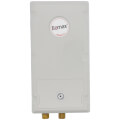
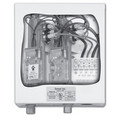



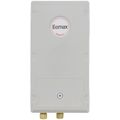
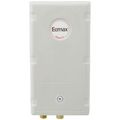
Eemax Single Point Electric Tankless Heaters are compact, point-of-use units designed to serve one fixture without a storage tank. Installers mount them close to a sink or wash station so hot water arrives on demand, cutting the wait time and standby heat loss that come with a shared tank system. The SP4208 model runs on 208V service at 4.1 kW and 19.7A, making it a fit for lavatory faucets on standard commercial circuits. Higher-draw jobs call for 277V models such as the SP60, rated at 6.0 kW and 22A, or the SP80, rated at 8.0 kW and 29A, both suited to break room sinks and utility fixtures with heavier flow demand. Because each heater serves a single point, contractors can match output to the fixture instead of oversizing a central system. Facility managers rely on single point tankless heaters for remote hand-washing stations, tenant build-outs, and any fixture where running a hot water line back to a central heater isn't practical.
Subcategories
- 208V Single Point Heaters: The SP4208 anchors this group, running on 208V circuits and drawing 4.1 kW at 19.7A. Contractors spec it for single lavatory sinks in offices, retail restrooms, and other light commercial settings already wired for 208V service. Output stays modest, matching hand-washing demand rather than high-flow fixtures. Electricians favor the fit because the amperage draw works on a standard branch circuit without a service upgrade.
- 277V Standard-Output Single Point Heaters: The SP60 delivers 6.0 kW at 22A on a 277V circuit, a step up from lavatory-only models. Facility electricians pick it for break room sinks and utility fixtures that see more frequent use than a single restroom lavatory. Buildings already running 277V lighting circuits can tap that same service for the heater, simplifying the installation. Output covers moderate flow demand without pushing into commercial dish-station territory.
- 277V High-Output Single Point Heaters: The SP80 tops the single point line at 8.0 kW and 29A on 277V service. Contractors reach for it when a fixture needs more sustained hot water than the SP60 can deliver, such as a busy utility sink or a multi-user wash station. Higher wattage means a dedicated circuit sized for the full 29A draw. Property managers use it where fixture demand outpaces the lower-output models in the lineup.
Buying Guide
Choosing among Eemax Single Point Electric Tankless Heaters starts with the electrical service already available at the fixture. A 208V circuit points toward the SP4208, while a building running 277V lighting circuits opens up the SP60 and SP80. Matching voltage to existing service avoids adding a new circuit or upgrading a panel, which keeps installation straightforward. Flow demand at the fixture comes next. A single lavatory sink with light, intermittent use fits comfortably on the SP4208's 4.1 kW output. A break room sink or utility fixture with steadier use calls for the SP60's 6.0 kW, and a high-traffic wash station or utility sink with sustained draw justifies the SP80's 8.0 kW. Amperage draw also shapes wiring decisions. The SP4208 pulls 19.7A, the SP60 pulls 22A, and the SP80 pulls 29A, so the breaker and wire gauge need to match the specific model rather than a generic tankless spec. Mounting location matters too. Single point heaters install close to the fixture they serve, so contractors should confirm clearance for the unit and its connections before finalizing rough-in plans. Property owners converting an old storage tank setup often standardize on one model across a building to simplify spare parts and electrician familiarity, but matching each fixture's actual demand delivers better performance than defaulting to the highest-output unit everywhere.
Frequently Asked Questions
What size electrical circuit does a single point tankless heater need?
Circuit size depends on the model. The SP4208 requires a 208V circuit rated for its 19.7A draw, while the SP60 and SP80 run on 277V circuits rated for 22A and 29A respectively. An electrician should size the breaker and wire gauge to the specific model's full load amperage before installation.
Can a single point heater serve more than one fixture?
Single point tankless heaters are built for one fixture, such as a lavatory sink or a utility sink. Feeding multiple fixtures from one unit spreads the kW output too thin and reduces the temperature rise at each outlet. Facilities with multiple fixtures typically install one heater per location instead.
What is the difference between the SP60 and SP80?
Both run on 277V circuits, but the SP60 delivers 6.0 kW at 22A while the SP80 delivers 8.0 kW at 29A. Higher wattage on the SP80 supports fixtures with heavier or more sustained hot water demand.
Do these heaters work on standard 120V outlets?
The confirmed single point models covered here, the SP4208, SP60, and SP80, run on 208V or 277V circuits rather than standard 120V outlets. Checking the nameplate voltage against available building service is a necessary step before ordering.
Where do plumbers typically install single point tankless heaters?
Common installations include remote hand-washing stations, break room sinks, and tenant build-outs where running a hot water line back to a central water heater isn't practical. Mounting the unit close to the served fixture keeps wait time for hot water short.
