




Impact Wrenches


 --%3E %3Csvg version='1.1' id='No-RB' xmlns='http://www.w3.org/2000/svg' xmlns:xlink='http://www.w3.org/1999/xlink' x='0px' y='0px' viewBox='0 0 100 100' enable-background='new 0 0 100 100' xml:space='preserve'%3E %3Cpath fill='%23CECECE' d='M79.44,0.95H20.56C9.78,0.95,0.95,9.78,0.95,20.56v58.87c0,10.79,8.82,19.61,19.61,19.61h58.87 c10.79,0,19.61-8.83,19.61-19.61V20.56C99.05,9.78,90.22,0.95,79.44,0.95z M65.38,58.24l9.38,29.58L49.69,69.78L24.5,87.82 l9.34-29.6L8.8,39.6l30.73-0.17c0,0,6.98-19.61,10-28.93c0.54,1.36,9.88,29.1,9.88,29.1H91.2L65.38,58.24z'/%3E %3C/svg%3E)





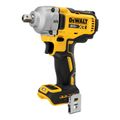
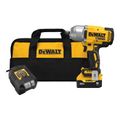
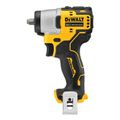
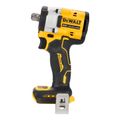


Impact Wrenches are power tools that drive and remove heavy fasteners with rotational impact force, which makes them a common tool for mechanical contractors, plumbers, and HVAC installers. The cordless models in this category run on manufacturer battery platforms, including Milwaukee M12, Milwaukee M18, and DeWalt 20V MAX XR. Torque varies widely by class. Milwaukee rates the M18 FUEL 1/2" High Torque model 2967-20 at 1,200 ft-lbs of fastening torque, while the M12 FUEL 3/8" Subcompact model 3049-20 is rated at 225 ft-lbs of nut-busting torque. Drive size, anvil type, and tool length all shape how a wrench fits the work. Matching those specs to the fasteners and the space on the job keeps crews from stalling on stubborn hardware or fighting an oversized tool in a tight spot.
Subcategories
- DeWalt Impact Wrenches: DeWalt cordless impact wrenches run on the 20V MAX XR platform. Contractors use them for heavy fastening and fastener removal. The DCF900 high torque model has a 1/2" hog ring anvil and is rated by DeWalt at 1,030 ft-lbs of max fastening torque and 1,400 ft-lbs of max breakaway torque. The DCF900P2 kit adds two 5.0Ah batteries, a charger, and a carrying bag.
- Milwaukee M12 Impact Wrenches: M12 impact wrenches are the compact tools in the Milwaukee lineup, built for confined spaces. Installers use them for equipment hardware and repetitive driving work. The M12 FUEL 3/8" Subcompact model 3049-20 measures 4.5" long and is rated at 225 ft-lbs of nut-busting torque with a friction ring anvil. All M12 tools run on the M12 battery system.
- Milwaukee M18 Impact Wrenches: M18 impact wrenches deliver more torque on the M18 battery platform. The M18 FUEL 1/2" Compact model 2855-20 is 4.9" long with 250 ft-lbs of nut-busting torque and a friction ring anvil. For heavier work, model 2966-20 is rated at 900 ft-lbs of fastening torque with a pin detent anvil. Contractors choose between friction ring and pin detent anvils based on how securely sockets need to stay on.
Buying Guide
Start with the torque the job demands. Compact 1/2" tools such as the Milwaukee M18 FUEL model 2855-20 are rated at 250 ft-lbs of nut-busting torque, while high torque models reach much greater output: model 2966-20 is rated at 900 ft-lbs of fastening torque and 1,100 ft-lbs of nut-busting torque. Fastening torque and nut-busting torque are different ratings, so compare like for like across brands.
Match the drive size to the work. A 3/8" drive, like the M12 FUEL model 3049-20, suits confined spaces and smaller hardware, and a 1/2" drive handles larger fasteners. Tool length matters in tight mechanical rooms: model 3049-20 measures 4.5", and the M18 FUEL model 2855-20 measures 4.9".
Choose the anvil type for socket retention. A friction ring allows tool-free, quick socket changes, while a pin detent anvil secures the socket with a pin. DeWalt's DCF900 uses a hog ring anvil.
Pick the battery platform next. When comparing Impact Wrenches, a crew already running M12, M18, or 20V MAX XR batteries can buy bare tools and reuse existing packs. Kits add batteries and a charger, such as the DCF900P2, which includes two 5.0Ah batteries, a charger, and a carrying bag.
Finally, look at control features. Milwaukee M18 FUEL models 2855-20 and 2966-20 include 4-Mode DRIVE CONTROL with an auto shut-off setting for hand-tight fastening. Matching the control mode to the hardware helps protect threads on smaller fasteners.
Frequently Asked Questions
What torque do I need from an impact wrench for HVAC and plumbing work?
Torque needs depend on the fastener size. Compact impact wrenches such as the Milwaukee M18 FUEL model 2855-20 are rated at 250 ft-lbs of nut-busting torque, while the M18 FUEL model 2967-20 is rated at 1,200 ft-lbs of fastening torque. Pick the impact wrench torque class that matches the largest fastener on the job.
What's the difference between fastening torque and nut-busting torque on impact wrenches?
Impact wrenches list both ratings because they measure different things. Milwaukee rates the M18 FUEL model 2966-20 at 900 ft-lbs of fastening torque and 1,100 ft-lbs of nut-busting torque. Nut-busting torque is the output for loosening stuck fasteners, and fastening torque is the output for tightening.
Should I pick a friction ring or a pin detent anvil?
Both anvil types hold sockets on impact wrenches in different ways. Milwaukee's 2855-20 uses a friction ring, and the 2966-20 uses a pin detent that secures the socket in place. Pick the pin detent when sockets must stay put and the friction ring when fast socket changes matter more.
What's the DeWalt DCF900 impact wrench rated for?
DeWalt rates the 20V MAX XR DCF900 1/2" impact wrench at 1,030 ft-lbs of max fastening torque and 1,400 ft-lbs of max breakaway torque. It uses a hog ring anvil. The ratings apply to the DCF900 only, not to every DeWalt impact wrench.
Do M12 and M18 impact wrenches use the same batteries?
Milwaukee lists M12 tools as compatible with M12 batteries and chargers, and M18 tools as compatible with M18 batteries. The M12 FUEL 3/8" model 3049-20 is an M12 tool, and the M18 FUEL models 2855-20 and 2966-20 are M18 tools. Check the platform before buying impact wrenches for a crew with existing batteries.
