




Filters
SORT
Product Availability –
Review Score –
 --%3E %3Csvg version='1.1' id='Fill' xmlns='http://www.w3.org/2000/svg' xmlns:xlink='http://www.w3.org/1999/xlink' x='0px' y='0px' viewBox='0 0 100 100' enable-background='new 0 0 100 100' xml:space='preserve'%3E %3Cpath fill='%23F15C02' d='M79.44,0.95H20.56C9.78,0.95,0.95,9.78,0.95,20.56v58.87c0,10.79,8.82,19.61,19.61,19.61h58.87 c10.79,0,19.61-8.83,19.61-19.61V20.56C99.05,9.78,90.22,0.95,79.44,0.95z M65.38,58.24l9.38,29.58L49.69,69.78L24.5,87.82 l9.34-29.6L8.8,39.6l30.73-0.17c0,0,6.98-19.61,10-28.93c0.54,1.36,9.88,29.1,9.88,29.1H91.2L65.38,58.24z'/%3E %3C/svg%3E)
 --%3E %3Csvg version='1.1' id='With-RB' xmlns='http://www.w3.org/2000/svg' xmlns:xlink='http://www.w3.org/1999/xlink' x='0px' y='0px' viewBox='0 0 100 100' enable-background='new 0 0 100 100' xml:space='preserve'%3E %3Cpath fill='%23FBC8B4' d='M79.44,0.95H20.56C9.78,0.95,0.95,9.78,0.95,20.56v58.87c0,10.79,8.82,19.61,19.61,19.61h58.87 c10.79,0,19.61-8.83,19.61-19.61V20.56C99.05,9.78,90.22,0.95,79.44,0.95z M65.38,58.24l9.38,29.58L49.69,69.78L24.5,87.82 l9.34-29.6L8.8,39.6l30.73-0.17c0,0,6.98-19.61,10-28.93c0.54,1.36,9.88,29.1,9.88,29.1H91.2L65.38,58.24z'/%3E %3C/svg%3E)
Price Range –
Infrared Thermometers


 --%3E %3Csvg version='1.1' id='No-RB' xmlns='http://www.w3.org/2000/svg' xmlns:xlink='http://www.w3.org/1999/xlink' x='0px' y='0px' viewBox='0 0 100 100' enable-background='new 0 0 100 100' xml:space='preserve'%3E %3Cpath fill='%23CECECE' d='M79.44,0.95H20.56C9.78,0.95,0.95,9.78,0.95,20.56v58.87c0,10.79,8.82,19.61,19.61,19.61h58.87 c10.79,0,19.61-8.83,19.61-19.61V20.56C99.05,9.78,90.22,0.95,79.44,0.95z M65.38,58.24l9.38,29.58L49.69,69.78L24.5,87.82 l9.34-29.6L8.8,39.6l30.73-0.17c0,0,6.98-19.61,10-28.93c0.54,1.36,9.88,29.1,9.88,29.1H91.2L65.38,58.24z'/%3E %3C/svg%3E)
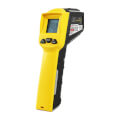
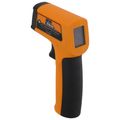
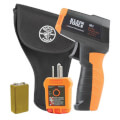
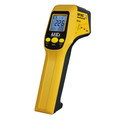
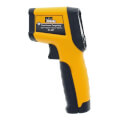

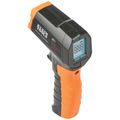
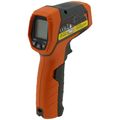
Infrared thermometers are handheld instruments that read surface temperature from a distance. The Klein Tools IR1, for example, has a measurement range of minus 4 degrees F to 752 degrees F and a 10:1 distance-to-spot ratio, with a targeting laser and a backlit display. Options from UEi Test Instruments and Klein Tools span apprentice level models, 12:1 optics and units with a K-type input for contact probes. Contractors use them to spot hot or cold surfaces during service calls and compare readings across a system. Because the spot ratio, temperature range and features differ from model to model, matching the meter to the work matters. A tool with the wrong range or optics gives readings that are hard to trust at the distances techs actually work.
Subcategories
- Entry Level Infrared Thermometers: Entry level infrared thermometers are built for routine surface temperature checks where cost matters. Apprentices and service techs use them for everyday readings. The UEi Test Instruments INF165C covers minus 76 to 1022 degrees F with a 12:1 distance-to-spot ratio. It has circular laser targeting, a fixed 0.95 emissivity and max value capture.
- Advanced Infrared Thermometers with K-Type Input: Advanced infrared thermometers add a K-type input, extended measurement and stronger optics. Professionals use them in advanced or specialty environments and on targets at greater distances. The UEi Test Instruments INF195C is a 12:1 model with a K-type input for a surface or contact probe. It also offers trend analysis features.
- Single Laser Infrared Thermometers: Single laser infrared thermometers use one targeting laser and a distance-to-spot ratio to mark the target. Techs use them for general temperature checks on HVAC and plumbing equipment. The Klein Tools IR1 measures minus 4 to 752 degrees F at 10:1 and adds automatic hold, a backlit display and auto power-off. It runs on one 9V zinc-carbon battery.
- Dual Laser Infrared Thermometers: Dual laser infrared thermometers use two targeting lasers to mark the measurement area. The distance between the two laser spots approximates the diameter of the circular area the sensor reads. The Klein Tools dual-laser model has a 12:1 distance-to-spot ratio, a range of minus 22 to 752 degrees F and several calculation modes. Techs choose it when the size of the measured area matters.
- Infrared Thermometer Kits: Infrared thermometer kits bundle a thermometer with a second tester. The Klein Tools IR1KIT includes the IR1 infrared thermometer and the RT210 GFCI receptacle tester, which detects common wiring problems. The IR1 measures minus 4 to 752 degrees F at a 10:1 distance-to-spot ratio. Techs who want both tools in one set choose a kit like this one.
Buying Guide
Choose the temperature range and distance-to-spot ratio first, because they decide what the meter can read well. Distance-to-spot ratio describes how large an area the sensor reads from a given distance. The UEi INF165C and INF195C are 12:1 models, and the Klein Tools IR1 is 10:1.
Next, compare range against the work. The IR1 covers minus 4 to 752 degrees F, the Klein Tools dual-laser model covers minus 22 to 752 degrees F, and the INF165C covers minus 76 to 1022 degrees F. Pick the range that fits the coldest and hottest surfaces on the jobs at hand.
When comparing Infrared Thermometers, weigh features against the task. Dual lasers help show the size of the measured area. Circular laser targeting is listed on the INF165C. A K-type input, like the one on the INF195C, adds surface or contact probe measurement. Max value capture, automatic hold and a backlit display are listed on different models and help with capturing and reading measurements.
Check power next. The IR1 and the Klein Tools dual-laser model use a 9V zinc-carbon battery, while the INF165C uses two AAA batteries and comes with a carrying case. The INF165C also includes a manual. Last, decide whether a kit makes sense, since the IR1KIT pairs the IR1 with an RT210 GFCI receptacle tester.
Frequently Asked Questions
What distance-to-spot ratio do I need on an infrared thermometer?
A higher distance-to-spot ratio reads a tighter spot at a given distance, which matters when the target is small or far away. Infrared thermometers here include 10:1 models like the Klein Tools IR1 and 12:1 models like the UEi INF165C. Match the ratio to how far techs usually stand from the target.
What temperature range do infrared thermometers cover?
Range varies by model. The UEi INF165C covers minus 76 to 1022 degrees F, the Klein Tools IR1 covers minus 4 to 752 degrees F and the Klein Tools dual-laser model covers minus 22 to 752 degrees F. Check the listing for an infrared thermometer before relying on it for hot or cold work.
Which infrared thermometer accepts a K-type probe?
The UEi INF195C is a 12:1 infrared thermometer with a K-type input for a surface or contact probe. It's described for frequent use in advanced or specialty applications. It also offers trend analysis features.
What's the benefit of a dual-laser infrared thermometer?
A dual-laser infrared thermometer projects two laser spots on the target. The distance between the spots approximates the diameter of the circular area the sensor is reading. The Klein Tools dual-laser model pairs that with a 12:1 ratio and several calculation modes.
Do any infrared thermometers come as a kit?
Yes, the Klein Tools IR1KIT pairs the IR1 infrared thermometer with an RT210 GFCI receptacle tester. The IR1 has a 10:1 distance-to-spot ratio and a targeting laser. The RT210 detects common wiring problems.
