




Filters
SORT
Product Availability –
Material –
Size –
Review Score –
 --%3E %3Csvg version='1.1' id='Fill' xmlns='http://www.w3.org/2000/svg' xmlns:xlink='http://www.w3.org/1999/xlink' x='0px' y='0px' viewBox='0 0 100 100' enable-background='new 0 0 100 100' xml:space='preserve'%3E %3Cpath fill='%23F15C02' d='M79.44,0.95H20.56C9.78,0.95,0.95,9.78,0.95,20.56v58.87c0,10.79,8.82,19.61,19.61,19.61h58.87 c10.79,0,19.61-8.83,19.61-19.61V20.56C99.05,9.78,90.22,0.95,79.44,0.95z M65.38,58.24l9.38,29.58L49.69,69.78L24.5,87.82 l9.34-29.6L8.8,39.6l30.73-0.17c0,0,6.98-19.61,10-28.93c0.54,1.36,9.88,29.1,9.88,29.1H91.2L65.38,58.24z'/%3E %3C/svg%3E)
 --%3E %3Csvg version='1.1' id='With-RB' xmlns='http://www.w3.org/2000/svg' xmlns:xlink='http://www.w3.org/1999/xlink' x='0px' y='0px' viewBox='0 0 100 100' enable-background='new 0 0 100 100' xml:space='preserve'%3E %3Cpath fill='%23FBC8B4' d='M79.44,0.95H20.56C9.78,0.95,0.95,9.78,0.95,20.56v58.87c0,10.79,8.82,19.61,19.61,19.61h58.87 c10.79,0,19.61-8.83,19.61-19.61V20.56C99.05,9.78,90.22,0.95,79.44,0.95z M65.38,58.24l9.38,29.58L49.69,69.78L24.5,87.82 l9.34-29.6L8.8,39.6l30.73-0.17c0,0,6.98-19.61,10-28.93c0.54,1.36,9.88,29.1,9.88,29.1H91.2L65.38,58.24z'/%3E %3C/svg%3E)
Price Range –
ProPEX Copper Fitting Adapters


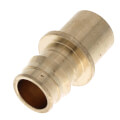
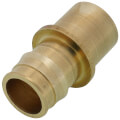
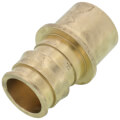
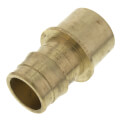
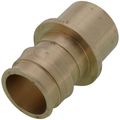

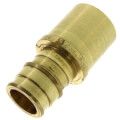
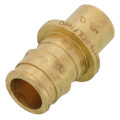
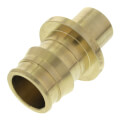

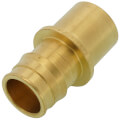
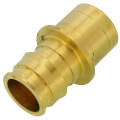


ProPEX Copper Fitting Adapters are brass transition fittings that connect PEX tubing to copper pipe, fittings, and valves using the ProPEX expansion connection method. Rated for 160 psi at 73°F and 80 psi at 200°F, these adapters hold up in both potable water and hydronic radiant heating systems without a crimp ring or added mechanical clamp at the PEX end. Plumbers and hydronic installers use them anywhere a job mixes PEX runs with existing copper stub outs, manifolds, or copper rough-in work, which happens constantly on both remodel and new construction jobs. The ProPEX expansion connection relies on the PEX tubing's memory to shrink back around a fitting after being expanded, creating a full flow connection with no reduction in inside diameter at the joint. Lead-free brass construction on current models keeps these adapters compliant with potable water requirements, making the category a dependable bridge between two of the most common piping materials on a trade truck.
Subcategories
- ProPEX x Copper Sweat Adapters: Sweat adapters transition a ProPEX expansion connection into a standard copper sweat end sized for a solder joint. Plumbers use them at any point where a PEX run needs to tie into existing copper pipe using a torch instead of a crimp or press tool. Sizes match common residential and light commercial copper stub outs, including the widely stocked half inch sweat connection. Because the copper end solders the same way as any other copper fitting, no new tooling is needed on that side of the joint.
- ProPEX x Copper Press Adapters: Press adapters swap the solder joint for a copper press connection, letting a mechanical press tool make the copper side connection instead of a torch. Installers favor these on occupied buildings, remodels, and any job where an open flame near existing framing or insulation is not practical. The ProPEX expansion end works identically to the sweat style, so choosing between the two comes down to the tooling on hand and the jobsite conditions. Lead-free press adapters are available for domestic water applications that require lead-free brass.
- Lead-Free ProPEX Copper Adapters: Lead-free models use brass alloys formulated to meet potable water requirements for lead content, marked with an LF designation in the model number. Plumbers specify these on domestic water lines feeding drinking water fixtures, where lead-free construction is required. The lead-free designation applies to the brass alloy itself, not the connection style, so lead-free adapters are available in both sweat and press configurations. Checking for the LF marking on the fitting confirms compliance before it goes into a potable water run.
Buying Guide
Pick the copper side connection first: sweat or press. Sweat adapters need a torch and standard soldering technique, which most plumbers already have the tools and experience for. Press adapters need a press tool sized for the fitting, but they let installers make the copper connection without an open flame, which matters on occupied buildings, near foam insulation, or on any job where a torch is not practical. Neither style changes how the PEX side connects, since both use the same ProPEX expansion method.
Next, confirm size on both ends. ProPEX Copper Fitting Adapters are sized separately for the PEX side and the copper side, and the two don't always match, since a common configuration steps a larger PEX line down to a smaller copper stub out. Checking both dimensions against the tubing and the existing copper avoids ordering the wrong reducing size.
Check for a lead-free requirement. Domestic water lines feeding drinking water fixtures typically call for lead-free brass, marked with an LF designation in the model number. Hydronic heating loops that never touch potable water don't carry the same requirement, though many installers standardize on lead-free stock anyway to avoid mixing parts.
Finally, verify the expansion tool on hand matches the tubing size being used, since ProPEX connections rely on an expansion tool sized to the specific PEX diameter.
Frequently Asked Questions
What's the difference between ProPEX sweat and press copper adapters?
Sweat adapters connect to copper pipe with a standard solder joint, while press adapters use a mechanical press tool instead of a torch on the copper side. Both styles use the same ProPEX expansion connection on the PEX end, so the choice only affects how the copper side gets joined. Press adapters suit occupied buildings or jobs where an open flame is not practical. Sweat adapters work well wherever standard soldering tools and technique are already on hand.
Are ProPEX copper fitting adapters rated for hydronic heating?
ProPEX Copper Fitting Adapters carry a pressure rating of 160 psi at 73°F and 80 psi at 200°F, covering both potable water and hydronic radiant heating applications. Hydronic loops that run hot water through radiant tubing fall within these rated limits. Checking the system's actual operating temperature and pressure against these ratings confirms the adapter is suited to the application. Both sweat and press copper connection styles carry the same rating.
Do ProPEX adapters need a special tool?
The PEX side of a ProPEX Copper Fitting Adapter needs an expansion tool sized to the tubing diameter, which expands the PEX end so it can slide over the fitting before shrinking back into place. Sweat adapters need only a torch and solder on the copper side, no different from any other copper joint. Press adapters need a press tool sized for the fitting instead of a torch. Matching the expansion tool to the tubing size is what makes the PEX connection seal properly.
What does the LF designation mean on these adapters?
LF marks a lead-free brass alloy formulated to meet potable water requirements for lead content in the fitting. Domestic water lines feeding drinking water fixtures typically call for lead-free construction. Hydronic heating loops that never carry potable water don't carry the same requirement, though many installers stock lead-free parts across the board to simplify inventory. The LF designation applies to the brass alloy, not the connection style, so it appears on both sweat and press adapters.
Can a ProPEX copper adapter step between two different pipe sizes?
ProPEX Copper Fitting Adapters are sized separately on the PEX side and the copper side, and those two sizes don't always match. A common configuration connects a larger PEX line to a smaller copper stub out in one fitting. Checking both dimensions against the tubing and the existing copper before ordering avoids a mismatched connection. Reducing configurations save a separate coupling compared to matching both sides to the same size and adding a bushing.
