




Filters
SORT
Product Availability –
Size –
Voltage –
Review Score –
 --%3E %3Csvg version='1.1' id='Fill' xmlns='http://www.w3.org/2000/svg' xmlns:xlink='http://www.w3.org/1999/xlink' x='0px' y='0px' viewBox='0 0 100 100' enable-background='new 0 0 100 100' xml:space='preserve'%3E %3Cpath fill='%23F15C02' d='M79.44,0.95H20.56C9.78,0.95,0.95,9.78,0.95,20.56v58.87c0,10.79,8.82,19.61,19.61,19.61h58.87 c10.79,0,19.61-8.83,19.61-19.61V20.56C99.05,9.78,90.22,0.95,79.44,0.95z M65.38,58.24l9.38,29.58L49.69,69.78L24.5,87.82 l9.34-29.6L8.8,39.6l30.73-0.17c0,0,6.98-19.61,10-28.93c0.54,1.36,9.88,29.1,9.88,29.1H91.2L65.38,58.24z'/%3E %3C/svg%3E)
 --%3E %3Csvg version='1.1' id='With-RB' xmlns='http://www.w3.org/2000/svg' xmlns:xlink='http://www.w3.org/1999/xlink' x='0px' y='0px' viewBox='0 0 100 100' enable-background='new 0 0 100 100' xml:space='preserve'%3E %3Cpath fill='%23FBC8B4' d='M79.44,0.95H20.56C9.78,0.95,0.95,9.78,0.95,20.56v58.87c0,10.79,8.82,19.61,19.61,19.61h58.87 c10.79,0,19.61-8.83,19.61-19.61V20.56C99.05,9.78,90.22,0.95,79.44,0.95z M65.38,58.24l9.38,29.58L49.69,69.78L24.5,87.82 l9.34-29.6L8.8,39.6l30.73-0.17c0,0,6.98-19.61,10-28.93c0.54,1.36,9.88,29.1,9.88,29.1H91.2L65.38,58.24z'/%3E %3C/svg%3E)
Watts Actuators & Valves

 --%3E %3Csvg version='1.1' id='No-RB' xmlns='http://www.w3.org/2000/svg' xmlns:xlink='http://www.w3.org/1999/xlink' x='0px' y='0px' viewBox='0 0 100 100' enable-background='new 0 0 100 100' xml:space='preserve'%3E %3Cpath fill='%23CECECE' d='M79.44,0.95H20.56C9.78,0.95,0.95,9.78,0.95,20.56v58.87c0,10.79,8.82,19.61,19.61,19.61h58.87 c10.79,0,19.61-8.83,19.61-19.61V20.56C99.05,9.78,90.22,0.95,79.44,0.95z M65.38,58.24l9.38,29.58L49.69,69.78L24.5,87.82 l9.34-29.6L8.8,39.6l30.73-0.17c0,0,6.98-19.61,10-28.93c0.54,1.36,9.88,29.1,9.88,29.1H91.2L65.38,58.24z'/%3E %3C/svg%3E)
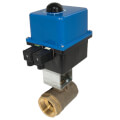
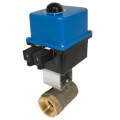
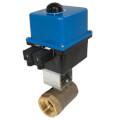
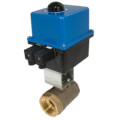

Watts Actuators & Valves are the motorized and manual flow-control components contractors use to automate zone control in hydronic heating, radiant floor, and commercial HVAC systems. The lineup spans individual valve actuators built for 24 VAC, 2.5 watt operation on radiant circuits, electrically actuated zone valves like the Series LFEMVII-6400-SS running on 115 or 24 VAC for commercial HVAC zone control, and bronze ball valves such as the Series B6400 built with standard actuator mounting pads for automation. Watts also makes linear actuators for mixing valve control, including the Flowrite II with a thrust range up to 1003 pounds. A technician zoning a radiant floor system or automating a commercial boiler loop needs an actuator and valve combination rated for the right voltage and flow, and Watts covers both ends, from a single-zone radiant circuit to a full commercial ball valve automation package.
Subcategories
- Radiant Valve Actuators: Watts valve actuators provide on/off flow control to individual radiant circuits, running on 24 VAC at 2.5 watts. Installers use them to give each radiant zone its own thermostat control without a full zone valve manifold. A visual indicator window shows whether the valve is open or closed at a glance. Matching the actuator's thread size and voltage to the manifold valve body is required before installing.
- Electric Motor Zone Valves: The Series LFEMVII-6400-SS uses an electrically actuated motor available in 115 or 24 VAC for commercial HVAC and light industrial zone control. Building automation techs use these valves to zone space heating with hot water or steam and air conditioning with chilled water on the same system. The electric motor replaces a manual handle so a controller can open and close the valve on a schedule. Sizing the valve to match system flow keeps the zone from starving downstream fixtures.
- Actuated Ball Valves: Series B6400 ball valves are 2-piece, standard port, bronze valves built for commercial and industrial use across a full range of liquids and gases. They come standard with actuator mounting pads, so a contractor can add motorized control later without swapping the valve body. Facilities running automated shutoff on process piping use this style over a standard manual ball valve. The bronze body holds up under continuous industrial duty.
- Mixing Valve Actuators: The Flowrite II Actuator is an enclosed spring and diaphragm linear actuator with direct and reverse action, built for mixing valve control with a thrust range from 543 to 1003 pounds. Technicians use it to automate temperature blending on a mixing valve instead of adjusting it manually. Direct and reverse action lets the same actuator work whether the valve needs to open or close on a rising signal. It's built into Watts' broader mixing valve control line.
Buying Guide
Start with the application. A single radiant heating zone calls for a low-voltage valve actuator rated at 24 VAC and around 2.5 watts, while a commercial HVAC zone serving hot water, steam, or chilled water calls for a motorized zone valve like the Series LFEMVII-6400-SS instead. Confirm voltage before ordering, since some Watts zone valves run on 115 VAC and others on 24 VAC, and wiring the wrong voltage into a control panel damages the actuator. When shopping Watts Actuators & Valves for an automated ball valve application, check whether the valve already has an actuator mounting pad, since the B6400 series ships ready for one and skips a retrofit bracket. Match the actuator's wire configuration to the existing control wiring; two-wire actuators run simple on/off control while four-wire versions add an end switch that reports valve position back to the controller. On mixing valve jobs, confirm the actuator's thrust rating against the valve's stem force requirement, since an undersized actuator won't fully stroke a larger mixing valve. Finally, check the actuator's fail-safe position, since a normally closed actuator shuts the circuit off during a power loss while a normally open version keeps flow going, and the wrong choice on a boiler loop or radiant zone can leave a system without heat or without freeze protection during an outage.
Frequently Asked Questions
What voltage do Watts radiant valve actuators run on?
Watts valve actuators for individual radiant circuits run on 24 VAC at about 2.5 watts. Confirming the manifold's valve body voltage before ordering an actuator prevents a mismatch at installation. Four-wire versions add an end switch for position feedback to a zone controller.
What's the difference between the LFEMVII-6400-SS zone valve and a standard ball valve?
The Series LFEMVII-6400-SS is an electrically actuated motor valve built for commercial HVAC zone control, running on 115 or 24 VAC. A standard B6400 ball valve is manually operated unless fitted with an actuator on its mounting pad. Choosing between them comes down to whether the system needs motorized zoning built in from the start or added later.
Can a manual ball valve be automated later?
Series B6400 ball valves ship with standard actuator mounting pads, so a contractor can add motorized control without replacing the valve body. That mounting pad lets a facility install manual valves during initial construction and automate specific points later as the system's control needs grow. The mounting pad eliminates the need for a separate retrofit bracket.
What does the Flowrite II Actuator control?
The Flowrite II Actuator is a linear actuator built for mixing valve control, with direct and reverse action and a thrust range from 543 to 1003 pounds. Technicians use it to automate temperature blending on a mixing valve rather than adjusting it by hand. Matching the actuator's thrust rating to the valve's stem force keeps it from stalling mid-stroke.
What happens to a Watts actuator during a power outage?
A normally closed actuator shuts its circuit off when power is lost, while a normally open actuator keeps flow going. The correct fail-safe choice depends on the system: a boiler loop that needs to stay open for freeze protection calls for a different fail-safe setting than a radiant zone that should shut down when unattended. Confirming the fail-safe position before installing avoids a system that fails in the wrong state during an outage.
