



'/%3E%3C/svg%3E)
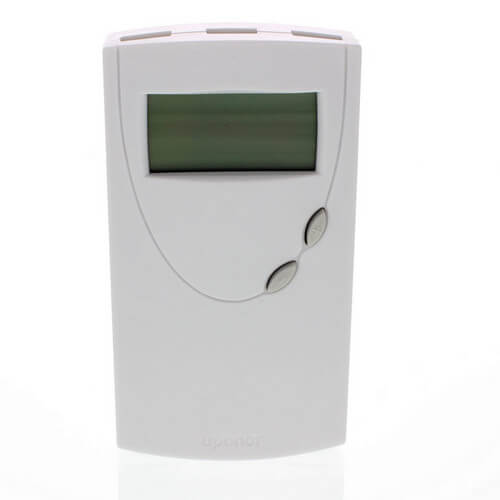
Wirsbo Radiant Thermostat (WT 1), Heat Only, Two-wire
 --%3E %3Csvg version='1.1' id='Fill' xmlns='http://www.w3.org/2000/svg' xmlns:xlink='http://www.w3.org/1999/xlink' x='0px' y='0px' viewBox='0 0 100 100' enable-background='new 0 0 100 100' xml:space='preserve'%3E %3Cpath fill='%23F15C02' d='M79.44,0.95H20.56C9.78,0.95,0.95,9.78,0.95,20.56v58.87c0,10.79,8.82,19.61,19.61,19.61h58.87 c10.79,0,19.61-8.83,19.61-19.61V20.56C99.05,9.78,90.22,0.95,79.44,0.95z M65.38,58.24l9.38,29.58L49.69,69.78L24.5,87.82 l9.34-29.6L8.8,39.6l30.73-0.17c0,0,6.98-19.61,10-28.93c0.54,1.36,9.88,29.1,9.88,29.1H91.2L65.38,58.24z'/%3E %3C/svg%3E)
' fill='%23F15C02' d='M49 0C21.938 0 0 21.938 0 49s21.938 49 49 49 49-21.938 49-49S76.062 0 49 0m0 82.709a7.54 7.54 0 1 1 0-15.08 7.54 7.54 0 0 1 0 15.08m7.54-28.412a7.541 7.541 0 0 1-15.08 0V22.831a7.54 7.54 0 0 1 15.08 0v31.466z'/%3E%3C/svg%3E)
MANUALS (2)
 --%3E %3Csvg version='1.1' id='Half' xmlns='http://www.w3.org/2000/svg' xmlns:xlink='http://www.w3.org/1999/xlink' x='0px' y='0px' viewBox='0 0 100 100' enable-background='new 0 0 100 100' xml:space='preserve'%3E %3Cg%3E %3Cpath fill='%23F15C02' d='M30.05,70.23l3.79-12.01L8.8,39.6l30.73-0.17c0,0,6.98-19.61,10-28.93c0.54,1.36,9.88,29.1,9.88,29.1h1.58 L93.71,7.18c-3.58-3.82-8.66-6.23-14.28-6.23H20.56C9.78,0.95,0.95,9.78,0.95,20.56v58.87c0,5.41,2.22,10.32,5.79,13.88 L30.05,70.23z'/%3E %3C/g%3E %3Cpath fill='%23FBC8B4' d='M93.71,7.18L60.98,39.6H91.2L65.38,58.24l9.38,29.58L49.69,69.78L24.5,87.82l5.55-17.59L6.75,93.32 c3.55,3.54,8.44,5.73,13.82,5.73h58.87c10.79,0,19.61-8.83,19.61-19.61V20.56C99.05,15.4,97.01,10.69,93.71,7.18z'/%3E %3C/svg%3E)
 --%3E %3Csvg version='1.1' id='With-RB' xmlns='http://www.w3.org/2000/svg' xmlns:xlink='http://www.w3.org/1999/xlink' x='0px' y='0px' viewBox='0 0 100 100' enable-background='new 0 0 100 100' xml:space='preserve'%3E %3Cpath fill='%23FBC8B4' d='M79.44,0.95H20.56C9.78,0.95,0.95,9.78,0.95,20.56v58.87c0,10.79,8.82,19.61,19.61,19.61h58.87 c10.79,0,19.61-8.83,19.61-19.61V20.56C99.05,9.78,90.22,0.95,79.44,0.95z M65.38,58.24l9.38,29.58L49.69,69.78L24.5,87.82 l9.34-29.6L8.8,39.6l30.73-0.17c0,0,6.98-19.61,10-28.93c0.54,1.36,9.88,29.1,9.88,29.1H91.2L65.38,58.24z'/%3E %3C/svg%3E)

Product Highlights


Description
- When it comes to radiant heating systems, not just any thermostat will do. That's why professional installers choose Wirsbo Radiant Thermostats. They are the first thermostats designed specifically for radiant floor heating.
- Why a special thermostat for radiant floor heating? The dynamics of a radiant heating system differ from typical baseboard or warm air heating systems. Radiant systems always heat objects and mass, and need to be addressed differently than conventional thermostat logic.
- The Wirsbo Thermostats offer two different control methods to handle this condition--differential and pulse-width modulation. Differential--When the measured room temperature falls 1F (0.5C) below the desired room setting, the control devices wired to the thermostat turns on.
- Pulse-width Modulation--When the condition exists where the room temperature is 1 to 3F (0.5 to 1.5 C) below the room setting, the thermostat manages the on-and-off cycle using pulse width modulation. The on-and-off times vary depending on the difference between the room and set temperatures. The farther away the room temperature is from setpoint, the longer the on time. This prevents the room temperature from rising above the set temperature. The heating system runs continually at room temperature differences greater than 3 degrees F below setpoint.
- These thermostats also feature digital filtering. This means that the thermostat measure the room temperature continuously. The thermostat's sensor detects even the smallest change, making it better able to react to a room's changing conditions. If all the room's temperatures were displayed as they are sensed, the temperatures shown would appear erratic and inconsistent. Filtering works by averaging the sensed values to ensure a smooth operation and display.
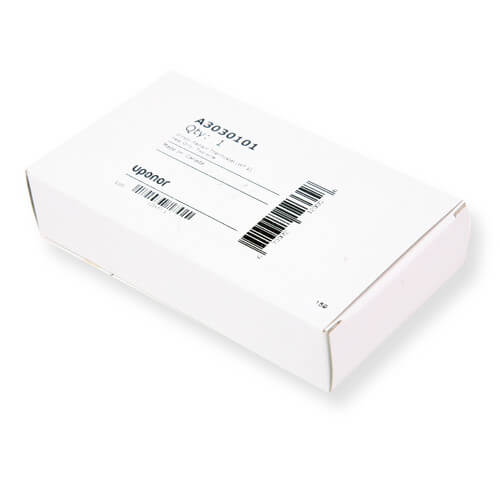
- Wirsbo offers three thermostat models: Heat Only (A3030101), Heat and Cool (A3030102) and Heat Only, Three-wire (A3030103). The Heat Only (A3030101) and Heat and Cool (A3030102) thermostats are designed to operate in heating mode over two wires. These types of thermostats obtain their power for operation from taking voltage from the connected wiring. Different from other industry power-sharing thermostats, these eliminate any need for a third wire or battery, which makes the thermostats simple to install, wire and service.
- And for those times when the two-wire thermostats aren't appropriate because of incompatibility with some third-party devices, Wirsbo also offers the Heat Only, Three-wire (A3030103).
- No matter which thermostat you use, when you're selling radiant, you're selling comfort, The Wirsbo Radiant Thermostats feature special built-in software that provides the ultimate control that standard thermostats--when used with radiant heat--simply cannot. There's no overshoot, no undershoot--just constant, even comfort. Your customers will love the distinctive design and easy-on-the-eyes readout. But most of all, they will love the true radiant comfort only Wirsbo Radiant Thermostats provide!
Specs
| Application: | Heat Only |
|---|---|
| Stages: | 1 Heat |
| Programmability: | Non-Programmable |
| User Interface: | Push Button |
| Mount: | Vertical |
| Power Method: | Hardwired |
| Voltage: | 24V Low voltage |
| Operating Voltage: | 24 VAC +/-10% |
| Wiring: | Two-Wire |
| Color: | White |
| Height: | 5" |
| Length: | 2.72" |
| Depth (Inches): | 0.91" |
| Max. Load: | 1.3A at 24 VAC |
| Display Range: | 32 to 99°F |
| Resolution: | 1° Displayed 0.25° Calculated |
Contact

Questions?
Product Reviews
Most Liked Positive Review
Very satisfied
Most Liked Negative Review
no backlight
Good thermostat but...

Good product that I needed and I bought it again yesterday.
Was the exact model we have had since 2001 in our home.
Well worth the investment
Using for Geothermal Radiant Heating
Great Product, simple install
Radiant radiant
easy to install and works just the way it is advertised
wire up and go (simple-dimple)
Works fine.... But
Product Q&A
38 QuestionsQ: Is there any way to connect these thermostats to home automation system? I would like to be able to set vacation temp on all at once. Would also like to be able to remotely control thermostats by WiFi or cell phone to return vacation setting to normal before I return home.
Asked by JP 13 years ago
Add your answer
No, each is an individual setting per room area. No added wires to allow an automation set up. Power into it and power out to open and close the valve when temp setting is met. Charles Chambers Southwest Border Region DHS\CBP\OAM Albuquerque Office Via Blackberry
Not directly they are way too complex sampling system for radiant heat. The controller they are tied to might be able to tie into home automation system. Keep in mind if your using radiant heat you can’t just run it up and down without causing thermo shock. The thermostat have a logarithmic differentiation program built in to prevent this.
I do not believe so it is a good thermostat but very simple one.
Q: I just installed this thermostat. I have a radiant floor system. I'm unclear about the Differential Mode and Pulse Width Mode. I want to be certain it's in PWM mode rather than Differential mode. It currently has the default settings. So, is it in PWM mode? How can I be certain? Thanks!
Asked by LeeGrins 13 years ago
Add your answer
The answer is both. The t-stat will be in PWM mode when the room temp is between 1-3 degrees below it's set point. This allows the t-stat to bring the temp up slowly to avoid overshooting the target. If the temp is 1 degree off, it will be in differential mode to quickly satisfy the demand. If it is more than 3 degrees off it will also be differential mode because it knows it has a long way to go to satisfy the demand. I have 6 of these in my house and they work well.
Q: I currently have 5 zones with Wirsbo T86H 3 wire radiant thermostats wired to an Advance Systems SR601 circulator switching relay controller. The system has pex tubing in lightweight concrete. The temperature mixing valve is manual – I have to set the water temp. low in fall and spring and raise it in winter. In winter, if we have a mild day, the room temp will overshoot. I see that the WT-1 is 2-wire and that the Wirsbo 3-wire A3030103 is no longer available. What options do I have to get a better thermostat?
Asked by Bob 13 years ago
Add your answer
Get an electronic mixing valve with outdoor reset. Sent from my iPad
The only way to prevent your overshoot is to install an automatic mixing valve with outdoor reset. This will adjust the water temp based on actual outdoor temp. Something like this would do the trick http://www.pexsupply.com/Taco-I075C3R-1-3-4-3-Way-Outdoor-Reset-I-Series-Mixing-Valve-w-Sensor-5203000-p
Q: We turn down our heating in the bedroom at night.Does this unit make adjustments easily. Not concerned about recovery just ability to adjust desired temperture at will.
Asked by David 14 years ago
Add your answer
This is a very simple thermostat. And works very well. You have to be careful in using it as you have to remember that you are dealing with stored heat and it takes time to cool of a room as well as heating it up. The internals of this T-stat is designed for radiant heat
Yes, this product is extremely easy to adjust AND it is (in my opinion) as accurate as any thermostat on the market. However, as you probably already know, radiant heat systems do not respond rapidly to thermostat setpoint changes; that is to say, most radiant (in-floor) heating systems provide greater homeowner satisfaction if the setpoint is set and left alone....unless you're out of the home for a long period of time, at which time you would be advised to adjust the temperature setpoint to a more economical setpoint, as long as no one will be in the building. That being said, give the system adequate time to respond to the normal setpoint after your return. I hope this helps...
Hi, sorry for the delay. These units are very responsive and I have had no problems in three years (I have four of them). The only thing I don't like about them is there in no on/off switch. We turn them all the way down in the off season (59 degrees) but if you get a 55 degree night and want to sleep with the windows open you get a heat call. I could just disconnect the 12V but our pump needs to periodically run so I just let it run. Who designs things like this and never uses them? Hope this helps. Todd
Q: I have the WT 1 wirsbo stat installed in my 1200 sq ft building with 1200 feet of 1/2" pex, 4 loops, I have a 11kw boiler, it's a closed loop system, glycol filled. I set the thermostat at 65 degrees and the boiler & pump run and shuts off when the stat is satisfied (like it should) but the temperature in the building continues to climbs to 70+ degrees. Would I be better off with a stat with a floor sensor? if so what would model should I install? something simple to use."
Asked by jkrash 14 years ago
Add your answer
Verified Reply- PexSupply StaffSlabs can continue to get hotter even after the circulator shuts down. This thermostat uses pulse-width-modulation technology to turn off the circulator earlier to prevent this from happening. Slab sensor thermostats, like Uponor's 501s, are another option.
Even if you install a floor sensor, the same problem exists: heating the floor up to a set temp. then turning off the pump, does not equal heat ceases to heat the room. The entire floor is essentially a heat source. It will continue to give off heat until the floor temp is equal to the room temp. Trying lowering the demand for heat to 62 or 65 and see if you don't find this to be a comfortable room temp. 70 is pretty hot for radiant.
Q: We installed our radiant system in Warmboard. Can a floor sensor work with such a subfloor and this Upanor Thermostat?
Asked by Steve 14 years ago
Add your answer
Verified Reply- PexSupply StaffThis thermostat is not compatible with a slab sensor, but you can use Uponor's A3041501. Its floor sensor works with Warmboard panels.
No that stat will not work with sensor. You will need a 511 or a stat that has inputs for a floor sensor. You can use a sensor on warm board if you cut a channel out for the sensor and wire and seal it back in under finished floor. Don't locate sensor directly next to any tubing or you will get false readings.
Q: I have the WT 1 wirsbo stat installed in my 1200 sq ft building with 1200 feet of 1/2" pex, 4 loops, I have a 11kw boiler. I set the thermostat at 65 degrees and the boiler runs and shuts off when the stat is satisfied (like it should) but the temperature in the building continues to climbs to 70+ degrees. Would I be better off with a stat with a floor sensor? if so what would model should I install? something simple to use.
Asked by jkrash 14 years ago
Add your answer
Floor thermos are better for vanity heat, eg. A warm bath floor. Recommend turning your boiler heat temp down. I have mine running at 130 degrees and it only over shoots by 1 degree. Radiant is slow heat but consistent.
The first things I would check are these. The easy ones. Where is the thermostat situated? How quickly does the thermostat/controller react. If you have the thermostat reading the air 5.5 ft above the floor (normal height for forced air), the temperature will continue to rise even after the boiler is stopped unless the pumps are stopped as well. Since I do not know the type of boiler you have nor how your pumps are set up, I will assume the boiler is heating to max temperature so room will continue to be heated until the thermostat hits 65, but the floors are warmer than 65 so the temperature will continue to rise especially if the pump isn't stopped. The installation should have taken into consideration the insulation type along with the building envelope and the sqft of openings in the heated area. This calc would determine the BTUs required for heating the space. It's possible you have oversized your system.
Q: We have infloor heating (3 zones and use heat only Wirsbo Thermostats. Problem: The living room thermostat was calling for heat, but was not heating. The bedroom thermostat was turned off, not calling for heat but was heating. The thermostat in living room zone would not shut off, but heat in bedroom continued without the thermostat showing it was calling for heat. We have had this Slant Fin Monitron electric boiler for 12 years and have had no problems before. We did have a Wirsbo thermostat replaced a number of years ago.
Asked by Earl the Pearl 14 years ago
Add your answer
Given the way this problem is described, it seems like one of two most likely causes: 1. The two thermostats are cross-wired, connected to the pump of the other zone. Unless there has been rewiring work since this worked properly, this seems unlikely. 2. There is an obstruction in the zone that controls the living room. For item 2, many systems have a zone pump and a primary pump. The primary would come on when there is a call for heat on any zone. The zone pump helps direct the heat to where it needs to go. If the primary pump is on but the zone pump is blocked, it's possible the water would circulate in an adjacent zone (the bedroom) even though the bedroom pump is not running. I'd suggest check the pumps and see which pumps are powered on when this problem is occurring. Also, for a pump that is powered on, check that the radiant line in and line out are both hot. If line in is hot and line out is cold yet the pump is powered on, the problem is in the pump itself.
Q: What is the range for the set point modulation. My radient floor is in concrete. From a cold start, it takes about 30 minutes for warm water to return to the hydronic boiler. With a normal thermostat, the room temperature will overshoot if circulation continues until the room temperature changes. So I'd like to heat the tubes and then delay the next pulse an hour or so to give the floor a chance to heat the room.
Asked by ChezProvence 14 years ago
Add your answer
Verified Reply- PexSupply StaffPlease find the information you request in the product manual below: http://s3.pexsupply.com/manuals/1286975873009/40450_PROD_FILE.pdf
Q: Currently I have a 1008 sq. foot single level home with radiant heat provided by a 9kw boiler mfg. by Electro Industries. One zone only. The control is currently performed through the embedded floor sensor only with a Ranco Electronic Temperature Control unit. I have to reprogram the setpoint of the control unit up or down every time the weather significantly changes in order to maintain the desired room air temperature. Is the answer to this issue as simple as changing control from the floor sensor to your Radiant WT 1 thermostat? Seems to me that using a thermostat like this that monitors and uses air temperature to control would be more accurate and efficient than me trying to estimate what floor sensor setpoint will give me the desired room temp......Or am I missing something here?? Please advise and thank you much!
Asked by tommyboy 14 years ago
Add your answer
I would think a room thermostat would give a much more consistent room temperature. I have three room thermostats one for each of three zones and am very happy with it.
It maybe that simple yes. Your comfort is closely tied to the temperature your head feels, both from radiation (structure temperature) and convection (air temperature). In cold weather, while the floor is warm, both the walls and the ceiling are likely to be significantly cooler, which will not only cool the air, but radiate cold to your head. In milder weather the warmer structure will require significantly less heat to be provided through the floor (a cooler slab) to be comfortable. Another factor is the amount of air circulation between the floor an the rest of the structure. A ceiling fan can significantly increase the transfer of heat from the floor to the rest of the structure, however an air temperature sensor is still recommended.