




Filters
SORT
Product Availability –
Review Score –
 --%3E %3Csvg version='1.1' id='Fill' xmlns='http://www.w3.org/2000/svg' xmlns:xlink='http://www.w3.org/1999/xlink' x='0px' y='0px' viewBox='0 0 100 100' enable-background='new 0 0 100 100' xml:space='preserve'%3E %3Cpath fill='%23F15C02' d='M79.44,0.95H20.56C9.78,0.95,0.95,9.78,0.95,20.56v58.87c0,10.79,8.82,19.61,19.61,19.61h58.87 c10.79,0,19.61-8.83,19.61-19.61V20.56C99.05,9.78,90.22,0.95,79.44,0.95z M65.38,58.24l9.38,29.58L49.69,69.78L24.5,87.82 l9.34-29.6L8.8,39.6l30.73-0.17c0,0,6.98-19.61,10-28.93c0.54,1.36,9.88,29.1,9.88,29.1H91.2L65.38,58.24z'/%3E %3C/svg%3E)
 --%3E %3Csvg version='1.1' id='With-RB' xmlns='http://www.w3.org/2000/svg' xmlns:xlink='http://www.w3.org/1999/xlink' x='0px' y='0px' viewBox='0 0 100 100' enable-background='new 0 0 100 100' xml:space='preserve'%3E %3Cpath fill='%23FBC8B4' d='M79.44,0.95H20.56C9.78,0.95,0.95,9.78,0.95,20.56v58.87c0,10.79,8.82,19.61,19.61,19.61h58.87 c10.79,0,19.61-8.83,19.61-19.61V20.56C99.05,9.78,90.22,0.95,79.44,0.95z M65.38,58.24l9.38,29.58L49.69,69.78L24.5,87.82 l9.34-29.6L8.8,39.6l30.73-0.17c0,0,6.98-19.61,10-28.93c0.54,1.36,9.88,29.1,9.88,29.1H91.2L65.38,58.24z'/%3E %3C/svg%3E)
Price Range –
Uponor Thermostats & Controls

 --%3E %3Csvg version='1.1' id='Half' xmlns='http://www.w3.org/2000/svg' xmlns:xlink='http://www.w3.org/1999/xlink' x='0px' y='0px' viewBox='0 0 100 100' enable-background='new 0 0 100 100' xml:space='preserve'%3E %3Cg%3E %3Cpath fill='%23F15C02' d='M30.05,70.23l3.79-12.01L8.8,39.6l30.73-0.17c0,0,6.98-19.61,10-28.93c0.54,1.36,9.88,29.1,9.88,29.1h1.58 L93.71,7.18c-3.58-3.82-8.66-6.23-14.28-6.23H20.56C9.78,0.95,0.95,9.78,0.95,20.56v58.87c0,5.41,2.22,10.32,5.79,13.88 L30.05,70.23z'/%3E %3C/g%3E %3Cpath fill='%23FBC8B4' d='M93.71,7.18L60.98,39.6H91.2L65.38,58.24l9.38,29.58L49.69,69.78L24.5,87.82l5.55-17.59L6.75,93.32 c3.55,3.54,8.44,5.73,13.82,5.73h58.87c10.79,0,19.61-8.83,19.61-19.61V20.56C99.05,15.4,97.01,10.69,93.71,7.18z'/%3E %3C/svg%3E)




 --%3E %3Csvg version='1.1' id='No-RB' xmlns='http://www.w3.org/2000/svg' xmlns:xlink='http://www.w3.org/1999/xlink' x='0px' y='0px' viewBox='0 0 100 100' enable-background='new 0 0 100 100' xml:space='preserve'%3E %3Cpath fill='%23CECECE' d='M79.44,0.95H20.56C9.78,0.95,0.95,9.78,0.95,20.56v58.87c0,10.79,8.82,19.61,19.61,19.61h58.87 c10.79,0,19.61-8.83,19.61-19.61V20.56C99.05,9.78,90.22,0.95,79.44,0.95z M65.38,58.24l9.38,29.58L49.69,69.78L24.5,87.82 l9.34-29.6L8.8,39.6l30.73-0.17c0,0,6.98-19.61,10-28.93c0.54,1.36,9.88,29.1,9.88,29.1H91.2L65.38,58.24z'/%3E %3C/svg%3E)


Uponor Thermostats & Controls are the components installers use to regulate and zone radiant heating and cooling systems built on Uponor PEX tubing and manifolds. Wireless digital thermostats in the lineup send a heating demand up to 98 feet to a wireless base unit, which lets an installer skip running low-voltage wire during a retrofit where opening walls is not practical. Heat-only touchscreen thermostats use pulse width modulation to modulate output to a radiant floor zone instead of simply switching on and off, and powered zone controllers manage several zones from a single panel. Thermal actuators mount directly on manifold valves to open and close individual loops, and slab sensors track floor temperature to keep a radiant zone from overheating. Contractors installing or servicing a radiant system need this control lineup because every zone requires its own sensing and demand signal to run efficiently across a house or building.
Subcategories
- Wireless Digital Thermostats: Wireless digital thermostats send a heating demand up to 98 feet to a wireless base unit without running new low-voltage wire between the thermostat and the manifold station. Installers working on a retrofit or an addition where opening walls is not an option reach for this option first. Placement is not tied to a wire run, so the thermostat goes wherever the homeowner wants a reading taken. Base units then relay the signal to the zone controller the same way a wired thermostat would.
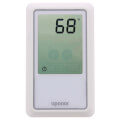
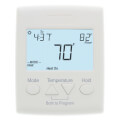
- Heat-Only Touchscreen Thermostats: Heat-only touchscreen thermostats use pulse width modulation to vary output to a radiant floor zone instead of a simple on and off cycle. A two-wire connection back to the zone controller keeps installation similar to a standard thermostat run. Installers use these on radiant floor zones where steady, modulated heat delivery matters more than a wide temperature swing. An optional floor sensor lets the thermostat read slab temperature directly instead of relying on air temperature alone.
- Powered Zone Controllers: Powered zone controllers manage multiple radiant zones from a single panel, with fuse-protected transformers and relays built in. Four-zone models are rated for 3 amps and six-zone models step up to 7 amps to handle the added actuator load. Installers size the controller to the number of zones on a project rather than adding a second panel later. A DHW priority switch on the controller lets domestic hot water demand take precedence over space heating when both call at once.
- Thermal Actuators and Zone Valves: Thermal actuators mount directly on a manifold valve to open and close an individual radiant loop as its thermostat calls for heat. Four-wire and two-wire versions match different zone controller wiring, so installers pick the actuator type based on the controller already on the job. Thermal zone valves serve the same open and close function on 3/4 inch and 1 inch sweat connections, running on 24 VAC power. An end switch built into the zone valve signals the circulator to start once the valve opens.
Buying Guide
Choosing the right Uponor Thermostats & Controls setup starts with counting zones. A single-zone radiant retrofit usually only needs one thermostat and a small zone controller, while a whole-house radiant system with several rooms on separate loops needs a controller sized to match, since a 4-zone controller rated for 3 amps will not safely run six zones of actuators.
Wired versus wireless comes down to access. A new construction job with open walls can run low-voltage wire to every thermostat location without much extra labor, so a wired heat-only touchscreen thermostat is often the simpler choice. A retrofit into finished walls favors a wireless digital thermostat instead, since it sends its heating demand up to 98 feet to a base unit and skips fishing wire through existing framing.
Actuator and zone valve selection depends on what is already on the manifold or what the zone controller expects. Four-wire and two-wire thermal actuators are not interchangeable on the same terminal block, so matching the actuator type to the controller wiring avoids a callback. Where a zone valve is the fitting of choice instead of a manifold actuator, confirm the sweat connection size, either 3/4 inch or 1 inch, matches the pipe already run to that zone.
Slab sensors add a layer of protection on any zone where floor covering is sensitive to heat, and pairing one with a heat-only touchscreen thermostat keeps a zone from overheating a finished floor.
Frequently Asked Questions
How far can a wireless Uponor thermostat communicate with its base unit?
Uponor wireless digital thermostats send a heating demand up to 98 feet to a wireless base unit under normal construction conditions. Distance can vary with the number of walls or floors between the thermostat and the base unit. Installers placing a base unit centrally in a home usually keep every wireless thermostat well within that range.
What size zone controller does a six-zone radiant job need?
Uponor powered zone controllers for six zones are rated for 7 amps to handle the added actuator load compared to a 4-zone controller rated for 3 amps. Matching controller amperage to the actual zone count keeps the transformer and relays from being overloaded. Adding zones later without upgrading the controller can push the amperage past its rating.
What is the difference between a four-wire and a two-wire thermal actuator?
Four-wire and two-wire thermal actuators both open and close an individual radiant loop on a manifold, but they wire back to the zone controller differently. Controller terminal blocks are built for one wiring type or the other, so an installer needs to match the actuator to whatever controller is already on the job. Mixing the two types on the same terminal block does not work without an adapter.
When should a thermal zone valve be used instead of a manifold actuator?
Thermal zone valves make sense where a system is piped with individual zone valves on 3/4 inch or 1 inch sweat connections rather than a central manifold with actuators on each loop. Zone valves run on 24 VAC and include an end switch that signals the circulator to start once the valve opens. Retrofitting a zone valve system onto an existing radiant layout keeps the piping design the same while still adding zone control.
Do heat-only touchscreen thermostats need a floor sensor?
Heat-only touchscreen thermostats can run on air temperature alone, but adding a floor sensor lets the thermostat read slab temperature directly for tighter control of a radiant zone. Pulse width modulation on these thermostats already smooths out temperature swings compared to a simple on and off thermostat. Pairing a floor sensor with the thermostat adds another layer of protection against overheating a finished floor.
