




Filters
SORT
Product Availability –
Brand –
Size –
Review Score –
 --%3E %3Csvg version='1.1' id='Fill' xmlns='http://www.w3.org/2000/svg' xmlns:xlink='http://www.w3.org/1999/xlink' x='0px' y='0px' viewBox='0 0 100 100' enable-background='new 0 0 100 100' xml:space='preserve'%3E %3Cpath fill='%23F15C02' d='M79.44,0.95H20.56C9.78,0.95,0.95,9.78,0.95,20.56v58.87c0,10.79,8.82,19.61,19.61,19.61h58.87 c10.79,0,19.61-8.83,19.61-19.61V20.56C99.05,9.78,90.22,0.95,79.44,0.95z M65.38,58.24l9.38,29.58L49.69,69.78L24.5,87.82 l9.34-29.6L8.8,39.6l30.73-0.17c0,0,6.98-19.61,10-28.93c0.54,1.36,9.88,29.1,9.88,29.1H91.2L65.38,58.24z'/%3E %3C/svg%3E)
 --%3E %3Csvg version='1.1' id='With-RB' xmlns='http://www.w3.org/2000/svg' xmlns:xlink='http://www.w3.org/1999/xlink' x='0px' y='0px' viewBox='0 0 100 100' enable-background='new 0 0 100 100' xml:space='preserve'%3E %3Cpath fill='%23FBC8B4' d='M79.44,0.95H20.56C9.78,0.95,0.95,9.78,0.95,20.56v58.87c0,10.79,8.82,19.61,19.61,19.61h58.87 c10.79,0,19.61-8.83,19.61-19.61V20.56C99.05,9.78,90.22,0.95,79.44,0.95z M65.38,58.24l9.38,29.58L49.69,69.78L24.5,87.82 l9.34-29.6L8.8,39.6l30.73-0.17c0,0,6.98-19.61,10-28.93c0.54,1.36,9.88,29.1,9.88,29.1H91.2L65.38,58.24z'/%3E %3C/svg%3E)
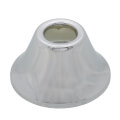
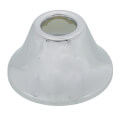
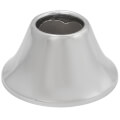
Bell Escutcheons


 --%3E %3Csvg version='1.1' id='No-RB' xmlns='http://www.w3.org/2000/svg' xmlns:xlink='http://www.w3.org/1999/xlink' x='0px' y='0px' viewBox='0 0 100 100' enable-background='new 0 0 100 100' xml:space='preserve'%3E %3Cpath fill='%23CECECE' d='M79.44,0.95H20.56C9.78,0.95,0.95,9.78,0.95,20.56v58.87c0,10.79,8.82,19.61,19.61,19.61h58.87 c10.79,0,19.61-8.83,19.61-19.61V20.56C99.05,9.78,90.22,0.95,79.44,0.95z M65.38,58.24l9.38,29.58L49.69,69.78L24.5,87.82 l9.34-29.6L8.8,39.6l30.73-0.17c0,0,6.98-19.61,10-28.93c0.54,1.36,9.88,29.1,9.88,29.1H91.2L65.38,58.24z'/%3E %3C/svg%3E)

 --%3E %3Csvg version='1.1' id='Half' xmlns='http://www.w3.org/2000/svg' xmlns:xlink='http://www.w3.org/1999/xlink' x='0px' y='0px' viewBox='0 0 100 100' enable-background='new 0 0 100 100' xml:space='preserve'%3E %3Cg%3E %3Cpath fill='%23F15C02' d='M30.05,70.23l3.79-12.01L8.8,39.6l30.73-0.17c0,0,6.98-19.61,10-28.93c0.54,1.36,9.88,29.1,9.88,29.1h1.58 L93.71,7.18c-3.58-3.82-8.66-6.23-14.28-6.23H20.56C9.78,0.95,0.95,9.78,0.95,20.56v58.87c0,5.41,2.22,10.32,5.79,13.88 L30.05,70.23z'/%3E %3C/g%3E %3Cpath fill='%23FBC8B4' d='M93.71,7.18L60.98,39.6H91.2L65.38,58.24l9.38,29.58L49.69,69.78L24.5,87.82l5.55-17.59L6.75,93.32 c3.55,3.54,8.44,5.73,13.82,5.73h58.87c10.79,0,19.61-8.83,19.61-19.61V20.56C99.05,15.4,97.01,10.69,93.71,7.18z'/%3E %3C/svg%3E)


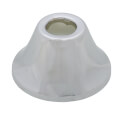
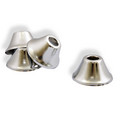
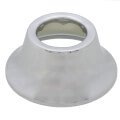
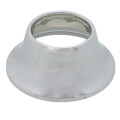
Bell escutcheons are decorative cover plates shaped with a flared, bell-like profile that conceals the hole where a pipe or valve stem passes through a wall, floor, or ceiling. Plumbers and heating technicians install them anywhere a supply line, radiator riser, or shutoff valve penetrates a finished surface, since patching drywall or tile around every pipe penetration isn't practical on a service call. Most bell escutcheons are stamped from chrome-plated steel or solid brass and slide over the pipe before the fitting or valve is installed, then hold in place with a friction fit or a set screw against the pipe. The bell shape distinguishes this style from flat box escutcheons and split, hinged designs, and it's a common choice where a slightly larger cover is needed to hide an oversized hole or a rough cut. Because the style is defined by shape rather than tied to one manufacturer, bell escutcheons are available in a range of finishes and pipe-diameter sizes to match nearly any exposed pipe in a residential or light commercial job.
Subcategories
- Chrome-Plated Steel Escutcheons: Chrome-plated steel is the most common bell escutcheon material, offering a bright, low-cost finish that matches most residential plumbing fixtures. Steel construction holds up well to the light handling these covers see once installed, since they aren't load-bearing or exposed to constant moisture contact. Sizing runs from small diameters for supply stops up to larger sizes for radiator risers and waste lines. Matching the finish to nearby fixtures, rather than just the pipe size, keeps a finished installation looking consistent.
- Solid Brass Escutcheons: Solid brass escutcheons cost more than chrome-plated steel but resist corrosion better in damp locations like below-grade mechanical rooms or near steam radiators. Brass also takes a polished or antique finish that some renovation jobs call for to match existing fixtures. The added weight compared to stamped steel makes brass escutcheons less prone to rattling on vibration-prone piping near a circulator pump. Choosing brass over steel is mostly a finish and durability decision rather than a fit difference, since both come in the same size ranges.
- Split & Hinged Escutcheons: Split or hinged escutcheons open on a hinge or snap-fit seam, allowing installation around a pipe that's already fixed in place without needing to slide the cover on from a pipe end. Retrofit and repair jobs favor this style since the original pipe run doesn't need to be disassembled to add or replace a cover plate. The trade-off is a visible seam line compared to a solid one-piece bell escutcheon. Split designs are available in the same chrome-plated steel and brass options as solid bell escutcheons.
- Escutcheon Sets & Multi-Packs: Multi-packs bundle several escutcheons of the same size and finish, which suits jobs with multiple identical pipe penetrations, like a bank of supply stops under a row of fixtures. Buying a set instead of individual pieces reduces the per-unit cost and keeps a consistent finish across the job. Common pack sizes cover the most frequently replaced diameters, matching standard supply line and riser sizes. Keeping a multi-pack stocked on the truck avoids a supply house trip for a job that turns up more penetrations than expected.
Buying Guide
Choosing a bell escutcheon starts with measuring the pipe's outside diameter accurately, since these covers are sized tightly to the pipe and a mismatched diameter either won't slide on or leaves a gap that defeats the purpose of covering the hole. Finish selection should match the surrounding fixtures or trim rather than the pipe material itself. Chrome-plated steel covers most residential jobs at a lower cost, while solid brass holds up better in damp mechanical rooms or near steam piping where corrosion resistance matters more than initial cost. For pipe that's already fixed in place, such as an existing riser being retrofitted with a cover, a split or hinged escutcheon avoids having to cut or disassemble the pipe run, while a solid one-piece bell escutcheon gives a cleaner look on new installations where the cover slides on before the fitting is attached. Jobs with several identical pipe penetrations, like a row of supply stops under multiple fixtures, are usually more economical to source as a multi-pack rather than as individual pieces. Confirming whether the wall or floor opening is oversized also matters: a larger bell-shaped cover hides a rough or enlarged hole better than a flat box style, which is one of the main reasons contractors reach for this shape over other escutcheon designs. Keeping a small assortment of sizes and finishes on hand covers most service calls without a special order.
Frequently Asked Questions
How do I measure a pipe for the correct escutcheon size?
Measure the pipe's outside diameter where it passes through the wall, floor, or ceiling, not the nominal pipe size, since actual outside diameter varies by pipe type and can throw off the fit. Most escutcheons list the outside diameter range they fit on the packaging.
What's the difference between a bell escutcheon and a box escutcheon?
A bell escutcheon has a flared, rounded profile, while a box escutcheon has flat, square edges. The bell shape covers a slightly larger or rougher hole more effectively, while box styles give a more minimal, flush look on a clean installation.
Can an escutcheon be installed after the pipe fitting is already in place?
A solid one-piece bell escutcheon needs to slide onto the pipe before the fitting or valve is attached, so it has to go on early in the installation. A split or hinged escutcheon can be added at any point since it opens around the pipe without needing to slide over an end.
Do bell escutcheons work on both copper and steel pipe?
Yes, sizing is based on the pipe's outside diameter rather than the material, so the same escutcheon size fits copper, steel, or PEX with a matching outer diameter as long as the fit is confirmed against the actual pipe measurement.
Why choose brass over chrome-plated steel for an escutcheon?
Brass resists corrosion better in damp or high-moisture locations, such as basements or near steam radiators, and holds up longer where a chrome-plated finish might eventually pit or flake. For a typical dry interior installation, chrome-plated steel performs just as well at a lower cost.
