




Filters
SORT
Product Availability –
Brand –
Review Score –
 --%3E %3Csvg version='1.1' id='Fill' xmlns='http://www.w3.org/2000/svg' xmlns:xlink='http://www.w3.org/1999/xlink' x='0px' y='0px' viewBox='0 0 100 100' enable-background='new 0 0 100 100' xml:space='preserve'%3E %3Cpath fill='%23F15C02' d='M79.44,0.95H20.56C9.78,0.95,0.95,9.78,0.95,20.56v58.87c0,10.79,8.82,19.61,19.61,19.61h58.87 c10.79,0,19.61-8.83,19.61-19.61V20.56C99.05,9.78,90.22,0.95,79.44,0.95z M65.38,58.24l9.38,29.58L49.69,69.78L24.5,87.82 l9.34-29.6L8.8,39.6l30.73-0.17c0,0,6.98-19.61,10-28.93c0.54,1.36,9.88,29.1,9.88,29.1H91.2L65.38,58.24z'/%3E %3C/svg%3E)
 --%3E %3Csvg version='1.1' id='With-RB' xmlns='http://www.w3.org/2000/svg' xmlns:xlink='http://www.w3.org/1999/xlink' x='0px' y='0px' viewBox='0 0 100 100' enable-background='new 0 0 100 100' xml:space='preserve'%3E %3Cpath fill='%23FBC8B4' d='M79.44,0.95H20.56C9.78,0.95,0.95,9.78,0.95,20.56v58.87c0,10.79,8.82,19.61,19.61,19.61h58.87 c10.79,0,19.61-8.83,19.61-19.61V20.56C99.05,9.78,90.22,0.95,79.44,0.95z M65.38,58.24l9.38,29.58L49.69,69.78L24.5,87.82 l9.34-29.6L8.8,39.6l30.73-0.17c0,0,6.98-19.61,10-28.93c0.54,1.36,9.88,29.1,9.88,29.1H91.2L65.38,58.24z'/%3E %3C/svg%3E)
Price Range –
Mixing Valves


 --%3E %3Csvg version='1.1' id='Half' xmlns='http://www.w3.org/2000/svg' xmlns:xlink='http://www.w3.org/1999/xlink' x='0px' y='0px' viewBox='0 0 100 100' enable-background='new 0 0 100 100' xml:space='preserve'%3E %3Cg%3E %3Cpath fill='%23F15C02' d='M30.05,70.23l3.79-12.01L8.8,39.6l30.73-0.17c0,0,6.98-19.61,10-28.93c0.54,1.36,9.88,29.1,9.88,29.1h1.58 L93.71,7.18c-3.58-3.82-8.66-6.23-14.28-6.23H20.56C9.78,0.95,0.95,9.78,0.95,20.56v58.87c0,5.41,2.22,10.32,5.79,13.88 L30.05,70.23z'/%3E %3C/g%3E %3Cpath fill='%23FBC8B4' d='M93.71,7.18L60.98,39.6H91.2L65.38,58.24l9.38,29.58L49.69,69.78L24.5,87.82l5.55-17.59L6.75,93.32 c3.55,3.54,8.44,5.73,13.82,5.73h58.87c10.79,0,19.61-8.83,19.61-19.61V20.56C99.05,15.4,97.01,10.69,93.71,7.18z'/%3E %3C/svg%3E)




 --%3E %3Csvg version='1.1' id='No-RB' xmlns='http://www.w3.org/2000/svg' xmlns:xlink='http://www.w3.org/1999/xlink' x='0px' y='0px' viewBox='0 0 100 100' enable-background='new 0 0 100 100' xml:space='preserve'%3E %3Cpath fill='%23CECECE' d='M79.44,0.95H20.56C9.78,0.95,0.95,9.78,0.95,20.56v58.87c0,10.79,8.82,19.61,19.61,19.61h58.87 c10.79,0,19.61-8.83,19.61-19.61V20.56C99.05,9.78,90.22,0.95,79.44,0.95z M65.38,58.24l9.38,29.58L49.69,69.78L24.5,87.82 l9.34-29.6L8.8,39.6l30.73-0.17c0,0,6.98-19.61,10-28.93c0.54,1.36,9.88,29.1,9.88,29.1H91.2L65.38,58.24z'/%3E %3C/svg%3E)




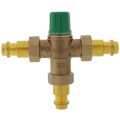
Mixing Valves blend hot and cold water, or hot boiler supply and cooler system return water, to deliver a controlled outlet temperature instead of sending full tank or boiler temperature straight to a fixture or heating loop. Thermostatic mixing valves used on domestic hot water systems automatically adjust the blend as inlet temperatures fluctuate, holding outlet temperature within a tight range to protect users from scald injury at showers and lavatories. On the hydronic side, mixing valves temper high boiler supply temperatures down to a lower loop temperature suited to radiant floor heating or low-temperature baseboard, letting one boiler serve zones with different design temperatures. Most valves carry a factory temperature range and a maximum inlet pressure rating, so matching those ratings to a system's actual supply conditions keeps the valve operating inside its design window instead of hunting or failing to hold setpoint.
Subcategories
- Domestic Thermostatic Mixing Valves: Blend hot water heater output with cold water to deliver a set, safe temperature at showers, tubs, and lavatories. Automatically adjust the mix as supply temperatures shift, holding outlet temperature within a narrow range. Common in both single-fixture point-of-use setups and whole-house installations.
- Hydronic and Radiant Mixing Valves: Temper high boiler supply temperature down to a lower loop temperature for radiant floor heating or low-temperature baseboard zones. Let a single boiler serve multiple zones running at different design temperatures. Sized to the loop's flow rate and target temperature range.
- Manual Mixing Valves: Set a fixed blend ratio by hand rather than adjusting automatically to changing inlet conditions. Suited to applications where supply temperatures stay fairly consistent and automatic modulation isn't required. Lower cost than a thermostatic valve for simple blending needs.
- Mixing Valve Repair Kits: Include replacement cartridges, seals, and internal components for servicing an existing mixing valve rather than replacing the entire body. Extends the service life of a valve with a worn seat or leaking seal. Matched to specific valve models and sizes.
Buying Guide
Choosing between a thermostatic and manual mixing valve comes down to how much the supply temperature varies and how much protection against scalding or overheating a system needs. Mixing Valves used on domestic hot water systems generally call for a thermostatic model, since water heater output temperature can shift with recovery cycles and a manual valve won't compensate for that swing at the fixture. On a hydronic loop feeding radiant floor heating, a fixed or adjustable mixing valve tempers boiler supply water down to a target loop temperature, and undersizing the valve for the loop's flow rate can prevent it from holding setpoint under full system demand. Temperature range and maximum inlet pressure are the two ratings worth checking most closely before ordering, since a valve rated for residential pressure and temperature won't hold up reliably on a commercial system running higher supply pressure or temperature. Port size and connection type need to match the existing piping, and thermostatic valves in particular often specify a minimum flow rate to function correctly, so undersized piping upstream can prevent the valve from responding properly even if the valve itself is sized correctly. For systems already in service, a repair kit sized to the specific valve model can restore performance on a unit with a worn cartridge or seat without replacing the entire valve body, which is often the more practical fix when the surrounding piping would otherwise need to be reworked.
Frequently Asked Questions
When is a thermostatic mixing valve needed instead of a manual one?
A thermostatic valve is the better fit any time supply temperature fluctuates, such as domestic hot water systems where recovery cycles shift output temperature, since it adjusts the blend automatically rather than holding a fixed ratio.
Can one mixing valve serve multiple heating zones with different temperatures?
A single hydronic mixing valve can temper boiler supply down to a lower loop temperature for one zone, but systems with multiple zones at different design temperatures typically need a separate mixing valve per zone.
What happens if a mixing valve is undersized for the system's flow rate?
An undersized valve can struggle to hold setpoint under full demand, causing outlet temperature to swing more than expected during peak flow periods.
Can a mixing valve be repaired instead of replaced?
A repair kit matched to the specific valve model can replace a worn cartridge or seal, restoring performance without reworking the surrounding piping needed to swap the entire valve body.
What ratings matter most when selecting a replacement mixing valve?
Temperature range and maximum inlet pressure matter most, since a valve rated for residential conditions may not hold up reliably on a commercial system running higher supply pressure or temperature.
