

CONTACT & SUPPORT
Live Chat: Online Now


0
CART

Radiant Floor Heating Supplies
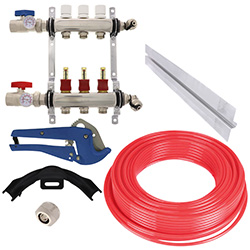
A fantastic alternative to traditional heating methods, radiant systems produce heat evenly from the floor up. With no visible or noisy components, the result is quiet comfort at a fraction of the cost. Whether you're interested in simple electric or popular hydronic systems, we've got you covered with options that suit any installation method, from cement foundation pours to above-the-subfloor solutions like Quik Trak. Choose from leading brands like Uponor or Bluefin and get a 25-year warranty you and your customers can count on.







Resources
FAQs, Manuals & Videos

Videos
Other Resources

Articles
More About Radiant Heat
There are two main types of radiant heat systems, electric and hydronic. Electric radiant heat uses electric cables or mats to heat a space. Hydronic radiant heat uses hot water passing through PEX tubing to heat a space. The majority of radiant installs are hydronic. When installing a hydronic radiant heat system most of the time you'll want to use an oxygen barrier PEX tubing to prevent rusting of the cast iron components in your heating system.
Radiant Heat may be installed several different ways. The tubing can be installed in a cement foundation pour, in an overpour, in between the floor joists with or without plates, and it can be installed above the subfloor in a product like Quik Trak. Depending upon the space where the tubing is being installed, a different method may be selected.
Use our Quick Trak Calculator when choosing panel layouts.
There are several advantages of radiant heat as compared to traditional heating systems. Radiant Heat is the most comfortable and efficient form of heating available. Radiant heat has no visible components unlike radiators, baseboard, or hot air systems. Finally, radiant heat produces no noise unlike radiators, baseboard, or hot air systems. Once you experience the comfort of radiant heat you'll want it in your house. As always we are here to support you and ensure that your job is a successful one.
Radiant Heat may be installed several different ways. The tubing can be installed in a cement foundation pour, in an overpour, in between the floor joists with or without plates, and it can be installed above the subfloor in a product like Quik Trak. Depending upon the space where the tubing is being installed, a different method may be selected.
Use our Quick Trak Calculator when choosing panel layouts.
There are several advantages of radiant heat as compared to traditional heating systems. Radiant Heat is the most comfortable and efficient form of heating available. Radiant heat has no visible components unlike radiators, baseboard, or hot air systems. Finally, radiant heat produces no noise unlike radiators, baseboard, or hot air systems. Once you experience the comfort of radiant heat you'll want it in your house. As always we are here to support you and ensure that your job is a successful one.
Resources
Videos

 --%3E %3C!DOCTYPE svg PUBLIC '-//W3C//DTD SVG 1.1//EN' 'http://www.w3.org/Graphics/SVG/1.1/DTD/svg11.dtd'%3E %3Csvg version='1.1' id='Layer_1' xmlns='http://www.w3.org/2000/svg' xmlns:xlink='http://www.w3.org/1999/xlink' x='0px' y='0px' width='90px' height='90px' viewBox='0 0 90 90' enable-background='new 0 0 90 90' xml:space='preserve'%3E %3Crect x='27' y='23' fill='%23FFFFFF' width='43' height='44'/%3E %3Cg%3E %3Cdefs%3E %3Crect id='SVGID_1_' width='90' height='90'/%3E %3C/defs%3E %3CclipPath id='SVGID_2_'%3E %3Cuse xlink:href='%23SVGID_1_' overflow='visible'/%3E %3C/clipPath%3E %3Cpath clip-path='url(%23SVGID_2_)' fill='%234186AD' d='M45,0C20.1,0,0,20.1,0,45c0,24.9,20.1,45,45,45c24.9,0,45-20.1,45-45 C90,20.1,69.9,0,45,0'/%3E %3C/g%3E %3Cpath fill='%23FFFFFF' d='M60.6,47.4l-22.5,14c-0.5,0.3-1,0.399-1.5,0.399s-0.9-0.1-1.4-0.399c-0.9-0.5-1.4-1.4-1.4-2.5v-28 c0-1,0.6-2,1.4-2.5c0.9-0.5,2-0.5,2.9,0.1l22.5,14.1C61.4,43.1,61.9,44,61.9,45S61.4,46.9,60.6,47.4'/%3E %3C/svg%3E)
Radiant Heating Systems
Other Resources
More About Radiant Heat
There are two main types of radiant heat systems, electric and hydronic. Electric radiant heat uses electric cables or mats to heat a space. Hydronic radiant heat uses hot water passing through PEX tubing to heat a space. The majority of radiant installs are hydronic. When installing a hydronic radiant heat system most of the time you'll want to use an oxygen barrier PEX tubing to prevent rusting of the cast iron components in your heating system.
Radiant Heat may be installed several different ways. The tubing can be installed in a cement foundation pour, in an overpour, in between the floor joists with or without plates, and it can be installed above the subfloor in a product like Quik Trak. Depending upon the space where the tubing is being installed, a different method may be selected.
Use our Quick Trak Calculator when choosing panel layouts.
There are several advantages of radiant heat as compared to traditional heating systems. Radiant Heat is the most comfortable and efficient form of heating available. Radiant heat has no visible components unlike radiators, baseboard, or hot air systems. Finally, radiant heat produces no noise unlike radiators, baseboard, or hot air systems. Once you experience the comfort of radiant heat you'll want it in your house. As always we are here to support you and ensure that your job is a successful one.
Radiant Heat may be installed several different ways. The tubing can be installed in a cement foundation pour, in an overpour, in between the floor joists with or without plates, and it can be installed above the subfloor in a product like Quik Trak. Depending upon the space where the tubing is being installed, a different method may be selected.
Use our Quick Trak Calculator when choosing panel layouts.
There are several advantages of radiant heat as compared to traditional heating systems. Radiant Heat is the most comfortable and efficient form of heating available. Radiant heat has no visible components unlike radiators, baseboard, or hot air systems. Finally, radiant heat produces no noise unlike radiators, baseboard, or hot air systems. Once you experience the comfort of radiant heat you'll want it in your house. As always we are here to support you and ensure that your job is a successful one.