



'/%3E%3C/svg%3E)
 --%3E %3Csvg version='1.1' id='Fill' xmlns='http://www.w3.org/2000/svg' xmlns:xlink='http://www.w3.org/1999/xlink' x='0px' y='0px' viewBox='0 0 100 100' enable-background='new 0 0 100 100' xml:space='preserve'%3E %3Cpath fill='%23F15C02' d='M79.44,0.95H20.56C9.78,0.95,0.95,9.78,0.95,20.56v58.87c0,10.79,8.82,19.61,19.61,19.61h58.87 c10.79,0,19.61-8.83,19.61-19.61V20.56C99.05,9.78,90.22,0.95,79.44,0.95z M65.38,58.24l9.38,29.58L49.69,69.78L24.5,87.82 l9.34-29.6L8.8,39.6l30.73-0.17c0,0,6.98-19.61,10-28.93c0.54,1.36,9.88,29.1,9.88,29.1H91.2L65.38,58.24z'/%3E %3C/svg%3E)
 --%3E %3Csvg version='1.1' id='Half' xmlns='http://www.w3.org/2000/svg' xmlns:xlink='http://www.w3.org/1999/xlink' x='0px' y='0px' viewBox='0 0 100 100' enable-background='new 0 0 100 100' xml:space='preserve'%3E %3Cg%3E %3Cpath fill='%23F15C02' d='M30.05,70.23l3.79-12.01L8.8,39.6l30.73-0.17c0,0,6.98-19.61,10-28.93c0.54,1.36,9.88,29.1,9.88,29.1h1.58 L93.71,7.18c-3.58-3.82-8.66-6.23-14.28-6.23H20.56C9.78,0.95,0.95,9.78,0.95,20.56v58.87c0,5.41,2.22,10.32,5.79,13.88 L30.05,70.23z'/%3E %3C/g%3E %3Cpath fill='%23FBC8B4' d='M93.71,7.18L60.98,39.6H91.2L65.38,58.24l9.38,29.58L49.69,69.78L24.5,87.82l5.55-17.59L6.75,93.32 c3.55,3.54,8.44,5.73,13.82,5.73h58.87c10.79,0,19.61-8.83,19.61-19.61V20.56C99.05,15.4,97.01,10.69,93.71,7.18z'/%3E %3C/svg%3E)


MANUALS (1)
Product Highlights


Description
Features
- No clog vent.
- Dirt and Debris resistant.
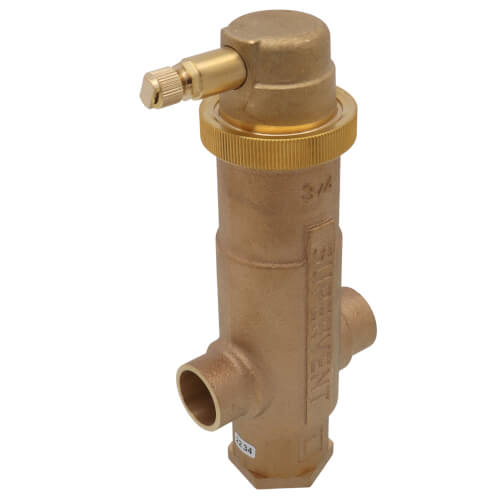
- 360 degree adjustable collar ring for installation flexibility.
- Stainless steel concentrator which eliminates gurgling noise.
- Bronze body for rigid construction.
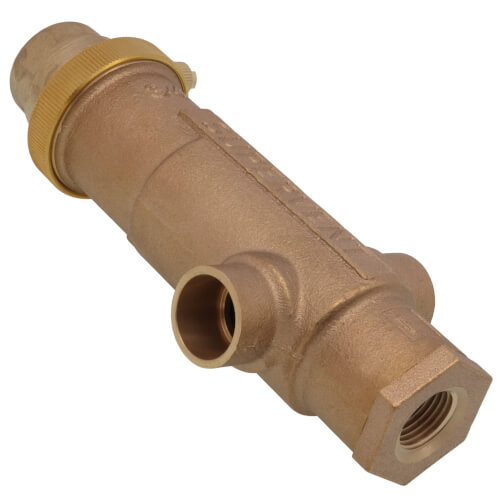
- Threaded connections.
Specifications
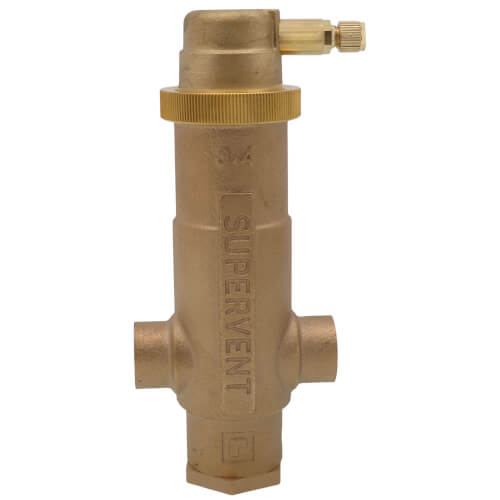
- Description: 3/4 in. Sweat SuperVent with 13 Cv capacity
- Application: Residential or Commercial closed loop hydronic heating or chilled water systems
- Connection Type: Sweat
- Connection Size: 3/4 in. bottom inlet
- Pipe Size: 3/4 in.
- Maximum Safe Operating Pressure (psi): 125 psi
- Maximum Operating Temperature (F): 240 F
- Dimensions: 6-29/32 in. high x 2-11/16 in. wide
- Maximum Diameter: 1-13/16 in.
- Materials: Bronze
Specs
| Application: | Heating |
|---|---|
| Size: | 3/4" |
| Connection Type: | C x C |
| Connection Method: | Sweat |
| Max Pressure (PSI): | 125 |
| Material: | Bronze |
| Max Temp (F): | 240°F |
| Capacity: | 13 Cv |
| Dimensions: | 6-29/32" H x 2-11/16" W |
| Diameter: | 1-13/16" Max |
| Product Type: | Air Eliminator |


Questions?
Compare Similar Products
You May Also Need
Product Reviews
Most Liked Positive Review
Solved 30 year issue
Most Liked Negative Review
 --%3E %3Csvg version='1.1' id='With-RB' xmlns='http://www.w3.org/2000/svg' xmlns:xlink='http://www.w3.org/1999/xlink' x='0px' y='0px' viewBox='0 0 100 100' enable-background='new 0 0 100 100' xml:space='preserve'%3E %3Cpath fill='%23FBC8B4' d='M79.44,0.95H20.56C9.78,0.95,0.95,9.78,0.95,20.56v58.87c0,10.79,8.82,19.61,19.61,19.61h58.87 c10.79,0,19.61-8.83,19.61-19.61V20.56C99.05,9.78,90.22,0.95,79.44,0.95z M65.38,58.24l9.38,29.58L49.69,69.78L24.5,87.82 l9.34-29.6L8.8,39.6l30.73-0.17c0,0,6.98-19.61,10-28.93c0.54,1.36,9.88,29.1,9.88,29.1H91.2L65.38,58.24z'/%3E %3C/svg%3E)
I would not even think to buy this again
I would not even think to buy this again
I would buy it again.
Awesome product.
Best air vent I have used
I would buy this product again
Will buy again
Great air vent.
AS I expected no problems
Solved 30 year issue
This is my favorite boiler, primary air eliminator.
Product Q&A
6 QuestionsQ: can this product be installed on the return side as there is very limited space on the supply side?
Asked by no room 11 years ago
Add your answer
yes, but it makes the most sense on the supply side to eliminate air before the water makes the run through your home's baseboards/rads where it will make noise
Q: Can you remove the bottom fitting and install a pipe to use it as an Elbow fitting and plug the inlet side?
Asked by vinnied 11 years ago
Add your answer
Verified Reply- Supplyhouse Staffno you can't
Q: Is a Supervent Air Eliminator necessary for systems with closed type expansion tanks? Is there any downsize to having an air eliminator with such a tank?
Asked by Paintguy 14 years ago
Add your answer
Verified Reply- PexSupply StaffYou should use an air eliminator in all closed-systems, even those with diaphragm-style expansion tanks. There would be no downside, but keep in mind that you have several different options for air eliminators.
You need an air eliminator to remove the oxygen, which is entrained in water, from the circulating water in the system. All cast iron part (flanges, pumps, heat exchangers, etc.) will be destroyed in an O2 environment (rust). Also, the hotter the water temp.- the better the air eliminator works. So it should be mounted on the hot supply side of the boiler.
Q: Do you need to install an expansion below the air eliminator as I have a conventional expansion tank in the system? and if so why?
Asked by 14 years ago
Add your answer
Verified Reply- PexSupply StaffThe air eliminator does not have to go directly on top of the expansion tank, but it is usually a good idea to install them close together at the "point of no pressure change."
The expansion tank is the "point of no pressure change". It should be connected to the system 12 pipe diameters minimum away from the inlet of the pump. The air eliminator should be on the hottest water(boiler supply side) to work most effectively.
Q: Can i attach the expansion tank to the supervent air eliminator? or the air scoop. I have both.
Asked by tom 15 years ago
Add your answer
Verified Reply- PexSupply StaffYou can connect the expansion tank to either one.
Q: Just want to verify, on the 'Sweat' version the bottom inlet is still threaded, correct?
Asked by DIY Scot 16 years ago
Add your answer
Verified Reply- PexSupply StaffYes, the bottom is still threaded. You can find more information in this Installation Manual: http://s3.pexsupply.com/manuals/1286886684637/40410_PROD_FILE.pdf