



Filters
SORT
Product Availability –
Size –
Material –
Review Score –
 --%3E %3Csvg version='1.1' id='Fill' xmlns='http://www.w3.org/2000/svg' xmlns:xlink='http://www.w3.org/1999/xlink' x='0px' y='0px' viewBox='0 0 100 100' enable-background='new 0 0 100 100' xml:space='preserve'%3E %3Cpath fill='%23F15C02' d='M79.44,0.95H20.56C9.78,0.95,0.95,9.78,0.95,20.56v58.87c0,10.79,8.82,19.61,19.61,19.61h58.87 c10.79,0,19.61-8.83,19.61-19.61V20.56C99.05,9.78,90.22,0.95,79.44,0.95z M65.38,58.24l9.38,29.58L49.69,69.78L24.5,87.82 l9.34-29.6L8.8,39.6l30.73-0.17c0,0,6.98-19.61,10-28.93c0.54,1.36,9.88,29.1,9.88,29.1H91.2L65.38,58.24z'/%3E %3C/svg%3E)
 --%3E %3Csvg version='1.1' id='With-RB' xmlns='http://www.w3.org/2000/svg' xmlns:xlink='http://www.w3.org/1999/xlink' x='0px' y='0px' viewBox='0 0 100 100' enable-background='new 0 0 100 100' xml:space='preserve'%3E %3Cpath fill='%23FBC8B4' d='M79.44,0.95H20.56C9.78,0.95,0.95,9.78,0.95,20.56v58.87c0,10.79,8.82,19.61,19.61,19.61h58.87 c10.79,0,19.61-8.83,19.61-19.61V20.56C99.05,9.78,90.22,0.95,79.44,0.95z M65.38,58.24l9.38,29.58L49.69,69.78L24.5,87.82 l9.34-29.6L8.8,39.6l30.73-0.17c0,0,6.98-19.61,10-28.93c0.54,1.36,9.88,29.1,9.88,29.1H91.2L65.38,58.24z'/%3E %3C/svg%3E)
Price Range –
Rigid/IMC Type-T Conduit Bodies


 --%3E %3Csvg version='1.1' id='No-RB' xmlns='http://www.w3.org/2000/svg' xmlns:xlink='http://www.w3.org/1999/xlink' x='0px' y='0px' viewBox='0 0 100 100' enable-background='new 0 0 100 100' xml:space='preserve'%3E %3Cpath fill='%23CECECE' d='M79.44,0.95H20.56C9.78,0.95,0.95,9.78,0.95,20.56v58.87c0,10.79,8.82,19.61,19.61,19.61h58.87 c10.79,0,19.61-8.83,19.61-19.61V20.56C99.05,9.78,90.22,0.95,79.44,0.95z M65.38,58.24l9.38,29.58L49.69,69.78L24.5,87.82 l9.34-29.6L8.8,39.6l30.73-0.17c0,0,6.98-19.61,10-28.93c0.54,1.36,9.88,29.1,9.88,29.1H91.2L65.38,58.24z'/%3E %3C/svg%3E)

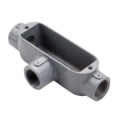


Rigid/IMC Type-T Conduit Bodies are threaded fittings that create a three-way access point in a rigid metal or intermediate metal conduit run, letting electricians pull wire, splice conductors, or inspect a junction without opening the conduit at another point. The T-shaped body has three NPT tapered hubs arranged so one straight run and one perpendicular branch share a single access opening under a removable cover. Common construction is aluminum, though malleable iron and stainless steel versions are available for corrosive or higher-strength applications. These fittings carry UL and cUL listings and are suitable for wet locations and direct burial in concrete, making them a common choice on both commercial and industrial conduit runs. Because the removable cover provides direct access to the conductors inside, electricians rely on Type-T bodies at points where a straight coupling wouldn't allow room for splicing or where a conduit run needs to branch off in a third direction.
Subcategories
- Aluminum Type-T Conduit Bodies: The most common material option, aluminum Type-T bodies balance corrosion resistance with lighter weight compared to iron or steel versions. Electricians use them on standard commercial and light industrial conduit runs where weight and cost matter. These bodies carry UL and cUL listings and are rated for wet locations. NPT tapered hubs allow a secure threaded connection to rigid or IMC conduit.
- Malleable Iron Type-T Conduit Bodies: Iron construction offers added mechanical strength for conduit runs exposed to physical impact or heavier mechanical loads. Electricians use malleable iron bodies on industrial sites where equipment traffic or rough handling is a concern. These bodies thread onto rigid conduit the same way as aluminum versions. The added weight is a tradeoff for the extra durability.
- Stainless Steel Type-T Conduit Bodies: Built for corrosive environments like wastewater treatment plants or coastal installations, stainless steel Type-T bodies resist rust and chemical degradation better than aluminum or iron. Electricians specify this material on jobs where the conduit run is exposed to washdown chemicals or salt air. The three-hub configuration and cover access work the same as other material options. This is typically the highest-cost option among the three.
- Conduit Bodies with Cover and Gasket: These come pre-packaged with a matching cover and gasket, giving a sealed enclosure suitable for wet or outdoor locations right out of the box. Electricians use this configuration when a separate cover and gasket order would slow down the job. The gasket maintains the wet-location rating of the assembly. This bundled option saves a step compared to sourcing the body and cover separately.
Buying Guide
Start with the conduit size already run on the job, since Type-T conduit bodies are sized to match standard rigid and IMC trade sizes and need to thread directly onto the existing conduit without an adapter. Material choice comes next: aluminum covers most general commercial applications, malleable iron adds strength for sites with heavy equipment traffic, and stainless steel is worth the added cost in corrosive or washdown environments like food processing or wastewater facilities. Confirm whether the body needs to be rated for a wet location or direct burial in concrete, since not every conduit body carries that rating and using an indoor-only fitting outdoors risks moisture getting into the conductors. If the fitting will sit in an exposed or damp location, ordering a body that already includes a matching cover and gasket saves a separate purchase and guarantees the gasket is sized correctly for that body. Check UL and cUL listing before buying for any job that requires inspection sign-off, since this listing confirms the fitting meets recognized safety standards for the application. Because a Type-T body creates a branch point in the conduit run, plan the hub orientation before ordering so the straight-through hubs and the branch hub line up with the direction the conduit actually needs to run and branch on site.
Frequently Asked Questions
What is a Type-T conduit body used for?
A Type-T conduit body provides a three-way access point in a rigid or IMC conduit run, letting an electrician pull wire, splice conductors, or branch the conduit in a perpendicular direction. The removable cover gives direct access to the conductors inside. It's used anywhere a straight coupling wouldn't allow enough room for splicing or a third conduit direction is needed.
What materials are Rigid/IMC Type-T Conduit Bodies available in?
Common material options include aluminum, malleable iron, and stainless steel. Aluminum suits general commercial use, malleable iron adds mechanical strength for industrial sites, and stainless steel resists corrosion in washdown or coastal environments. All three use the same NPT tapered hub configuration for threading onto conduit.
Are these conduit bodies rated for outdoor or wet locations?
Many Rigid/IMC Type-T Conduit Bodies are rated for wet locations and suitable for direct burial in concrete, though this depends on the specific cover and gasket configuration. Confirming the wet-location rating before ordering matters for any outdoor or exposed install. A body sold with a matching cover and gasket typically maintains this rating out of the box.
Do Type-T conduit bodies carry a safety listing?
Yes, these conduit bodies typically carry UL and cUL listings, confirming they meet recognized safety standards for the application. This listing is often required for inspection sign-off on commercial and industrial jobs. Checking the listing before purchase avoids a failed inspection later.
How do I know what size Type-T conduit body to order?
The conduit body size needs to match the trade size of the rigid or IMC conduit already run on the job, since the NPT tapered hubs thread directly onto that conduit without an adapter. Ordering the wrong size means the body won't thread onto the existing run. Checking the conduit size before ordering avoids a mismatched fitting.
