




Filters
SORT
Product Availability –
Size –
Capacity (BTU) –
Review Score –
 --%3E %3Csvg version='1.1' id='Fill' xmlns='http://www.w3.org/2000/svg' xmlns:xlink='http://www.w3.org/1999/xlink' x='0px' y='0px' viewBox='0 0 100 100' enable-background='new 0 0 100 100' xml:space='preserve'%3E %3Cpath fill='%23F15C02' d='M79.44,0.95H20.56C9.78,0.95,0.95,9.78,0.95,20.56v58.87c0,10.79,8.82,19.61,19.61,19.61h58.87 c10.79,0,19.61-8.83,19.61-19.61V20.56C99.05,9.78,90.22,0.95,79.44,0.95z M65.38,58.24l9.38,29.58L49.69,69.78L24.5,87.82 l9.34-29.6L8.8,39.6l30.73-0.17c0,0,6.98-19.61,10-28.93c0.54,1.36,9.88,29.1,9.88,29.1H91.2L65.38,58.24z'/%3E %3C/svg%3E)
Price Range –
Straight-Thru-Flow Regulators

 --%3E %3Csvg version='1.1' id='No-RB' xmlns='http://www.w3.org/2000/svg' xmlns:xlink='http://www.w3.org/1999/xlink' x='0px' y='0px' viewBox='0 0 100 100' enable-background='new 0 0 100 100' xml:space='preserve'%3E %3Cpath fill='%23CECECE' d='M79.44,0.95H20.56C9.78,0.95,0.95,9.78,0.95,20.56v58.87c0,10.79,8.82,19.61,19.61,19.61h58.87 c10.79,0,19.61-8.83,19.61-19.61V20.56C99.05,9.78,90.22,0.95,79.44,0.95z M65.38,58.24l9.38,29.58L49.69,69.78L24.5,87.82 l9.34-29.6L8.8,39.6l30.73-0.17c0,0,6.98-19.61,10-28.93c0.54,1.36,9.88,29.1,9.88,29.1H91.2L65.38,58.24z'/%3E %3C/svg%3E)


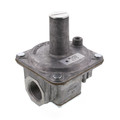

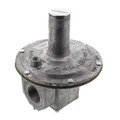

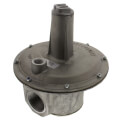
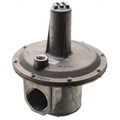

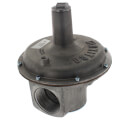

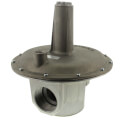


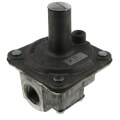
Straight-Thru-Flow Regulators are gas pressure regulators designed to deliver high capacity at low inlet pressure without the restriction typical of standard regulator designs. Maxitrol's RV series covers this category, with models like the RV53-1 handling up to 1,300,000 BTU through a 1 inch connection. Straight-through construction means gas passes directly through the regulator body rather than around an internal baffle, which reduces pressure drop and lets the regulator handle larger appliances or multiple connected units on a single line. Installers sizing a regulator for a rooftop unit, commercial kitchen line, or multi-appliance gas manifold need to match the connection size and BTU capacity to the total load the piping serves, since undersizing a regulator restricts gas flow and can starve appliances during peak demand. Selecting the correct straight-thru-flow regulator keeps gas pressure stable across the full range of connected equipment and helps avoid callbacks for pressure-related appliance faults.
Subcategories
- 1/2" and 3/4" Regulators (900,000 BTU): The RV52 series covers 1/2 inch and 3/4 inch connections, both rated for 900,000 BTU capacity. Installers use this size range on smaller residential and light commercial appliances, including single furnaces, water heaters, or unit heaters that do not require a large gas manifold. The straight-through design keeps pressure drop low even at this smaller connection size. Confirming the appliance's maximum BTU input against the regulator's rated capacity prevents undersizing on the job.
- 3/4" and 1" Regulators (1,300,000 BTU): The RV53 series steps up to 1,300,000 BTU capacity across 3/4 inch and 1 inch connections. The added capacity fits mid-size commercial equipment or multiple residential appliances sharing a single gas line. Techs sizing a regulator for a small commercial kitchen or a multi-unit residential boiler room often land in this capacity range. Matching the pipe size to the existing gas line simplifies installation without requiring a reducer fitting.
- 1-1/4" Regulators (2,500,000 BTU): The RV61-1-1/4 handles up to 2,500,000 BTU through a 1-1/4 inch connection. The added capacity supports larger commercial boilers, rooftop units, or manifolds feeding several appliances at once. Facilities with growing gas demand often upsize to this regulator when adding equipment to an existing line. Verifying total connected BTU load, not just the largest single appliance, keeps this regulator sized correctly.
- 1-1/2" Regulators (4,500,000 BTU): The RV81-1-1/2 tops the straight-thru-flow lineup at 4,500,000 BTU through a 1-1/2 inch connection. Large commercial and industrial installations, including multi-boiler plants and large rooftop package units, call for this capacity. Engineers specifying gas piping for high-demand facilities size the regulator to the full connected load plus any planned future capacity. Installing a regulator this large requires confirming the incoming gas main can supply adequate volume at the required inlet pressure.
Buying Guide
Sizing a Straight-Thru-Flow Regulator correctly starts with adding up the total BTU input of every appliance the regulator will serve, not just the largest single unit on the line. Undersizing leads to pressure drop during peak demand, which can cause burners to short-cycle or fail to reach full firing rate, while oversizing wastes money on a larger connection than the job requires. Once the total BTU load is known, match it to the closest regulator rating at or above that figure. The RV52 series covers smaller jobs up to 900,000 BTU across 1/2 inch and 3/4 inch connections, the RV53 series extends to 1,300,000 BTU on 3/4 inch and 1 inch pipe, and the RV61 and RV81 series step up to 2,500,000 BTU and 4,500,000 BTU for larger commercial and industrial loads. Connection size needs to match the existing gas line or the installer will need a reducer or expansion fitting, which adds a point of potential leakage. Inlet pressure also factors into sizing, since straight-thru-flow regulators are built to handle high capacity at low inlet pressure, so confirming the utility's supply pressure against the regulator's rated range avoids performance issues after installation. Facilities planning to add equipment in the future should size the regulator for anticipated load growth rather than only current demand, since replacing an undersized regulator afterward means shutting down gas service to make the swap. Local gas codes may dictate minimum pipe sizing independent of BTU capacity, so checking code requirements alongside appliance load keeps installation compliant.
Frequently Asked Questions
What does straight-thru-flow mean on a gas regulator?
Straight-thru-flow describes a regulator design where gas passes directly through the body instead of routing around an internal baffle. The design reduces pressure drop and lets the regulator handle higher BTU capacity at a given pipe size. Maxitrol's RV series, including the RV53 and RV61 models, uses this straight-through construction.
What BTU capacity does a straight-thru-flow regulator need to handle?
Total BTU capacity needs to match or exceed the combined input of every appliance connected to the line, not just the largest unit. The RV52 series covers up to 900,000 BTU, the RV53 series extends to 1,300,000 BTU, and the RV61 and RV81 series handle 2,500,000 BTU and 4,500,000 BTU respectively. Adding up connected appliance load before ordering prevents undersizing the regulator.
What pipe sizes are available for straight-thru-flow gas regulators?
Maxitrol's RV series spans 1/2 inch through 1-1/2 inch connections. The RV52 series covers 1/2 inch and 3/4 inch, the RV53 series covers 3/4 inch and 1 inch, the RV61-1-1/4 uses a 1-1/4 inch connection, and the RV81-1-1/2 uses a 1-1/2 inch connection. Matching pipe size to the existing gas line simplifies installation and avoids extra reducer fittings.
Can one straight-thru-flow regulator serve multiple appliances?
A single straight-thru-flow regulator can serve multiple appliances as long as the combined BTU load of every connected unit stays at or below the regulator's rated capacity. Larger capacity models, like the RV61-1-1/4 rated for 2,500,000 BTU, are commonly sized for gas manifolds feeding several pieces of equipment. Recalculating total load whenever new equipment is added to the line keeps the regulator properly sized.
What happens if a gas regulator is undersized for the connected load?
An undersized regulator restricts gas flow during peak demand, which can cause connected appliances to short-cycle, lose firing rate, or fail to reach full BTU input. Straight-thru-flow regulators are built to minimize this restriction, but capacity still needs to match total connected load. Recalculating BTU demand before adding new equipment to an existing gas line prevents this problem.
