




Filters
SORT
Product Availability –
Brand –
AWG –
Color –
Features –
Cable Type –
Review Score –
 --%3E %3Csvg version='1.1' id='Fill' xmlns='http://www.w3.org/2000/svg' xmlns:xlink='http://www.w3.org/1999/xlink' x='0px' y='0px' viewBox='0 0 100 100' enable-background='new 0 0 100 100' xml:space='preserve'%3E %3Cpath fill='%23F15C02' d='M79.44,0.95H20.56C9.78,0.95,0.95,9.78,0.95,20.56v58.87c0,10.79,8.82,19.61,19.61,19.61h58.87 c10.79,0,19.61-8.83,19.61-19.61V20.56C99.05,9.78,90.22,0.95,79.44,0.95z M65.38,58.24l9.38,29.58L49.69,69.78L24.5,87.82 l9.34-29.6L8.8,39.6l30.73-0.17c0,0,6.98-19.61,10-28.93c0.54,1.36,9.88,29.1,9.88,29.1H91.2L65.38,58.24z'/%3E %3C/svg%3E)
 --%3E %3Csvg version='1.1' id='With-RB' xmlns='http://www.w3.org/2000/svg' xmlns:xlink='http://www.w3.org/1999/xlink' x='0px' y='0px' viewBox='0 0 100 100' enable-background='new 0 0 100 100' xml:space='preserve'%3E %3Cpath fill='%23FBC8B4' d='M79.44,0.95H20.56C9.78,0.95,0.95,9.78,0.95,20.56v58.87c0,10.79,8.82,19.61,19.61,19.61h58.87 c10.79,0,19.61-8.83,19.61-19.61V20.56C99.05,9.78,90.22,0.95,79.44,0.95z M65.38,58.24l9.38,29.58L49.69,69.78L24.5,87.82 l9.34-29.6L8.8,39.6l30.73-0.17c0,0,6.98-19.61,10-28.93c0.54,1.36,9.88,29.1,9.88,29.1H91.2L65.38,58.24z'/%3E %3C/svg%3E)
Price Range –
Thermostat Cables







 --%3E %3Csvg version='1.1' id='No-RB' xmlns='http://www.w3.org/2000/svg' xmlns:xlink='http://www.w3.org/1999/xlink' x='0px' y='0px' viewBox='0 0 100 100' enable-background='new 0 0 100 100' xml:space='preserve'%3E %3Cpath fill='%23CECECE' d='M79.44,0.95H20.56C9.78,0.95,0.95,9.78,0.95,20.56v58.87c0,10.79,8.82,19.61,19.61,19.61h58.87 c10.79,0,19.61-8.83,19.61-19.61V20.56C99.05,9.78,90.22,0.95,79.44,0.95z M65.38,58.24l9.38,29.58L49.69,69.78L24.5,87.82 l9.34-29.6L8.8,39.6l30.73-0.17c0,0,6.98-19.61,10-28.93c0.54,1.36,9.88,29.1,9.88,29.1H91.2L65.38,58.24z'/%3E %3C/svg%3E)

 --%3E %3Csvg version='1.1' id='Half' xmlns='http://www.w3.org/2000/svg' xmlns:xlink='http://www.w3.org/1999/xlink' x='0px' y='0px' viewBox='0 0 100 100' enable-background='new 0 0 100 100' xml:space='preserve'%3E %3Cg%3E %3Cpath fill='%23F15C02' d='M30.05,70.23l3.79-12.01L8.8,39.6l30.73-0.17c0,0,6.98-19.61,10-28.93c0.54,1.36,9.88,29.1,9.88,29.1h1.58 L93.71,7.18c-3.58-3.82-8.66-6.23-14.28-6.23H20.56C9.78,0.95,0.95,9.78,0.95,20.56v58.87c0,5.41,2.22,10.32,5.79,13.88 L30.05,70.23z'/%3E %3C/g%3E %3Cpath fill='%23FBC8B4' d='M93.71,7.18L60.98,39.6H91.2L65.38,58.24l9.38,29.58L49.69,69.78L24.5,87.82l5.55-17.59L6.75,93.32 c3.55,3.54,8.44,5.73,13.82,5.73h58.87c10.79,0,19.61-8.83,19.61-19.61V20.56C99.05,15.4,97.01,10.69,93.71,7.18z'/%3E %3C/svg%3E)


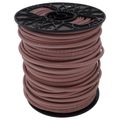
Thermostat cables are low-voltage, multi-conductor wires that connect a thermostat to the furnace, air handler, or HVAC control board. Each conductor in the cable carries a signal for one function, such as heat, cooling stages, the fan, or a common wire that powers a smart thermostat's display, so installers pick a conductor count that matches how many functions the specific system needs to control. HVAC technicians run this cable during new equipment installs, thermostat upgrades, and zoning retrofits, often pulling extra conductors beyond what the current system uses so a future equipment or thermostat change doesn't require fishing new wire through a finished wall. Because the cable only carries control signals rather than line voltage, it installs differently than standard electrical wiring, and getting the conductor count and jacket rating right up front avoids a return trip when the thermostat calls for a wire that isn't in the wall.
Subcategories
- Basic Conventional Cable: Lower conductor-count cable serves simple single-stage heating or heating-and-cooling systems where the thermostat only needs to switch a couple of functions on and off. Technicians use this on straightforward replacement jobs where the existing system isn't multi-stage. It's the most common choice for basic residential furnace and air conditioner pairings.
- Multi-Stage and Smart Thermostat Cable: Higher conductor-count cable supports multi-stage heating and cooling, humidifiers, and smart thermostats that need a dedicated common wire to stay powered. Installers pull this cable whenever a smart thermostat is going in, since a missing common wire is one of the most frequent callback reasons on smart thermostat installs. It also leaves room for accessories like a dehumidifier or zone damper added later.
- Riser and Plenum-Rated Cable: These cables carry a fire and smoke rating suited to running through risers, plenums, or return air spaces where code requires it, most often in commercial and multifamily buildings. Contractors working in commercial spaces need to confirm which rating the local code and building inspector require before pulling standard cable through those spaces. Using the wrong rating in a plenum space is a common reason for a failed inspection.
Buying Guide
Start by counting the functions the system needs to control. A basic single-stage system needs fewer conductors than a two-stage heat pump with emergency heat, a humidifier, and a smart thermostat, so listing out every function before buying avoids coming up short mid-install.
Pull more conductors than the current install needs whenever the wall is already open. Thermostat Cables cost little relative to the labor of fishing new wire, so running two or three spare conductors during a new install or major renovation saves a much bigger job later if the homeowner upgrades equipment or adds zoning.
Check whether the run passes through a plenum, riser, or return air space, since those locations typically require a fire and smoke-rated cable rather than standard jacketed cable, and using the wrong rating can fail inspection on a commercial or multifamily job.
Confirm the thermostat's common wire requirement before finalizing conductor count, since most smart thermostats need a dedicated common wire to stay powered, and a missing common wire is one of the most frequent reasons for a return trip after a thermostat swap.
Finally, match cable length to the actual run with some slack for routing, since low-voltage cable that's stretched too tight or routed alongside high-voltage wiring can pick up interference that causes intermittent thermostat behavior.
Frequently Asked Questions
How many conductors do I need for a smart thermostat?
Most smart thermostats need a dedicated common wire in addition to the standard heat, cool, and fan wires, so a higher conductor-count cable is usually the safer choice.
Should I pull extra conductors even if the current system doesn't need them?
Yes, when the wall is already open. Running a couple of spare conductors during install is much cheaper than fishing new wire later if the equipment or thermostat changes.
Do I need a special rated cable for a commercial building?
Runs through plenums, risers, or return air spaces typically require a fire and smoke-rated cable, so check local code and the building inspector's requirements before pulling standard cable.
Why does my smart thermostat keep losing power or resetting?
This is often caused by a missing or miswired common wire, which most smart thermostats need to stay continuously powered.
Can I run thermostat cable alongside standard electrical wiring?
It's best to keep low-voltage thermostat cable separated from line-voltage wiring where possible, since running them together can introduce interference that causes intermittent thermostat behavior.
