




Filters
SORT
Product Availability –
Diameter (Inches) –
Capacity (Gallons) –
Review Score –
 --%3E %3Csvg version='1.1' id='Fill' xmlns='http://www.w3.org/2000/svg' xmlns:xlink='http://www.w3.org/1999/xlink' x='0px' y='0px' viewBox='0 0 100 100' enable-background='new 0 0 100 100' xml:space='preserve'%3E %3Cpath fill='%23F15C02' d='M79.44,0.95H20.56C9.78,0.95,0.95,9.78,0.95,20.56v58.87c0,10.79,8.82,19.61,19.61,19.61h58.87 c10.79,0,19.61-8.83,19.61-19.61V20.56C99.05,9.78,90.22,0.95,79.44,0.95z M65.38,58.24l9.38,29.58L49.69,69.78L24.5,87.82 l9.34-29.6L8.8,39.6l30.73-0.17c0,0,6.98-19.61,10-28.93c0.54,1.36,9.88,29.1,9.88,29.1H91.2L65.38,58.24z'/%3E %3C/svg%3E)
 --%3E %3Csvg version='1.1' id='With-RB' xmlns='http://www.w3.org/2000/svg' xmlns:xlink='http://www.w3.org/1999/xlink' x='0px' y='0px' viewBox='0 0 100 100' enable-background='new 0 0 100 100' xml:space='preserve'%3E %3Cpath fill='%23FBC8B4' d='M79.44,0.95H20.56C9.78,0.95,0.95,9.78,0.95,20.56v58.87c0,10.79,8.82,19.61,19.61,19.61h58.87 c10.79,0,19.61-8.83,19.61-19.61V20.56C99.05,9.78,90.22,0.95,79.44,0.95z M65.38,58.24l9.38,29.58L49.69,69.78L24.5,87.82 l9.34-29.6L8.8,39.6l30.73-0.17c0,0,6.98-19.61,10-28.93c0.54,1.36,9.88,29.1,9.88,29.1H91.2L65.38,58.24z'/%3E %3C/svg%3E)
Price Range –
Weil Mclain Indirect Water Heaters

 --%3E %3Csvg version='1.1' id='No-RB' xmlns='http://www.w3.org/2000/svg' xmlns:xlink='http://www.w3.org/1999/xlink' x='0px' y='0px' viewBox='0 0 100 100' enable-background='new 0 0 100 100' xml:space='preserve'%3E %3Cpath fill='%23CECECE' d='M79.44,0.95H20.56C9.78,0.95,0.95,9.78,0.95,20.56v58.87c0,10.79,8.82,19.61,19.61,19.61h58.87 c10.79,0,19.61-8.83,19.61-19.61V20.56C99.05,9.78,90.22,0.95,79.44,0.95z M65.38,58.24l9.38,29.58L49.69,69.78L24.5,87.82 l9.34-29.6L8.8,39.6l30.73-0.17c0,0,6.98-19.61,10-28.93c0.54,1.36,9.88,29.1,9.88,29.1H91.2L65.38,58.24z'/%3E %3C/svg%3E)


 --%3E %3Csvg version='1.1' id='Half' xmlns='http://www.w3.org/2000/svg' xmlns:xlink='http://www.w3.org/1999/xlink' x='0px' y='0px' viewBox='0 0 100 100' enable-background='new 0 0 100 100' xml:space='preserve'%3E %3Cg%3E %3Cpath fill='%23F15C02' d='M30.05,70.23l3.79-12.01L8.8,39.6l30.73-0.17c0,0,6.98-19.61,10-28.93c0.54,1.36,9.88,29.1,9.88,29.1h1.58 L93.71,7.18c-3.58-3.82-8.66-6.23-14.28-6.23H20.56C9.78,0.95,0.95,9.78,0.95,20.56v58.87c0,5.41,2.22,10.32,5.79,13.88 L30.05,70.23z'/%3E %3C/g%3E %3Cpath fill='%23FBC8B4' d='M93.71,7.18L60.98,39.6H91.2L65.38,58.24l9.38,29.58L49.69,69.78L24.5,87.82l5.55-17.59L6.75,93.32 c3.55,3.54,8.44,5.73,13.82,5.73h58.87c10.79,0,19.61-8.83,19.61-19.61V20.56C99.05,15.4,97.01,10.69,93.71,7.18z'/%3E %3C/svg%3E)
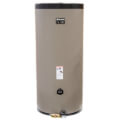
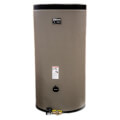


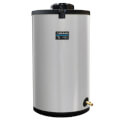
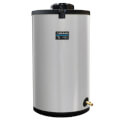
Weil-McLain indirect water heaters use a home or building's boiler to heat domestic hot water instead of running a separate heating element. Contractors specify indirect systems on hydronic jobs where the boiler already has spare capacity, since the water heater tank draws heat through a coil rather than firing its own burner. The Aqua Pro line ships in four capacities, 30, 55, 80, and 119 gallons, built around a non-metallic composite tank designed for harsh water conditions. Pairing an indirect tank with an existing boiler cuts down on the number of combustion appliances in a mechanical room, which simplifies venting and combustion air calculations on a retrofit. Recovery rate depends on the boiler's output rather than a fixed heating element, so a properly sized boiler recovers faster than most standalone tank-style heaters.
Subcategories
- Aqua Pro Indirect Water Heaters: The Aqua Pro line covers 30, 55, 80, and 119 gallon capacities for residential and light commercial jobs. Its tank uses a non-metallic composite construction built without welds, which resists corrosion in harsh water conditions better than a standard glass-lined steel tank. Contractors reach for Aqua Pro on retrofits where a lightweight tank simplifies moving the unit into a tight mechanical room. Weil-McLain backs residential and commercial installs with separate warranty terms.
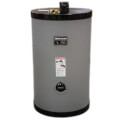
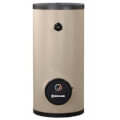
- Aqua Plus Series 2 Indirect Water Heaters: Aqua Plus Series 2 targets homes that need reliable hot water output paired with an existing boiler rather than a standalone water heater. The series comes in multiple sizes to match household demand without oversizing the tank. Technicians pair this line with Weil-McLain boilers already installed on a hydronic system, keeping the same control platform across heating and hot water. Recovery speed scales with the connected boiler's output rather than a fixed internal element.
- Commercial Indirect Water Heaters: Weil-McLain's commercial indirect line targets larger buildings with hot water demand that exceeds typical residential capacity. Pairing with commercial boiler output gives these systems higher recovery rates than a residential tank can match. Contractors specify commercial indirect tanks on multi-unit properties, restaurants, and other high-draw applications where storage capacity alone won't keep up with demand. Sizing depends on matching the connected boiler's output to the building's peak draw.
- Residential Indirect Water Heaters: Weil-McLain's residential lineup covers the smaller-capacity end of the indirect category, distinct from the commercial-scale units, and gives single-family and small multi-family homes a way to generate hot water off an existing boiler instead of adding a second combustion appliance. Contractors size the tank to household fixture count and peak-hour draw rather than total square footage. A properly matched boiler and tank combination recovers faster than a standalone electric or gas water heater of similar capacity.
Buying Guide
Sizing comes first when specifying an indirect tank: match the tank's capacity and recovery rate to the connected boiler's output rather than picking a gallon size in isolation. A boiler with plenty of spare capacity supports a larger tank and faster recovery, while an undersized boiler paired with a large tank still runs short during peak draw.
Application narrows the choice next. Residential jobs on single-family homes typically fit the Aqua Plus Series 2 or a smaller Aqua Pro capacity, while multi-unit buildings, restaurants, and other high-draw properties call for the commercial line. Weil-McLain Indirect Water Heaters split cleanly along this residential-versus-commercial line, so confirming the building type early avoids a mismatched order.
Tank construction matters on harsh water. The Aqua Pro's non-metallic composite tank resists corrosion better than a glass-lined steel tank in areas with aggressive water chemistry, which extends service life without changing the boiler side of the install.
Finally, confirm mechanical room space and venting before finalizing a model. Indirect tanks add a second appliance to the space even though they share the boiler's burner, so clearances and combustion air calculations still need to account for the additional tank footprint.
Frequently Asked Questions
How does an indirect water heater differ from a standard tank water heater?
An indirect water heater uses the home's boiler to heat water through an internal coil instead of firing its own burner or running its own electric element. Recovery speed depends on the boiler's output rather than a dedicated heating source. Homes with a properly sized boiler often see faster recovery than a standalone gas or electric tank.
What gallon sizes does Weil-McLain offer for indirect water heaters?
The Aqua Pro line comes in 30, 55, 80, and 119 gallon capacities. Aqua Plus Series 2 and the commercial line add additional sizes for larger households and higher-draw buildings. Match the capacity to the connected boiler's output rather than the largest available size.
Can an indirect water heater work with any boiler?
An indirect tank needs a boiler with enough spare capacity to heat both the space and the water heater coil without falling short on either job. Undersized boilers paired with a large indirect tank often struggle to keep up during peak hot water draw. Confirm the boiler's rated output before adding an indirect tank to an existing system.
How do I choose between residential and commercial indirect models?
Residential models like the Aqua Plus Series 2 and smaller Aqua Pro capacities suit single-family and small multi-family homes. Commercial indirect tanks target restaurants, multi-unit buildings, and other properties with hot water demand that exceeds typical residential capacity. Building type and peak draw, not just square footage, should drive the choice.
Does the tank material matter for water quality?
Yes. The Aqua Pro's non-metallic composite tank resists corrosion better than a glass-lined steel tank in areas with harsh or aggressive water chemistry. Choosing the right tank material upfront avoids early tank failure in those conditions.
