




Filters
SORT
Product Availability –
Brand –
BTU Input –
Diameter (Inches) –
Review Score –
 --%3E %3Csvg version='1.1' id='Fill' xmlns='http://www.w3.org/2000/svg' xmlns:xlink='http://www.w3.org/1999/xlink' x='0px' y='0px' viewBox='0 0 100 100' enable-background='new 0 0 100 100' xml:space='preserve'%3E %3Cpath fill='%23F15C02' d='M79.44,0.95H20.56C9.78,0.95,0.95,9.78,0.95,20.56v58.87c0,10.79,8.82,19.61,19.61,19.61h58.87 c10.79,0,19.61-8.83,19.61-19.61V20.56C99.05,9.78,90.22,0.95,79.44,0.95z M65.38,58.24l9.38,29.58L49.69,69.78L24.5,87.82 l9.34-29.6L8.8,39.6l30.73-0.17c0,0,6.98-19.61,10-28.93c0.54,1.36,9.88,29.1,9.88,29.1H91.2L65.38,58.24z'/%3E %3C/svg%3E)
 --%3E %3Csvg version='1.1' id='With-RB' xmlns='http://www.w3.org/2000/svg' xmlns:xlink='http://www.w3.org/1999/xlink' x='0px' y='0px' viewBox='0 0 100 100' enable-background='new 0 0 100 100' xml:space='preserve'%3E %3Cpath fill='%23FBC8B4' d='M79.44,0.95H20.56C9.78,0.95,0.95,9.78,0.95,20.56v58.87c0,10.79,8.82,19.61,19.61,19.61h58.87 c10.79,0,19.61-8.83,19.61-19.61V20.56C99.05,9.78,90.22,0.95,79.44,0.95z M65.38,58.24l9.38,29.58L49.69,69.78L24.5,87.82 l9.34-29.6L8.8,39.6l30.73-0.17c0,0,6.98-19.61,10-28.93c0.54,1.36,9.88,29.1,9.88,29.1H91.2L65.38,58.24z'/%3E %3C/svg%3E)
Price Range –
40 Gallon Indirect Water Heaters



 --%3E %3Csvg version='1.1' id='Half' xmlns='http://www.w3.org/2000/svg' xmlns:xlink='http://www.w3.org/1999/xlink' x='0px' y='0px' viewBox='0 0 100 100' enable-background='new 0 0 100 100' xml:space='preserve'%3E %3Cg%3E %3Cpath fill='%23F15C02' d='M30.05,70.23l3.79-12.01L8.8,39.6l30.73-0.17c0,0,6.98-19.61,10-28.93c0.54,1.36,9.88,29.1,9.88,29.1h1.58 L93.71,7.18c-3.58-3.82-8.66-6.23-14.28-6.23H20.56C9.78,0.95,0.95,9.78,0.95,20.56v58.87c0,5.41,2.22,10.32,5.79,13.88 L30.05,70.23z'/%3E %3C/g%3E %3Cpath fill='%23FBC8B4' d='M93.71,7.18L60.98,39.6H91.2L65.38,58.24l9.38,29.58L49.69,69.78L24.5,87.82l5.55-17.59L6.75,93.32 c3.55,3.54,8.44,5.73,13.82,5.73h58.87c10.79,0,19.61-8.83,19.61-19.61V20.56C99.05,15.4,97.01,10.69,93.71,7.18z'/%3E %3C/svg%3E)


 --%3E %3Csvg version='1.1' id='No-RB' xmlns='http://www.w3.org/2000/svg' xmlns:xlink='http://www.w3.org/1999/xlink' x='0px' y='0px' viewBox='0 0 100 100' enable-background='new 0 0 100 100' xml:space='preserve'%3E %3Cpath fill='%23CECECE' d='M79.44,0.95H20.56C9.78,0.95,0.95,9.78,0.95,20.56v58.87c0,10.79,8.82,19.61,19.61,19.61h58.87 c10.79,0,19.61-8.83,19.61-19.61V20.56C99.05,9.78,90.22,0.95,79.44,0.95z M65.38,58.24l9.38,29.58L49.69,69.78L24.5,87.82 l9.34-29.6L8.8,39.6l30.73-0.17c0,0,6.98-19.61,10-28.93c0.54,1.36,9.88,29.1,9.88,29.1H91.2L65.38,58.24z'/%3E %3C/svg%3E)



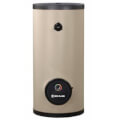
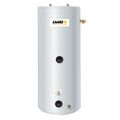
40 gallon indirect water heaters are storage tank units that draw heat from a connected boiler instead of running their own burner or heating element. A coil or heat exchanger inside the tank carries hot water from the boiler loop, warming the domestic water in the tank without mixing the two supplies. A 40 gallon capacity fits smaller households, condos, and secondary living spaces where hot water demand stays moderate and mechanical room space is tight. Because the boiler supplies the heat, an indirect water heater has fewer moving parts than a standalone gas or electric unit, often translating into a longer service life and less routine maintenance. Contractors commonly install indirect water heaters in homes that already run a boiler for space heating, letting one heat source cover both domestic hot water and the heating system. Matching the tank's recovery rate to the boiler's output keeps hot water available even when several fixtures draw at once.
Subcategories
- Single-Wall Coil Models: Single-wall coil models route boiler water through a single layer of tubing submerged in the domestic water tank, transferring heat efficiently across a simple design. They're a common choice where local code allows single-wall separation between the boiler loop and potable water. Because the design has fewer components than a double-wall unit, it's often less expensive to purchase and simpler to service. Contractors should still confirm local plumbing code before specifying a single-wall model, since some jurisdictions require double-wall separation for added protection.
- Double-Wall Heat Exchanger Models: Double-wall models add a second, isolated barrier between the boiler fluid and the domestic water supply, so a leak in one wall doesn't let boiler-side fluid mix with potable water. Many plumbing codes require this extra separation whenever the boiler loop contains anything other than plain water, such as glycol for freeze protection. The added barrier can slightly reduce heat transfer efficiency compared to a single-wall design, so double-wall units are often sized a bit larger to compensate. Choosing a double-wall model up front avoids a costly swap later if an inspector flags a single-wall unit on a glycol-fed system.
- Stainless Steel Tank Models: Stainless steel tank construction resists corrosion better than a standard glass-lined steel tank, which can extend service life in areas with aggressive water chemistry. These tanks typically carry a longer warranty than comparable glass-lined units, reflecting their added corrosion resistance. Stainless models often cost more upfront, so they suit installations where water quality or long-term reliability outweighs the higher initial price. Contractors should still install a properly sized expansion tank on stainless models just as they would on any closed water heating system.
- Replacement Parts and Aquastats: Replacement parts for indirect water heaters include aquastats, anode rods, and circulator components that keep the unit running efficiently over time. An aquastat controls when the boiler fires to maintain the tank's set temperature, so a failed aquastat can leave a household without consistent hot water. Anode rods sacrifice themselves to corrosion so the tank itself doesn't, and replacing a spent rod on schedule extends the tank's service life significantly. Keeping common replacement parts stocked on the truck helps a service call finish in one visit instead of requiring a return trip.
Buying Guide
Start by confirming the connected boiler has enough output to meet the water heater's recovery rate, since an indirect unit is only as fast as the boiler feeding it. A boiler that's undersized for the tank will leave a household waiting longer for a full tank of hot water to recover after heavy use.
Check local plumbing code before choosing between a single-wall and double-wall heat exchanger, particularly on systems that use glycol or other additives in the boiler loop. Many jurisdictions require double-wall separation whenever the boiler fluid isn't plain water.
Confirm the physical footprint of a 40 gallon indirect water heater fits the mechanical room, including clearance for the connections, expansion tank, and any required service access around the unit. Tight mechanical rooms sometimes call for a taller, narrower tank profile instead of a shorter, wider one.
Factor in household hot water demand alongside available boiler capacity. A 40 gallon tank suits smaller households well, but a home with several bathrooms and simultaneous fixture use may need a larger tank or a boiler with more reserve capacity to keep up.
Finally, plan for routine maintenance items like anode rod replacement and aquastat checks from the start, since indirect water heaters depend on these components staying in good condition to deliver consistent performance over the unit's service life.
Frequently Asked Questions
How does an indirect water heater differ from a standard gas water heater?
An indirect water heater uses a connected boiler's heat exchanger to warm the tank's water instead of running its own gas burner, so it needs an existing boiler to function rather than operating as a standalone unit.
Is a 40 gallon tank big enough for a family?
A 40 gallon tank typically suits smaller households or homes with one to two bathrooms; larger households with simultaneous high hot water demand may need a bigger tank or a boiler with more reserve capacity.
Can an indirect water heater run without the boiler operating?
No, an indirect water heater relies entirely on the connected boiler for heat, so if the boiler is down, the tank will gradually lose its stored heat and stop producing hot water.
What maintenance does an indirect water heater need?
Routine maintenance includes checking the aquastat's calibration, inspecting or replacing the anode rod on schedule, and confirming the circulator pump is moving water properly between the boiler and the tank.
Do these units need an expansion tank?
Yes, indirect water heaters are closed systems that need a properly sized expansion tank to absorb the pressure increase that occurs as water heats and expands.
