




Filters
SORT
Product Availability –
Brand –
Review Score –
 --%3E %3Csvg version='1.1' id='Fill' xmlns='http://www.w3.org/2000/svg' xmlns:xlink='http://www.w3.org/1999/xlink' x='0px' y='0px' viewBox='0 0 100 100' enable-background='new 0 0 100 100' xml:space='preserve'%3E %3Cpath fill='%23F15C02' d='M79.44,0.95H20.56C9.78,0.95,0.95,9.78,0.95,20.56v58.87c0,10.79,8.82,19.61,19.61,19.61h58.87 c10.79,0,19.61-8.83,19.61-19.61V20.56C99.05,9.78,90.22,0.95,79.44,0.95z M65.38,58.24l9.38,29.58L49.69,69.78L24.5,87.82 l9.34-29.6L8.8,39.6l30.73-0.17c0,0,6.98-19.61,10-28.93c0.54,1.36,9.88,29.1,9.88,29.1H91.2L65.38,58.24z'/%3E %3C/svg%3E)
 --%3E %3Csvg version='1.1' id='With-RB' xmlns='http://www.w3.org/2000/svg' xmlns:xlink='http://www.w3.org/1999/xlink' x='0px' y='0px' viewBox='0 0 100 100' enable-background='new 0 0 100 100' xml:space='preserve'%3E %3Cpath fill='%23FBC8B4' d='M79.44,0.95H20.56C9.78,0.95,0.95,9.78,0.95,20.56v58.87c0,10.79,8.82,19.61,19.61,19.61h58.87 c10.79,0,19.61-8.83,19.61-19.61V20.56C99.05,9.78,90.22,0.95,79.44,0.95z M65.38,58.24l9.38,29.58L49.69,69.78L24.5,87.82 l9.34-29.6L8.8,39.6l30.73-0.17c0,0,6.98-19.61,10-28.93c0.54,1.36,9.88,29.1,9.88,29.1H91.2L65.38,58.24z'/%3E %3C/svg%3E)
Price Range –
Air Pressure Switches


 --%3E %3Csvg version='1.1' id='No-RB' xmlns='http://www.w3.org/2000/svg' xmlns:xlink='http://www.w3.org/1999/xlink' x='0px' y='0px' viewBox='0 0 100 100' enable-background='new 0 0 100 100' xml:space='preserve'%3E %3Cpath fill='%23CECECE' d='M79.44,0.95H20.56C9.78,0.95,0.95,9.78,0.95,20.56v58.87c0,10.79,8.82,19.61,19.61,19.61h58.87 c10.79,0,19.61-8.83,19.61-19.61V20.56C99.05,9.78,90.22,0.95,79.44,0.95z M65.38,58.24l9.38,29.58L49.69,69.78L24.5,87.82 l9.34-29.6L8.8,39.6l30.73-0.17c0,0,6.98-19.61,10-28.93c0.54,1.36,9.88,29.1,9.88,29.1H91.2L65.38,58.24z'/%3E %3C/svg%3E)





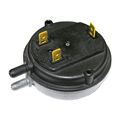


Air pressure switches are safety controls that monitor differential air pressure inside a furnace, boiler, or draft-inducer assembly and prevent the burner from firing unless proper airflow or draft is confirmed. HVAC technicians replace these switches most often on gas furnaces, where the switch verifies the induced-draft blower is moving enough air to safely vent combustion gases before the ignition sequence begins. A stuck-open or stuck-closed switch is a common cause of a furnace that won't start or that locks out on a safety fault, so it's usually one of the first components checked during a no-heat diagnostic. Most switches use a diaphragm connected to pressure tubing that reads the difference between two points in the airflow path, tripping an internal contact once the pressure differential crosses its set point. Because set points vary by application and even by furnace model, matching the replacement switch's trip pressure to the original is critical for correct operation rather than just matching the physical connector style.
Subcategories
- Fixed Set-Point Pressure Switches: Fixed set-point switches trip at one factory-calibrated pressure and can't be field-adjusted, which keeps them simple to install as a direct replacement on the same furnace model. Manufacturers rate each switch for a specific pressure range in inches of water column, so confirming the original switch's rating before ordering is the only way to keep the replacement accurate. These switches are the most common style found in residential gas furnaces and are usually the least expensive option when an exact match is available. Because there's no adjustment screw, there's also nothing for a technician to accidentally mis-set in the field.
- Adjustable Pressure Switches: Adjustable switches include a screw or dial that lets a technician fine-tune the trip point within a rated range, which is useful when a universal replacement doesn't have an exact factory match. This flexibility comes with more responsibility: an incorrectly set adjustable switch can either fail to trip when it should or nuisance-trip during normal operation. Technicians typically use a manometer to confirm actual system pressure before dialing in the switch's set point rather than guessing. These switches are common in universal replacement kits that cover multiple furnace models with one part number.
- Universal Replacement Switches: Universal switches are designed to cross-reference against multiple OEM part numbers, which helps when the original manufacturer's exact switch is discontinued or backordered. They typically ship with a small kit of adapters, mounting brackets, or tubing fittings to match different furnace cabinet layouts. Confirming the pressure range and electrical rating match the original switch is still necessary even when the physical fit is universal. Stocking a few universal switches on the truck covers a wide range of no-heat calls without carrying every OEM part number.
- High-Altitude Pressure Switches: High-altitude switches are calibrated for the lower ambient air pressure found at elevation, where a standard switch's set point would either fail to trip or trip too easily due to the thinner air. Furnaces installed above the elevation threshold specified by the manufacturer generally require this switch style to operate correctly and safely. Using a standard switch at high altitude can cause nuisance lockouts or, worse, allow the burner to fire without adequate draft. Confirming the installation elevation against the furnace manufacturer's specification sheet determines whether this switch style is required.
Buying Guide
Start by confirming what the switch is actually monitoring: draft-proving switches read the pressure created by an induced-draft blower before ignition, while other Air Pressure Switches monitor combustion air or blower airflow at a different point in the system. Pulling the failed switch's part number, or the furnace model and serial number if the switch tag is unreadable, is the most reliable way to find an exact match. When an exact OEM match isn't available, a universal replacement switch works as long as its pressure range, port configuration, and electrical rating match the original. Fixed set-point switches are the simpler and usually cheaper choice for a straightforward like-for-like replacement, while adjustable switches make sense when a universal part needs to be tuned to a specific furnace's actual operating pressure. Installations above the manufacturer's stated elevation threshold need a high-altitude-rated switch regardless of which other category applies, since standard switches aren't calibrated for reduced air pressure at elevation. After installing any replacement switch, verifying actual system pressure with a manometer confirms the new switch trips at the correct point rather than assuming the published rating matches real-world performance in that specific installation. Skipping this verification step is a common reason a no-heat call comes back a second time.
Frequently Asked Questions
What's the difference between a draft-proving switch and an air pressure switch?
In most furnace applications, they're the same component: a draft-proving switch is just an air pressure switch installed specifically to confirm draft-inducer airflow before allowing ignition. Some systems use additional air pressure switches elsewhere to monitor combustion air or blower airflow at other points, so the terms aren't always fully interchangeable across every furnace design.
How do I know if my furnace's pressure switch is bad versus a blower problem?
Checking the actual pressure at the switch's tubing connection with a manometer during a call for heat is the most direct test; if the reading meets the switch's rated trip pressure but the switch still won't close, the switch itself has failed. If the pressure reading is below the switch's rating, the draft-inducer blower, venting, or tubing is the more likely cause rather than the switch.
Can I use an adjustable pressure switch to replace a fixed set-point switch?
Yes, as long as the adjustable switch's rated range covers the original fixed switch's trip pressure and the port and electrical connections match. Setting the adjustable switch to the correct pressure with a manometer during commissioning is necessary since it won't come pre-calibrated to the original furnace's exact requirement.
Do I need a different pressure switch for a high-altitude installation?
Furnace manufacturers specify an elevation threshold above which a standard pressure switch is no longer rated to trip correctly, and installations above that line need a high-altitude-rated switch. Checking the furnace's installation manual for its specific elevation threshold is the fastest way to confirm which switch style the job requires.
Why does my furnace lock out on a pressure switch fault intermittently?
Intermittent lockouts often trace back to partially blocked pressure tubing, a cracked diaphragm, or venting that's marginal enough to pass on some cycles and fail on others. Clearing and inspecting the tubing and testing actual system pressure with a manometer usually isolates whether the switch, the tubing, or the venting is the real cause before a part gets replaced unnecessarily.
