




'/%3E%3C/svg%3E)
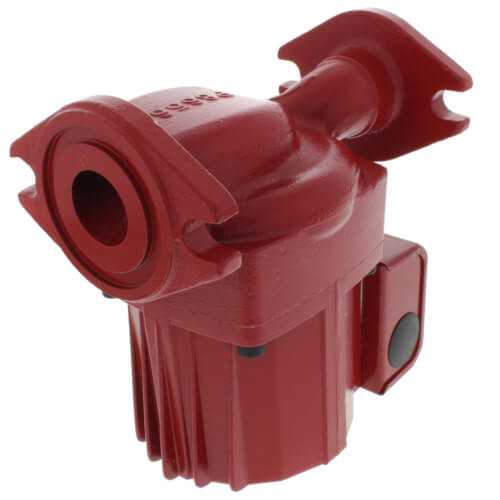
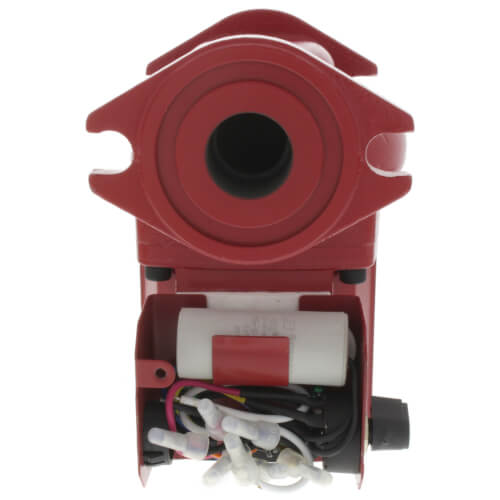
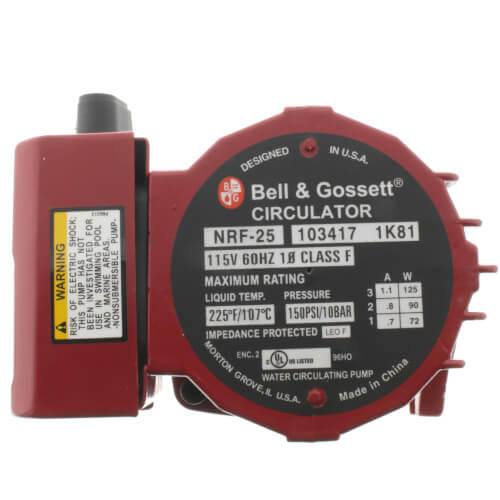
NRF-25 Red Fox Circulator Pump, 3 Speed
 --%3E %3Csvg version='1.1' id='Fill' xmlns='http://www.w3.org/2000/svg' xmlns:xlink='http://www.w3.org/1999/xlink' x='0px' y='0px' viewBox='0 0 100 100' enable-background='new 0 0 100 100' xml:space='preserve'%3E %3Cpath fill='%23F15C02' d='M79.44,0.95H20.56C9.78,0.95,0.95,9.78,0.95,20.56v58.87c0,10.79,8.82,19.61,19.61,19.61h58.87 c10.79,0,19.61-8.83,19.61-19.61V20.56C99.05,9.78,90.22,0.95,79.44,0.95z M65.38,58.24l9.38,29.58L49.69,69.78L24.5,87.82 l9.34-29.6L8.8,39.6l30.73-0.17c0,0,6.98-19.61,10-28.93c0.54,1.36,9.88,29.1,9.88,29.1H91.2L65.38,58.24z'/%3E %3C/svg%3E)


MANUALS (4)
Product Highlights


Description
A residential or light commercial, maintenance free, axial flanged, in-line, cast iron, wet rotor, circulation pump for hydronic heating systems. UL and cUL listed.
Features
- High starting torque provides years of trouble-free start-ups
- Unique B&G DuraGlide Bearing System assures whisper-quiet, maintenance-free operation
- Closed impeller design improves operating efficiency
- Backed by B&G's representatives and a great 3-year warranty
Specs
| Horse Power: | 1/15 |
|---|---|
| Application: | Heating |
| Material: | Cast Iron |
| Voltage: | 115V |
| Type: | 3-Speed Pump |
| Amperage: | 1.2 |
| RPM: | 2950 |
| Max Pressure (PSI): | 150 |
| Max Temp (F): | 225°F |
| Hertz: | 60 |
| Phase: | 1 |
| Flow Range (GPM): | 0-24 |
| Max Head (Ft): | 19 |
| Head Range (ft.): | 0-19 |
| Connection Type: | Flanged x Flanged |
| Max Flow (GPM): | 24 |
| Connection Size: | 3/4" 1" 1-1/4" 1-1/2" |
| Warranty: | 3 Year |


Questions?
Compare Similar Products
You May Also Need
Product Reviews
The guys are good at what they do!
This replaced a 007 1/25HP
Yes I would purchase this product again
Perfect match
Circulating pump
Perfect replacement
 --%3E %3Csvg version='1.1' id='With-RB' xmlns='http://www.w3.org/2000/svg' xmlns:xlink='http://www.w3.org/1999/xlink' x='0px' y='0px' viewBox='0 0 100 100' enable-background='new 0 0 100 100' xml:space='preserve'%3E %3Cpath fill='%23FBC8B4' d='M79.44,0.95H20.56C9.78,0.95,0.95,9.78,0.95,20.56v58.87c0,10.79,8.82,19.61,19.61,19.61h58.87 c10.79,0,19.61-8.83,19.61-19.61V20.56C99.05,9.78,90.22,0.95,79.44,0.95z M65.38,58.24l9.38,29.58L49.69,69.78L24.5,87.82 l9.34-29.6L8.8,39.6l30.73-0.17c0,0,6.98-19.61,10-28.93c0.54,1.36,9.88,29.1,9.88,29.1H91.2L65.38,58.24z'/%3E %3C/svg%3E)
Very good product
Great product great costumer service
Quality product. Good service. Fast shipping.
yes
Product Q&A
2 QuestionsQ: Does b+g circ.pumps come with a I.F.C
Asked by hoolio 10 years ago
Add your answer
Verified Reply- SupplyHouse StaffThe 103417 Bell and Gossett Pump does include a high temperature check valve. This check is included in the box with the pump.
Q: What speed should I keep this at for best operation? Thank you! Greg
Asked by Greg 14 years ago
Add your answer
Low speed worked fine, but we had a mild winter last year. You may have to set it at a higher speed depending on how cold it is outside to get enough heat to your heat exchanger. It's a little bit of trial and error. You can start off low and always bump it up if needed. I hope this helps.
Here are some considerations: 1. If some of your rooms are far from the furnace, faster speeds means they will warm up with less delay. 2. Higher water velocity means better heat transfer from water to fins. Therefore the boiler water can be set to a lower temperature for the same amount of transferred heat. 3. However, if the water is circulating faster, it doesn't lose all of its heat going through the finned tubing, so some will be lost in the return piping, which may not place the heat where you want it. 4 Slower speed means lower velocity, so heat transfer is poorer, which means the boiler must be set at a higher temperature, which uses more fuel. It also means the water loses more heat before it gets to the return line, so rooms at the end of the loop may not get as warm as wanted. 5. This seems to indicate that the higher the speed the better, but there are drawbacks. One is, if the speed is too high, there is flow noise in the pipes which can be annoying. More significantly, if the water returns to the furnace still hot, the boiler tends to turn on and off very frequently (called short cycling), which causes wear and tear on the motor and switches. I think the purpose of a three speed pump is to be able to select a flow rate that works best in a particular system. Fast enough to provide rapid heating and good heat transfer efficiency, but not so fast as to cause noise and short cycling. And keep in mind, when zone valves open and close, the velocity goes up and down, so achieving a good balance is not so easy. Here is a link to an article that goes through all the ins and outs using some basic engineering analysis http://www.rileyplumbing.com/media/phc08_pg_46_48_pump.pdf . A thorough analysis is a pretty complicated affair. I hope this helps a little. Ultimately you may have to do some trial and error, knowing what to look for from some of the info above. Good luck. Bob Scher ****@***.***
I keep mine at 1 and it heats our old 1700 sq ft house fine. I don't know if it is the very high heat of my boiler system, but when I ran it at 3 for a while it developed a squeel. No other adverse affects 2 years later.
Greg : I have mine set on 3. I use it as a pump on my coal boiler to circulate between it and my oil boiler where the pump there finishes circulating it through the system. This is a old house with a lot of large piping and about a 16 foot rise to the highest point. You may be able to get away with a lower setting on a ranch style house. You may have to just experiment. The pump is quiet and has been trouble free so far. I replaced a big old B&G full sized pump and I can't tell any difference in the performance Good Luck, Alex
Greg, since there are so many variations in systems, I recommend you finding that out through trial. For my system which is 1900 sq. ft. and a pellet boiler which also supplies my domestic hot water, I use the lowest setting for smoothest temperature transition. On higher speeds during coldest months, ( eastern Pa.) my boiler temperature drops very quickly when demanding both heat and DHW and thus shuts circulator off and slows the radiator heating process and DHW temp will drop. For me it works great at slowest speed. If you have a larger system and different than mine, it's nice to have the option for optimal operation. Hope this helps. Cliff
I used speed 2 and work well
I would use #2 speed to start with. See if that heats your area in a sufficient amount of time. Generally if you are trying to supply heat to a short run or small room I would use speed #1 or 2. A long run or large area, speed #2-3. Hope this helps
Greg, This pump replaces three earlier B&G single speed pumps, each of which might have a "best" application on a particular use. A chart with a "pump curve" of GPM vs FT of Head of the piping application comes in the literature with the pump. In this case, the chart would have three lines, one for each speed. If you know the head of the piping application in "equivalent feet", then you can consult the chart to pick a speed that delivers the desired gpm at that "footage". That said, you would probably want to use the speed that fell within the middle section of any speed's pump curve. Alternately, if you have a fast acting heat emitter like a baseboard radiator or a duct coil, you can find experimentally what speed gives you a desired temperature difference across the device. Usually 20deg. F. of temperature drop across such a device is desirable. With slow acting heat emitters, like radiant floors, quite a bit of experimenting may be needed, as the return temperature will vary greatly depending on the starting temperature of the floor vs its average temperature once the target temperature of the room is achieved vs the input water temperature to the floor. Perhaps you could get someone familiar with your application locally to help you figure the needed gpm at your application's feet of head, and then it would be relatively straightforward to pick a speed appropriate to your individual application. best wishes, Randy the Hydronics Guy
I installed many of these and I set them always at the highest level - 3. I do not realy understand what was the designer's intention by ptoviding the 2 lower speeds. What I might think of is that during mild temperatures in spring and fall they thouht it would make sense to set to lower speed. Again I say NO, you lower your cost of heating and a smooth temperature regulation by lowering the temperature of the boiler output water. By keeping higher circ. speed you achieve much smoother heating regulation and equal temperature in each radiator throughout the house. This delivers 25 GPM whitch i find sufficient. The more GPMs you want the more you will pay, much more. This is just the right fit for a bungalow or duplex.