




Filters
SORT
Product Availability –
Brand –
Size –
PEX Size –
Length (Inches) –
Review Score –
 --%3E %3Csvg version='1.1' id='Fill' xmlns='http://www.w3.org/2000/svg' xmlns:xlink='http://www.w3.org/1999/xlink' x='0px' y='0px' viewBox='0 0 100 100' enable-background='new 0 0 100 100' xml:space='preserve'%3E %3Cpath fill='%23F15C02' d='M79.44,0.95H20.56C9.78,0.95,0.95,9.78,0.95,20.56v58.87c0,10.79,8.82,19.61,19.61,19.61h58.87 c10.79,0,19.61-8.83,19.61-19.61V20.56C99.05,9.78,90.22,0.95,79.44,0.95z M65.38,58.24l9.38,29.58L49.69,69.78L24.5,87.82 l9.34-29.6L8.8,39.6l30.73-0.17c0,0,6.98-19.61,10-28.93c0.54,1.36,9.88,29.1,9.88,29.1H91.2L65.38,58.24z'/%3E %3C/svg%3E)
 --%3E %3Csvg version='1.1' id='With-RB' xmlns='http://www.w3.org/2000/svg' xmlns:xlink='http://www.w3.org/1999/xlink' x='0px' y='0px' viewBox='0 0 100 100' enable-background='new 0 0 100 100' xml:space='preserve'%3E %3Cpath fill='%23FBC8B4' d='M79.44,0.95H20.56C9.78,0.95,0.95,9.78,0.95,20.56v58.87c0,10.79,8.82,19.61,19.61,19.61h58.87 c10.79,0,19.61-8.83,19.61-19.61V20.56C99.05,9.78,90.22,0.95,79.44,0.95z M65.38,58.24l9.38,29.58L49.69,69.78L24.5,87.82 l9.34-29.6L8.8,39.6l30.73-0.17c0,0,6.98-19.61,10-28.93c0.54,1.36,9.88,29.1,9.88,29.1H91.2L65.38,58.24z'/%3E %3C/svg%3E)
Price Range –
ProPEX Stub Out Elbows


 --%3E %3Csvg version='1.1' id='Half' xmlns='http://www.w3.org/2000/svg' xmlns:xlink='http://www.w3.org/1999/xlink' x='0px' y='0px' viewBox='0 0 100 100' enable-background='new 0 0 100 100' xml:space='preserve'%3E %3Cg%3E %3Cpath fill='%23F15C02' d='M30.05,70.23l3.79-12.01L8.8,39.6l30.73-0.17c0,0,6.98-19.61,10-28.93c0.54,1.36,9.88,29.1,9.88,29.1h1.58 L93.71,7.18c-3.58-3.82-8.66-6.23-14.28-6.23H20.56C9.78,0.95,0.95,9.78,0.95,20.56v58.87c0,5.41,2.22,10.32,5.79,13.88 L30.05,70.23z'/%3E %3C/g%3E %3Cpath fill='%23FBC8B4' d='M93.71,7.18L60.98,39.6H91.2L65.38,58.24l9.38,29.58L49.69,69.78L24.5,87.82l5.55-17.59L6.75,93.32 c3.55,3.54,8.44,5.73,13.82,5.73h58.87c10.79,0,19.61-8.83,19.61-19.61V20.56C99.05,15.4,97.01,10.69,93.71,7.18z'/%3E %3C/svg%3E)

 --%3E %3Csvg version='1.1' id='No-RB' xmlns='http://www.w3.org/2000/svg' xmlns:xlink='http://www.w3.org/1999/xlink' x='0px' y='0px' viewBox='0 0 100 100' enable-background='new 0 0 100 100' xml:space='preserve'%3E %3Cpath fill='%23CECECE' d='M79.44,0.95H20.56C9.78,0.95,0.95,9.78,0.95,20.56v58.87c0,10.79,8.82,19.61,19.61,19.61h58.87 c10.79,0,19.61-8.83,19.61-19.61V20.56C99.05,9.78,90.22,0.95,79.44,0.95z M65.38,58.24l9.38,29.58L49.69,69.78L24.5,87.82 l9.34-29.6L8.8,39.6l30.73-0.17c0,0,6.98-19.61,10-28.93c0.54,1.36,9.88,29.1,9.88,29.1H91.2L65.38,58.24z'/%3E %3C/svg%3E)
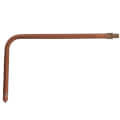
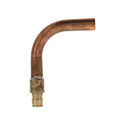
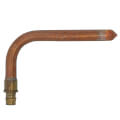
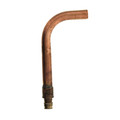
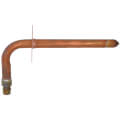
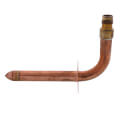
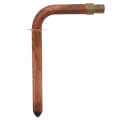
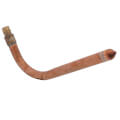

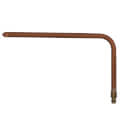
ProPEX stub out elbows create a fixed 90-degree transition point where a PEX supply line comes out of a wall or floor to meet a fixture, valve, or appliance connection. Each elbow uses Uponor's ProPEX expansion system, which requires a dedicated ProPEX expansion tool and a separate PEX ring rather than a crimp or clamp. Sizes commonly used on residential work include a 1/2 inch PEX to 1/2 inch copper stub and a 1 inch PEX to 1 inch copper stub, letting the fitting land on either PEX or copper depending on what the fixture connection needs. For domestic hot water applications, the connection is rated to stay under 140 degrees Fahrenheit at 80 psi per ASTM F2023. Because the stub out is mounted directly to a wall plate or blocking, it holds its position through drywall and finish work far better than an unsupported PEX run.
Subcategories
- 1/2 Inch ProPEX Stub Out Elbows: The 1/2 inch size is the most common stub out used for individual fixture supplies, such as a sink, toilet, or washing machine connection. It transitions 1/2 inch PEX tubing to a 1/2 inch copper stub that a shutoff valve or supply line connects to directly. Mounting the stub to a bracket or blocking before drywall goes up keeps the fitting from moving once the fixture trim is installed. The ProPEX expansion connection on the tubing side needs the matching size expansion tool and ring.
- 1 Inch ProPEX Stub Out Elbows: 1 inch stub out elbows handle larger supply runs, such as a main branch feeding a water heater or a multi-fixture manifold takeoff. The larger diameter carries more flow with less pressure drop over a long run compared to stepping down to a smaller stub early. Contractors mount these to more substantial blocking given the larger fitting's weight and the higher flow pressure moving through it. Both ends still use the same PEX-to-copper transition design as the smaller size.
- ProPEX Rings & Expansion Tools: Rings and expansion tools are sold separately from the stub out elbow itself and are required to complete the ProPEX connection. The expansion tool stretches the PEX tubing and ring before it's slid over the fitting's barb, and the tubing then contracts back down to grip the fitting as it cools. Ring size must match the tubing and fitting diameter exactly, since a mismatched ring won't seal. Keeping spare rings in the correct sizes on the truck avoids a trip back to the supply house mid-installation.
Buying Guide
Confirm which fixture or valve connection the stub needs to land on before ordering, since ProPEX Stub Out Elbows come with either a 1/2 inch or 1 inch copper stub on the fixture side and choosing wrong means adding a reducer or coupling later. Check that a ProPEX expansion tool in the matching size is on hand before the job starts, since the connection can't be made with a standard crimp or clamp tool. Order enough rings in the correct size for every stub on the job, plus a few spares, since a ring is a small, easy part to lose or damage during installation. Mount the stub to solid blocking or a manufactured bracket before closing up the wall, since an unsupported stub can shift out of alignment when the fixture trim is installed later. For a domestic hot water application, verify the system's operating temperature and pressure stay within the fitting's rating of 140 degrees Fahrenheit at 80 psi, since exceeding that rating on a commercial or high-temperature system calls for a different fitting altogether. On a multi-fixture job, standardizing on one stub size across similar fixtures cuts down on the number of ring sizes that need to be stocked. Double check the stub's rough-in depth against the finished wall thickness so the fitting ends up flush once trim is installed, not recessed or proud of the surface.
Frequently Asked Questions
Do ProPEX stub out elbows need a special tool to install?
Yes, the PEX side of the connection uses Uponor's ProPEX expansion system, which requires a ProPEX expansion tool and a matching-size ring rather than a crimp or clamp tool. The copper side of the stub connects with a standard sweat, compression, or threaded fitting depending on what the job needs.
What's the difference between the 1/2 inch and 1 inch stub out elbow?
The 1/2 inch size is sized for individual fixture supplies like a sink or toilet, while the 1 inch size handles larger branch runs such as a water heater feed or manifold takeoff. Both use the same PEX-to-copper transition design, just at different diameters.
Can a ProPEX stub out elbow be used outdoors or in a high-temperature system?
The rated operating conditions for domestic hot water applications stay under 140 degrees Fahrenheit at 80 psi per ASTM F2023, so a system running hotter or under higher pressure needs a different fitting. Checking the specific application against that rating before installation avoids a fitting failure later.
Why does the ProPEX ring need to match the tubing size exactly?
The ring is what holds the compression seal between the tubing and the fitting's barb after expansion, so a ring sized for a different diameter won't create a tight enough seal. A loose or mismatched ring is one of the more common causes of a slow leak at a ProPEX connection.
How should a stub out elbow be supported before drywall goes up?
Mounting the stub to solid blocking or a manufactured bracket keeps it from shifting position while the wall is finished and the fixture trim is installed. An unsupported stub can move enough to throw off the alignment needed for a clean fixture connection.
