




Filters
SORT
Product Availability –
Size –
Review Score –
 --%3E %3Csvg version='1.1' id='Fill' xmlns='http://www.w3.org/2000/svg' xmlns:xlink='http://www.w3.org/1999/xlink' x='0px' y='0px' viewBox='0 0 100 100' enable-background='new 0 0 100 100' xml:space='preserve'%3E %3Cpath fill='%23F15C02' d='M79.44,0.95H20.56C9.78,0.95,0.95,9.78,0.95,20.56v58.87c0,10.79,8.82,19.61,19.61,19.61h58.87 c10.79,0,19.61-8.83,19.61-19.61V20.56C99.05,9.78,90.22,0.95,79.44,0.95z M65.38,58.24l9.38,29.58L49.69,69.78L24.5,87.82 l9.34-29.6L8.8,39.6l30.73-0.17c0,0,6.98-19.61,10-28.93c0.54,1.36,9.88,29.1,9.88,29.1H91.2L65.38,58.24z'/%3E %3C/svg%3E)
Price Range –
Service Weight Cast Iron Fittings



 --%3E %3Csvg version='1.1' id='No-RB' xmlns='http://www.w3.org/2000/svg' xmlns:xlink='http://www.w3.org/1999/xlink' x='0px' y='0px' viewBox='0 0 100 100' enable-background='new 0 0 100 100' xml:space='preserve'%3E %3Cpath fill='%23CECECE' d='M79.44,0.95H20.56C9.78,0.95,0.95,9.78,0.95,20.56v58.87c0,10.79,8.82,19.61,19.61,19.61h58.87 c10.79,0,19.61-8.83,19.61-19.61V20.56C99.05,9.78,90.22,0.95,79.44,0.95z M65.38,58.24l9.38,29.58L49.69,69.78L24.5,87.82 l9.34-29.6L8.8,39.6l30.73-0.17c0,0,6.98-19.61,10-28.93c0.54,1.36,9.88,29.1,9.88,29.1H91.2L65.38,58.24z'/%3E %3C/svg%3E)





Service weight cast iron fittings are drainage, waste, and vent fittings made to the lighter of the two common cast iron wall-thickness standards, paired with hub-and-spigot cast iron soil pipe rather than the newer no-hub style. Plumbers use them to build or repair above- and below-ground DWV systems in older buildings where the original piping is hub-and-spigot cast iron, since matching the fitting style keeps the joint compatible with what's already in the wall or under the slab. The hub end accepts a spigot with a gasket or traditional oakum-and-lead joint, while the spigot end fits into the next fitting's hub down the line.
Because service weight fittings are thinner-walled than extra heavy fittings, they're intended for standard residential and light-commercial drainage loads rather than the higher-pressure or heavy-traffic applications extra heavy iron is built for. Contractors working on older multi-family buildings, renovations, and repair jobs need this style specifically because mixing wall thicknesses or joint types on the same run can create a fitting mismatch that won't seal properly.
Subcategories
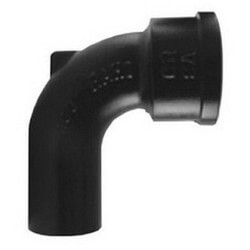
- Hub & Spigot Bends and Elbows: These change the direction of a drain or vent line while keeping the traditional hub-and-spigot joint style throughout the run. They're sized to match standard cast iron soil pipe diameters and are used anywhere a run needs to turn without switching to a different joining method. Common bend angles include 1/4 bend (90°), 1/8 bend (45°), and 1/16 bend (22.5°).
- Tees and Wyes: Tees and wyes let a plumber branch a secondary line off a main drain or vent stack. A wye fitting joins the branch at an angle that follows the direction of flow, which is the preferred choice on drain lines to avoid trapping solids at a sharp turn. Tees are more commonly used on vent piping, where flow direction matters less.
- No-Hub Adapters: No-hub adapters let a plumber transition from hub-and-spigot pipe to no-hub cast iron or another pipe material using a no-hub band clamp instead of a caulked joint. Renovation and repair crews use these to tie new work into an existing hub-and-spigot system without re-running the whole line in the older joint style.
- Cleanouts: Cleanout fittings provide an accessible opening into the drain line for clearing blockages, capped with a threaded plug that can be removed with a wrench. They're placed at required intervals along a drain run and at changes in direction per local plumbing code, and they come in both straight and Y-branch configurations to match the fitting they're installed on.
Buying Guide
The first thing to confirm on any service weight cast iron job is that the existing pipe is genuinely hub-and-spigot, not no-hub. The two systems use different joining methods and aren't interchangeable without an adapter, so matching the fitting family to what's already installed is the starting point for the whole order.
Pipe diameter needs to match the existing line exactly, since cast iron fittings aren't designed to be forced onto an undersized or oversized pipe. Measure the existing pipe's outside diameter rather than assuming a nominal size, especially on older buildings where dimensions can vary slightly from current standards.
Decide on a joint method for any new connections into the old system. Traditional oakum-and-lead joints are still used on some restoration work, but a gasketed compression joint is faster to install and doesn't require melting lead on site, which many contractors prefer for repair and renovation work.
Fitting configuration should match the actual drainage path. Wyes are the right choice for branch connections on drain lines because the angled entry keeps waste moving in the right direction, while a straight tee is more appropriate on vent-only branches where flow direction isn't a concern.
Confirm local code requirements for cleanout placement and spacing before finalizing an order, since requirements vary by jurisdiction and by whether the line is a repair versus new construction. Building in the required cleanouts up front avoids a callback to cut into finished work later.
Frequently Asked Questions
What's the difference between service weight and extra heavy cast iron fittings?
Service weight fittings have a thinner wall than extra heavy fittings and are built for standard residential and light-commercial drainage loads. Extra heavy fittings are used where a heavier-duty application calls for the added wall thickness, so the two aren't meant to be mixed on the same run.
Can I connect service weight cast iron to no-hub cast iron pipe?
Yes, with a no-hub adapter fitting that lets a no-hub band clamp join to the hub-and-spigot piece. This is a common way to tie new work into an older system without recreating the original joint style.
Do I need to use lead and oakum joints on service weight fittings?
Not necessarily. Gasketed compression joints are widely used today and are faster to install than traditional oakum-and-lead joints, though some restoration work still calls for the traditional method to match existing construction.
How do I know what size fitting I need?
Measure the outside diameter of the existing pipe rather than relying on a nominal size, since older cast iron installations can vary slightly from current standard dimensions. Matching the actual measured diameter avoids a fitting that won't seat properly.
Where are cleanouts required on a cast iron drain line?
Requirements vary by local plumbing code, but cleanouts are generally required at intervals along a run and at significant changes in direction. Checking the local code before finalizing the fitting layout helps avoid having to cut into finished work later.
