




Spray Nozzles


 --%3E %3Csvg version='1.1' id='Fill' xmlns='http://www.w3.org/2000/svg' xmlns:xlink='http://www.w3.org/1999/xlink' x='0px' y='0px' viewBox='0 0 100 100' enable-background='new 0 0 100 100' xml:space='preserve'%3E %3Cpath fill='%23F15C02' d='M79.44,0.95H20.56C9.78,0.95,0.95,9.78,0.95,20.56v58.87c0,10.79,8.82,19.61,19.61,19.61h58.87 c10.79,0,19.61-8.83,19.61-19.61V20.56C99.05,9.78,90.22,0.95,79.44,0.95z M65.38,58.24l9.38,29.58L49.69,69.78L24.5,87.82 l9.34-29.6L8.8,39.6l30.73-0.17c0,0,6.98-19.61,10-28.93c0.54,1.36,9.88,29.1,9.88,29.1H91.2L65.38,58.24z'/%3E %3C/svg%3E)


 --%3E %3Csvg version='1.1' id='Half' xmlns='http://www.w3.org/2000/svg' xmlns:xlink='http://www.w3.org/1999/xlink' x='0px' y='0px' viewBox='0 0 100 100' enable-background='new 0 0 100 100' xml:space='preserve'%3E %3Cg%3E %3Cpath fill='%23F15C02' d='M30.05,70.23l3.79-12.01L8.8,39.6l30.73-0.17c0,0,6.98-19.61,10-28.93c0.54,1.36,9.88,29.1,9.88,29.1h1.58 L93.71,7.18c-3.58-3.82-8.66-6.23-14.28-6.23H20.56C9.78,0.95,0.95,9.78,0.95,20.56v58.87c0,5.41,2.22,10.32,5.79,13.88 L30.05,70.23z'/%3E %3C/g%3E %3Cpath fill='%23FBC8B4' d='M93.71,7.18L60.98,39.6H91.2L65.38,58.24l9.38,29.58L49.69,69.78L24.5,87.82l5.55-17.59L6.75,93.32 c3.55,3.54,8.44,5.73,13.82,5.73h58.87c10.79,0,19.61-8.83,19.61-19.61V20.56C99.05,15.4,97.01,10.69,93.71,7.18z'/%3E %3C/svg%3E)


 --%3E %3Csvg version='1.1' id='No-RB' xmlns='http://www.w3.org/2000/svg' xmlns:xlink='http://www.w3.org/1999/xlink' x='0px' y='0px' viewBox='0 0 100 100' enable-background='new 0 0 100 100' xml:space='preserve'%3E %3Cpath fill='%23CECECE' d='M79.44,0.95H20.56C9.78,0.95,0.95,9.78,0.95,20.56v58.87c0,10.79,8.82,19.61,19.61,19.61h58.87 c10.79,0,19.61-8.83,19.61-19.61V20.56C99.05,9.78,90.22,0.95,79.44,0.95z M65.38,58.24l9.38,29.58L49.69,69.78L24.5,87.82 l9.34-29.6L8.8,39.6l30.73-0.17c0,0,6.98-19.61,10-28.93c0.54,1.36,9.88,29.1,9.88,29.1H91.2L65.38,58.24z'/%3E %3C/svg%3E)





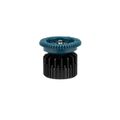


Spray nozzles are the interchangeable tips that thread onto pop-up spray bodies and risers to control how water leaves an irrigation zone, shaping output into arcs, full circles, strips, or rotating streams. Contractors match nozzle type to throw radius, arc angle, and precipitation rate so a zone waters evenly without soaking hardscape or leaving dry corners. Hunter's Pro Adjustable Nozzles, for instance, rotate through a full 0 to 360 degree arc, letting one nozzle style cover triangular beds, rectangular lawns, and everything between. Because the nozzle, not the valve or the pipe, sets flow pattern and distance, swapping a mismatched nozzle is often the fastest fix for uneven coverage, overspray, or a customer complaint about a soggy patch near a driveway. Getting nozzle selection right on install day cuts callbacks and keeps water use in line with local restrictions, which matters on both residential accounts and commercial contracts where coverage complaints and water audits are common.
Subcategories
- Adjustable Arc Nozzles: Adjustable arc nozzles let an installer dial in coverage from a narrow sliver up to a complete circle on a single nozzle body, which cuts down on the number of SKUs a truck needs to stock. Hunter's Pro Adjustable Nozzle line rotates through a full 0 to 360 degree arc and ships in radius models labeled 8A through 17A, each with a matched precipitation rate so mixed arcs on one zone still water evenly. Landscapers use them on irregular residential lawns, corner lots, and planting beds where a fixed pattern would leave gaps or overspray a sidewalk. Because the arc adjusts in the field with a small tool or by hand, techs can fine-tune coverage during the final walkthrough instead of swapping parts.
- Fixed Pattern Nozzles: Fixed pattern nozzles come preset to a specific arc, such as quarter circle, half circle, or full circle, rather than adjusting on site. Rain Bird's MPR Series is built across 5, 8, 10, and 15 foot radius models with matched precipitation rates and color-coded tops, so a tech can mix radii and arcs on the same zone without creating dry or overwatered spots. Installers reach for fixed pattern nozzles on standard rectangular lawns and commercial zones where the layout rarely changes and a preset pattern installs faster than an adjustable one. The color coding also speeds up identification during maintenance visits, since a tech can spot the radius from the nozzle color alone.
- Rotator Nozzles: Rotator nozzles throw multiple rotating streams instead of a single spray pattern, which lowers precipitation rate and improves distribution uniformity on larger turf areas. Hunter's MP Rotator line spans an 8 to 35 foot radius across its models, with the MP3000 covering 22 to 30 feet at a 0.4 inch per hour precipitation rate and an adjustable arc. Property managers and commercial landscapers favor rotators on larger lawns and slopes because the slower application rate reduces runoff compared to standard spray nozzles. Arc and radius adjust independently on most models, so one nozzle can be dialed in for a specific zone without swapping to a different unit.
- Strip Pattern Nozzles: Strip pattern nozzles spray a narrow rectangular pattern instead of an arc or circle, built specifically for long, thin planting strips. Hunter's SS-530 covers a 5 by 30 foot rectangular area, making it a fit for medians, walkway borders, and narrow beds squeezed between a driveway and a fence line. Irrigation techs specify strip nozzles when a round or arc pattern would overspray hardscape along a narrow bed. Because the throw is rectangular rather than radial, strip nozzles typically get installed in a row along the length of the strip rather than as a single point source.
Buying Guide
Start with the zone shape before picking a nozzle. Rectangular lawns and consistent bed shapes usually call for fixed pattern nozzles, since a preset arc installs faster and there's nothing to adjust or accidentally bump out of alignment. Irregular lots, corner properties, and mixed-shape beds are better suited to adjustable arc nozzles, which let a tech dial in coverage on site instead of carrying multiple fixed models on the truck.
Radius and area size drive the next decision. Smaller residential zones typically pair well with standard adjustable or fixed pattern nozzles in the 8 to 17 foot range, while larger turf areas, slopes, or properties with runoff concerns benefit from rotator nozzles, which apply water at a slower precipitation rate and reduce puddling on compact soil. Selecting spray nozzles for a mixed zone means checking that precipitation rates are matched across all nozzles on that valve, otherwise some areas will dry out while others stay soaked.
Narrow strips between hardscape, such as walkway borders or medians, call for strip pattern nozzles rather than forcing an arc or circle nozzle to cover an oddly shaped space. Matching precipitation rate across a zone matters more than matching brand, since mixed manufacturers with the same rated output will still distribute water evenly. Confirm thread size and body compatibility with the existing pop-up or riser before ordering replacements for an established system.
Frequently Asked Questions
What's the difference between adjustable arc and fixed pattern nozzles?
Adjustable arc nozzles let a technician set the coverage arc anywhere from 0 to 360 degrees on site, which works well for irregular lot shapes. Fixed pattern nozzles come preset to a specific arc, such as quarter or half circle, and install faster on standard rectangular zones. Both nozzle types can carry a matched precipitation rate, so mixing them on one valve doesn't cause uneven watering as long as the rated output matches.
When should a rotator nozzle get used instead of a standard spray nozzle?
Rotator nozzles apply water at a slower precipitation rate than standard spray nozzles, which reduces runoff on slopes and compact soil. Larger turf areas also benefit from rotators because one nozzle, such as the MP3000, covers a 22 to 30 foot radius rather than the shorter throw of a standard nozzle. Rotators are a common swap when a property has recurring puddling or runoff complaints along a specific zone.
What nozzle works best for a narrow strip of lawn between a driveway and a fence?
Strip pattern nozzles are built for exactly that layout, spraying a rectangular pattern instead of an arc or circle. Hunter's SS-530, for example, covers a 5 by 30 foot rectangular area, which fits narrow beds and medians without overspraying hardscape along the sides. Installing strip nozzles in a row along the length of the space usually gives more even coverage than trying to angle a standard arc nozzle into the same area.
Can nozzles from different manufacturers be mixed on the same irrigation zone?
Mixing manufacturers on one zone works as long as the precipitation rates match across every nozzle on that valve. Rain Bird's MPR Series and Hunter's Pro Adjustable Nozzles both publish matched precipitation rate data by radius model, which makes cross-referencing straightforward. Checking the rated precipitation rate before mixing brands avoids the dry spots or oversaturation that come from mismatched output.
How does a technician adjust the arc on an existing nozzle without replacing it?
Most adjustable arc and rotator nozzles have an arc adjustment ring built into the nozzle body, adjustable by hand or with a small tool. Hunter's Pro Adjustable Nozzle line adjusts through a full 0 to 360 degree range without removing the nozzle from the riser. Field adjustment during a walkthrough is usually faster than swapping to a different fixed pattern nozzle when coverage needs a small correction.
