




Filters
SORT
Product Availability –
Brand –
Capillary Length –
Max Temp (F) –
Min Temp (F) –
Review Score –
 --%3E %3Csvg version='1.1' id='Fill' xmlns='http://www.w3.org/2000/svg' xmlns:xlink='http://www.w3.org/1999/xlink' x='0px' y='0px' viewBox='0 0 100 100' enable-background='new 0 0 100 100' xml:space='preserve'%3E %3Cpath fill='%23F15C02' d='M79.44,0.95H20.56C9.78,0.95,0.95,9.78,0.95,20.56v58.87c0,10.79,8.82,19.61,19.61,19.61h58.87 c10.79,0,19.61-8.83,19.61-19.61V20.56C99.05,9.78,90.22,0.95,79.44,0.95z M65.38,58.24l9.38,29.58L49.69,69.78L24.5,87.82 l9.34-29.6L8.8,39.6l30.73-0.17c0,0,6.98-19.61,10-28.93c0.54,1.36,9.88,29.1,9.88,29.1H91.2L65.38,58.24z'/%3E %3C/svg%3E)
 --%3E %3Csvg version='1.1' id='With-RB' xmlns='http://www.w3.org/2000/svg' xmlns:xlink='http://www.w3.org/1999/xlink' x='0px' y='0px' viewBox='0 0 100 100' enable-background='new 0 0 100 100' xml:space='preserve'%3E %3Cpath fill='%23FBC8B4' d='M79.44,0.95H20.56C9.78,0.95,0.95,9.78,0.95,20.56v58.87c0,10.79,8.82,19.61,19.61,19.61h58.87 c10.79,0,19.61-8.83,19.61-19.61V20.56C99.05,9.78,90.22,0.95,79.44,0.95z M65.38,58.24l9.38,29.58L49.69,69.78L24.5,87.82 l9.34-29.6L8.8,39.6l30.73-0.17c0,0,6.98-19.61,10-28.93c0.54,1.36,9.88,29.1,9.88,29.1H91.2L65.38,58.24z'/%3E %3C/svg%3E)
Price Range –
Freeze Stats


 --%3E %3Csvg version='1.1' id='No-RB' xmlns='http://www.w3.org/2000/svg' xmlns:xlink='http://www.w3.org/1999/xlink' x='0px' y='0px' viewBox='0 0 100 100' enable-background='new 0 0 100 100' xml:space='preserve'%3E %3Cpath fill='%23CECECE' d='M79.44,0.95H20.56C9.78,0.95,0.95,9.78,0.95,20.56v58.87c0,10.79,8.82,19.61,19.61,19.61h58.87 c10.79,0,19.61-8.83,19.61-19.61V20.56C99.05,9.78,90.22,0.95,79.44,0.95z M65.38,58.24l9.38,29.58L49.69,69.78L24.5,87.82 l9.34-29.6L8.8,39.6l30.73-0.17c0,0,6.98-19.61,10-28.93c0.54,1.36,9.88,29.1,9.88,29.1H91.2L65.38,58.24z'/%3E %3C/svg%3E)


 --%3E %3Csvg version='1.1' id='Half' xmlns='http://www.w3.org/2000/svg' xmlns:xlink='http://www.w3.org/1999/xlink' x='0px' y='0px' viewBox='0 0 100 100' enable-background='new 0 0 100 100' xml:space='preserve'%3E %3Cg%3E %3Cpath fill='%23F15C02' d='M30.05,70.23l3.79-12.01L8.8,39.6l30.73-0.17c0,0,6.98-19.61,10-28.93c0.54,1.36,9.88,29.1,9.88,29.1h1.58 L93.71,7.18c-3.58-3.82-8.66-6.23-14.28-6.23H20.56C9.78,0.95,0.95,9.78,0.95,20.56v58.87c0,5.41,2.22,10.32,5.79,13.88 L30.05,70.23z'/%3E %3C/g%3E %3Cpath fill='%23FBC8B4' d='M93.71,7.18L60.98,39.6H91.2L65.38,58.24l9.38,29.58L49.69,69.78L24.5,87.82l5.55-17.59L6.75,93.32 c3.55,3.54,8.44,5.73,13.82,5.73h58.87c10.79,0,19.61-8.83,19.61-19.61V20.56C99.05,15.4,97.01,10.69,93.71,7.18z'/%3E %3C/svg%3E)

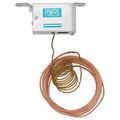
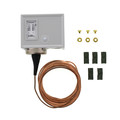
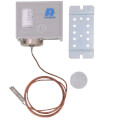
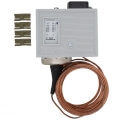
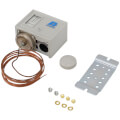
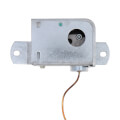

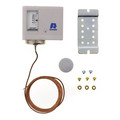
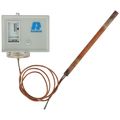


Freeze stats are safety switches installed on HVAC coils and air handling equipment to detect dangerously low temperatures and shut down the system before a coil freezes and ruptures.
A capillary tube running across the face of a chilled water or refrigerant coil senses temperature along its entire length, tripping the switch if any section drops below the set threshold, commonly around 36 to 38 degrees.
Reacting to the coldest point along the coil rather than a single spot sensor is what makes this style of control reliable in systems with uneven airflow across the coil face.
Technicians install freeze stats primarily on air handling units serving cold climates or on systems prone to low airflow conditions, since a frozen and split coil is an expensive repair and a guaranteed system outage.
Manual-reset models are common in commercial applications specifically so a technician has to diagnose the underlying airflow or refrigerant issue before the system restarts, rather than letting it cycle back on into the same freezing condition.
Subcategories
- Manual-Reset Freeze Stats: Manual-reset freeze stats require a technician to physically reset the switch after it trips, forcing a diagnosis of the underlying cause before the equipment restarts. Contractors specify this style on commercial air handlers where an automatic restart into the same freezing condition could damage the coil further. The manual reset button is typically located on the switch housing for easy access. Requiring a manual reset prevents a nuisance trip from silently resolving itself and hiding a real problem.
- Automatic-Reset Freeze Stats: Automatic-reset freeze stats clear themselves once coil temperature rises back above the set threshold, restarting the equipment without technician intervention. Contractors use them on applications where brief, self-correcting temperature dips are expected and a service call for every trip isn't practical. Some residential and light commercial installs suit this style better than manual-reset switches. Monitoring for repeated trips still matters, since frequent cycling points to an ongoing airflow problem.
- Capillary Tube Length Options: Capillary tube length varies to match coil face dimensions, with longer tubes covering wider coils and providing more sensing points along the airflow path. Technicians select a tube length that spans the full coil face rather than just a section, since a short tube can miss a localized cold spot caused by uneven airflow. Mounting clips secure the tube evenly across the coil fins. Proper coverage is the main factor separating a reliable installation from a nuisance-prone one.
- Replacement Switches and Housings: Replacement switches and housings let a technician restore a freeze stat to working condition without replacing the entire capillary tube assembly if only the electrical switch has failed. Contractors check the original switch's trip temperature and electrical rating before ordering a replacement to keep the control acting exactly as designed. Housings are typically weatherproof for outdoor air handler installations. Swapping just the switch saves time compared to rerouting a new capillary tube across the coil.
Buying Guide
Choosing the right freeze stat starts with confirming the coil face dimensions so the capillary tube length fully spans the airflow path, since a tube that's too short can miss a cold spot and defeat the whole purpose of the control.
Trip temperature settings typically fall in the 36 to 38 degree range for most chilled water applications, but checking the specific coil manufacturer's recommendation avoids nuisance trips or, worse, a setting too low to protect the coil.
Freeze stats split mainly between manual and automatic reset styles, and manual-reset switches are the better choice for most commercial installations, since forcing a technician to investigate before restarting the system catches airflow or refrigerant charge problems that an automatic reset would simply paper over.
Mounting the capillary tube evenly across the coil fins, using the manufacturer's clips rather than improvised fasteners, keeps the sensor reading representative of the whole coil rather than a single point.
Technicians servicing rooftop units in cold climates should factor in wind exposure and airflow patterns specific to that unit, since a freeze stat sized correctly on paper can still trip unexpectedly if installed in a spot with unusual air stratification.
Keeping a replacement switch on hand separate from a full capillary tube assembly is worth it for routine service work, since most freeze stat failures are electrical rather than a damaged capillary tube.
Frequently Asked Questions
What temperature does a freeze stat typically trip at?
Most freeze stats trip in the 36 to 38 degree range, though the exact setting depends on the specific coil and application. Checking the coil manufacturer's recommendation before setting or replacing a freeze stat avoids nuisance trips or inadequate protection. Commercial chilled water systems commonly use settings within this range.
Why does the capillary tube need to cover the whole coil face?
The capillary tube senses temperature along its entire length and trips if any single point drops below the threshold, which only works if the tube spans the full coil face. A short tube can miss a localized cold spot caused by uneven airflow. Full coverage is what makes this control reliable compared to a single-point sensor.
Should I choose a manual-reset or automatic-reset freeze stat?
Manual-reset switches are generally the safer choice for commercial systems, since they force a technician to diagnose the cause before the equipment restarts. Automatic-reset switches suit applications where brief, self-correcting dips are expected and a service call for every trip isn't practical. The choice often comes down to how critical avoiding repeated trips is for that particular system.
Can I replace just the switch without replacing the whole freeze stat?
Many freeze stats allow the electrical switch to be replaced separately from the capillary tube assembly if only the switch has failed. Matching the replacement switch's trip temperature and electrical rating to the original keeps the control working as designed. Swapping only the switch saves the labor of rerouting a new capillary tube.
What causes a freeze stat to trip repeatedly?
Frequent trips usually point to an ongoing airflow restriction, a refrigerant charge issue, or a damper stuck in the wrong position rather than a faulty freeze stat itself. Diagnosing the underlying cause before resetting the switch prevents repeated coil damage risk. A technician should treat repeated trips as a system problem, not a control malfunction, until proven otherwise.
