



Filters
SORT
Product Availability –
Connection Type –
Inlet Size –
Outlet Size –
Refrigerant Type –
Ton –
Review Score –
 --%3E %3Csvg version='1.1' id='Fill' xmlns='http://www.w3.org/2000/svg' xmlns:xlink='http://www.w3.org/1999/xlink' x='0px' y='0px' viewBox='0 0 100 100' enable-background='new 0 0 100 100' xml:space='preserve'%3E %3Cpath fill='%23F15C02' d='M79.44,0.95H20.56C9.78,0.95,0.95,9.78,0.95,20.56v58.87c0,10.79,8.82,19.61,19.61,19.61h58.87 c10.79,0,19.61-8.83,19.61-19.61V20.56C99.05,9.78,90.22,0.95,79.44,0.95z M65.38,58.24l9.38,29.58L49.69,69.78L24.5,87.82 l9.34-29.6L8.8,39.6l30.73-0.17c0,0,6.98-19.61,10-28.93c0.54,1.36,9.88,29.1,9.88,29.1H91.2L65.38,58.24z'/%3E %3C/svg%3E)
Price Range –
HF/HFK Series Thermal Expansion Valves


 --%3E %3Csvg version='1.1' id='No-RB' xmlns='http://www.w3.org/2000/svg' xmlns:xlink='http://www.w3.org/1999/xlink' x='0px' y='0px' viewBox='0 0 100 100' enable-background='new 0 0 100 100' xml:space='preserve'%3E %3Cpath fill='%23CECECE' d='M79.44,0.95H20.56C9.78,0.95,0.95,9.78,0.95,20.56v58.87c0,10.79,8.82,19.61,19.61,19.61h58.87 c10.79,0,19.61-8.83,19.61-19.61V20.56C99.05,9.78,90.22,0.95,79.44,0.95z M65.38,58.24l9.38,29.58L49.69,69.78L24.5,87.82 l9.34-29.6L8.8,39.6l30.73-0.17c0,0,6.98-19.61,10-28.93c0.54,1.36,9.88,29.1,9.88,29.1H91.2L65.38,58.24z'/%3E %3C/svg%3E)



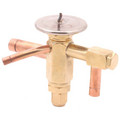



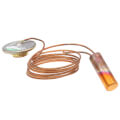
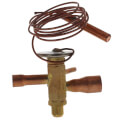

HF/HFK Series Thermal Expansion Valves regulate refrigerant flow into the evaporator coil of a refrigeration, air conditioning, or heat pump system, matching the flow rate to the load on the coil. Manufactured by Emerson Flow Controls, the HF line uses a balanced port design and a stainless steel power element that resists corrosion, which helps the valve hold its calibration over years of cycling. Two body sizes cover a wide capacity range, from a quarter ton up to twenty tons, so the same valve family fits everything from a small split system to a rooftop package unit. Technicians can order a complete finished valve, a service kit with a swap-in power element and cage, or individual components when only one part failed. Getting the sizing and equalization type right on a replacement keeps superheat stable and protects the compressor from liquid slugging.
Subcategories
- Complete HF/HFK Valves: Complete HF and HFK valves ship fully assembled and ready to braze into the liquid line, with the power element, cage, and body already matched at the factory. Refrigeration and HVAC technicians use these on new installations or when a full valve replacement is simpler than a field rebuild. The balanced port design holds a steady superheat setting across a range of condensing pressures. Available connection sizes run from 1/4 inch up to 7/8 inch ODF on the larger tonnage models.
- HFK Service Kits: HFK service kits bundle a valve body, power element, and cage so a technician can rebuild an expansion valve already brazed into a system. Contractors reach for a kit when only the internal parts have failed and cutting out the whole valve body isn't necessary. Kits are sized to match the tonnage and connection size of the original installed valve. Rebuilding with a kit typically takes less time than removing and replacing a brazed-in valve body.
- Power Elements: Power elements are the thermostatic sensing bulb and diaphragm assembly that drives the valve's pin position in response to evaporator outlet temperature. Techs replace a power element on its own when the valve body and cage are still in good condition but the charge has lost its calibration. Each element is stamped for a specific refrigerant type, so matching the element to the system charge is required for correct superheat control. Power elements are available for standard flow and bi-flow valve bodies.
- Bi-Flow Valves: Bi-flow HF valves control superheat in both the cooling and heating cycle of a heat pump, so a single valve handles refrigerant flow in either direction through the coil. Bi-flow capacity on the HF line is rated up to five and a half tons on R-22 systems. Installers use bi-flow construction to simplify heat pump piping, since a separate check valve and expansion valve for each direction isn't needed. Beyond the rated tonnage cutoff, separate directional valves are the more common setup.
- Distributor Assemblies and Cages: The cage sits inside the valve body and houses the pin and seat that the power element positions to meter refrigerant flow. Techs order a replacement cage when the metering components are worn or damaged but the power element and body are still serviceable. A distributor assembly then splits the metered refrigerant evenly among the multiple circuits of the evaporator coil. Matching the cage size to the original valve tonnage keeps the metering characteristics consistent after a rebuild.
Buying Guide
Matching an HF/HFK valve to a system starts with tonnage. Undersized valves starve the evaporator and cause low superheat or flooding at the compressor, while oversized valves cause excess superheat and reduced capacity. Confirming the tonnage rating on the original valve, or calculating system capacity from the compressor and coil data, sets the right starting point before ordering.
Connection size and type come next. HF/HFK valves are available with SAE flare connections and ODF sweat connections in sizes from 1/4 inch through 7/8 inch, so the replacement needs to match both the tonnage and the existing line set connections to avoid adding adapters. HF/HFK Series Thermal Expansion Valves also come in standard flow and bi-flow versions, and a heat pump application generally calls for the bi-flow body so a single valve manages both the cooling and heating cycle.
Equalization type matters on longer line sets or systems with a pressure drop across the evaporator. Internally equalized valves work on shorter, simpler coil circuits, while externally equalized valves sense pressure directly at the evaporator outlet and hold superheat more accurately on coils with more pressure drop.
For a rebuild rather than a full replacement, an HFK service kit lets a technician swap the power element and cage without removing the brazed-in body, provided the body itself shows no damage or contamination from a prior compressor failure.
Frequently Asked Questions
What is the difference between the HF and HFK designation?
HF refers to a complete, factory assembled expansion valve, while HFK denotes a service kit that bundles a valve body, power element, and cage for a field rebuild. Techs use HFK kits when they need to update calibration or repair a system without buying a full new valve. Both share the same balanced port design and connection types across the series.
How do I know which power element I need?
The power element ships with the refrigerant charge marked on the element itself, matched to the system's refrigerant type and application. Ordering the wrong element for the refrigerant in the system prevents the valve from holding correct superheat. Cross-reference the old element's stamped number, or check the SupplyHouse listing for the matching part before ordering.
What does bi-flow mean on an HF valve?
A bi-flow HF valve controls superheat in both directions, so a single valve handles the cooling cycle and the heating cycle on a heat pump. Bi-flow capacity is rated up to five and a half tons on R-22 systems, above which separate valves for each cycle are typically used. Bi-flow construction simplifies heat pump piping since only one expansion device sits in the line.
Can I rebuild an HF valve instead of replacing it?
Yes; an HFK service kit lets a tech replace the power element and cage without removing the valve body from the line, provided the existing body is not damaged or contaminated. Rebuilding saves labor on a brazed-in valve where cutting out the whole body isn't practical. Confirm the kit number matches the body's tonnage and connection size before starting the repair.
What tonnage range does the HF/HFK Series cover?
The HF/HFK line spans a quarter ton up to twenty tons across two body sizes, covering equipment from small split systems to larger rooftop and commercial refrigeration units. Selecting the correct tonnage keeps the valve properly matched to the evaporator load. Undersized or oversized valves both lead to poor superheat control and reduced system efficiency.
