




Jobsite Radios & Speakers


 --%3E %3Csvg version='1.1' id='Fill' xmlns='http://www.w3.org/2000/svg' xmlns:xlink='http://www.w3.org/1999/xlink' x='0px' y='0px' viewBox='0 0 100 100' enable-background='new 0 0 100 100' xml:space='preserve'%3E %3Cpath fill='%23F15C02' d='M79.44,0.95H20.56C9.78,0.95,0.95,9.78,0.95,20.56v58.87c0,10.79,8.82,19.61,19.61,19.61h58.87 c10.79,0,19.61-8.83,19.61-19.61V20.56C99.05,9.78,90.22,0.95,79.44,0.95z M65.38,58.24l9.38,29.58L49.69,69.78L24.5,87.82 l9.34-29.6L8.8,39.6l30.73-0.17c0,0,6.98-19.61,10-28.93c0.54,1.36,9.88,29.1,9.88,29.1H91.2L65.38,58.24z'/%3E %3C/svg%3E)


 --%3E %3Csvg version='1.1' id='No-RB' xmlns='http://www.w3.org/2000/svg' xmlns:xlink='http://www.w3.org/1999/xlink' x='0px' y='0px' viewBox='0 0 100 100' enable-background='new 0 0 100 100' xml:space='preserve'%3E %3Cpath fill='%23CECECE' d='M79.44,0.95H20.56C9.78,0.95,0.95,9.78,0.95,20.56v58.87c0,10.79,8.82,19.61,19.61,19.61h58.87 c10.79,0,19.61-8.83,19.61-19.61V20.56C99.05,9.78,90.22,0.95,79.44,0.95z M65.38,58.24l9.38,29.58L49.69,69.78L24.5,87.82 l9.34-29.6L8.8,39.6l30.73-0.17c0,0,6.98-19.61,10-28.93c0.54,1.36,9.88,29.1,9.88,29.1H91.2L65.38,58.24z'/%3E %3C/svg%3E)


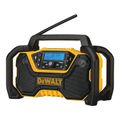
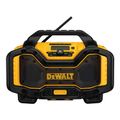

Jobsite radios & speakers are ruggedized audio units built to run on a construction site's power tool batteries or standard AC current instead of relying on a wall outlet. A cordless jobsite speaker running on 12V MAX, 20V MAX, or FLEXVOLT batteries streams audio over Bluetooth up to 100 ft. away, while a detachable AC cord covers sites with grid power available. A dual power setup like that makes these units practical on a framing site one day and a finished space the next.
Housing design matters as much as power source: a metal grille and impact-resistant body stand up to drops and jobsite dust that would damage a consumer speaker. For crews running plumbing, HVAC, or electrical work through a long install, a jobsite radio that shares battery packs with existing power tools cuts down on extra chargers and dead batteries at the end of a shift.
Subcategories
- Battery-Powered Speakers: Battery-powered speakers run on the same cordless battery packs as a crew's drills and saws, such as 12V MAX, 20V MAX, or FLEXVOLT platforms. Techs use these on sites without reliable grid power, like new construction before permanent electrical service is live. Sharing a battery platform with other tools means fewer separate chargers on the truck.
- AC/Battery Hybrid Radios: AC/battery hybrid radios run on a detachable AC cord when grid power is available and switch to battery power when it isn't. Crews moving between finished spaces with outlets and rough framing without power use this flexibility most. A hybrid unit removes the need to carry two separate audio devices for different site conditions.
- Bluetooth-Enabled Units: Bluetooth-enabled units stream audio wirelessly from a phone or tablet up to roughly 100 ft. away, letting a tech keep a device in a pocket or truck cab. Signal range holds up well across an open jobsite but can drop with walls or equipment in the way. Manual controls on the unit itself back up phone-based volume and playback control.
- Rugged and Weather-Resistant Models: Rugged and weather-resistant models use a metal grille and impact-resistant housing to survive drops, dust, and light moisture exposure common on active jobsites. Crews working outdoor or unfinished sites need this durability more than a finished-space install would. An integrated USB charging port on many rugged models doubles as a phone charging station during a shift.
Buying Guide
Power source is the first thing to check against actual site conditions. A crew working new construction before permanent power is live needs a unit that runs on existing cordless battery packs, while a crew in finished commercial or residential spaces can rely on an AC cord alone. A hybrid unit that does both covers a crew moving between site types without carrying two separate speakers.
Matching battery platform matters just as much as power source itself. Jobsite radios & speakers built for a specific voltage platform, such as 12V MAX, 20V MAX, or FLEXVOLT, only share packs with tools on that same platform, so a crew running a different brand's batteries won't get the shared-charger benefit. Confirming platform compatibility with the tools already on the truck avoids buying a speaker that needs its own dedicated batteries.
Durability and connectivity round out the decision. A metal grille and impact-resistant housing matter most on active construction or outdoor sites where drops and dust are routine, while a finished-space install can prioritize sound quality over ruggedness. Bluetooth range in the 100 ft. class covers most single-floor jobsites, and a built-in USB charging port adds practical value for keeping crew phones charged through a long shift.
Frequently Asked Questions
Can a jobsite speaker run on power tool batteries?
Many jobsite speakers run on the same cordless battery platform as a brand's drills and saws, such as 12V MAX, 20V MAX, or FLEXVOLT packs. Sharing a battery platform means one charger covers both tools and speaker. Confirming platform compatibility with existing tools avoids buying a unit that needs its own dedicated batteries.
How far does Bluetooth reach on a jobsite speaker?
Bluetooth connectivity on most jobsite units reaches up to roughly 100 ft. in open conditions. Walls, equipment, and other obstructions can shorten that range on an active site. Manual controls on the unit itself provide a backup when a phone is out of reliable range.
Are jobsite radios durable enough for construction sites?
Rugged jobsite units use a metal grille and impact-resistant housing built to survive drops and dust common on active construction sites. Durability like this matters most on outdoor or unfinished spaces where a consumer speaker wouldn't hold up. Crews working finished, controlled environments have more flexibility to prioritize sound quality over ruggedness.
Does a jobsite speaker need AC power or batteries?
Hybrid units run on a detachable AC cord when grid power is available and switch to battery power when it isn't. Flexibility like this suits crews moving between finished spaces with outlets and rough framing without power. A battery-only or AC-only unit works fine when site conditions stay consistent.
Can a jobsite speaker charge a phone while playing audio?
Many rugged jobsite speaker models include an integrated USB charging port that charges a phone while streaming audio. A charging port like this doubles as practical device charging during a long shift without a separate charger. The feature is common on higher-end battery-and-AC hybrid units.
