




Filters
SORT
Product Availability –
Brand –
Size –
Review Score –
 --%3E %3Csvg version='1.1' id='Fill' xmlns='http://www.w3.org/2000/svg' xmlns:xlink='http://www.w3.org/1999/xlink' x='0px' y='0px' viewBox='0 0 100 100' enable-background='new 0 0 100 100' xml:space='preserve'%3E %3Cpath fill='%23F15C02' d='M79.44,0.95H20.56C9.78,0.95,0.95,9.78,0.95,20.56v58.87c0,10.79,8.82,19.61,19.61,19.61h58.87 c10.79,0,19.61-8.83,19.61-19.61V20.56C99.05,9.78,90.22,0.95,79.44,0.95z M65.38,58.24l9.38,29.58L49.69,69.78L24.5,87.82 l9.34-29.6L8.8,39.6l30.73-0.17c0,0,6.98-19.61,10-28.93c0.54,1.36,9.88,29.1,9.88,29.1H91.2L65.38,58.24z'/%3E %3C/svg%3E)
Price Range –
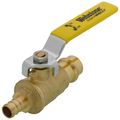
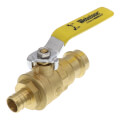
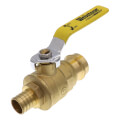
PEX Crimp x Copper Press Ball Valves


 --%3E %3Csvg version='1.1' id='No-RB' xmlns='http://www.w3.org/2000/svg' xmlns:xlink='http://www.w3.org/1999/xlink' x='0px' y='0px' viewBox='0 0 100 100' enable-background='new 0 0 100 100' xml:space='preserve'%3E %3Cpath fill='%23CECECE' d='M79.44,0.95H20.56C9.78,0.95,0.95,9.78,0.95,20.56v58.87c0,10.79,8.82,19.61,19.61,19.61h58.87 c10.79,0,19.61-8.83,19.61-19.61V20.56C99.05,9.78,90.22,0.95,79.44,0.95z M65.38,58.24l9.38,29.58L49.69,69.78L24.5,87.82 l9.34-29.6L8.8,39.6l30.73-0.17c0,0,6.98-19.61,10-28.93c0.54,1.36,9.88,29.1,9.88,29.1H91.2L65.38,58.24z'/%3E %3C/svg%3E)
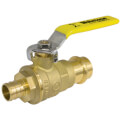
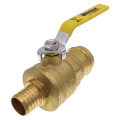
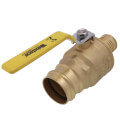
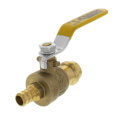
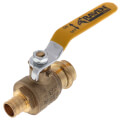
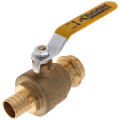
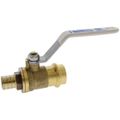


PEX crimp by copper press ball valves let a plumber install a shutoff valve directly at the transition point between PEX tubing and copper pipe, without needing a separate coupling and valve. One end accepts a standard PEX crimp ring for connection to cross-linked polyethylene tubing, while the other end is pressed onto copper pipe using a press tool rather than soldered, which keeps an open flame away from areas where PEX tubing is already in place nearby. Combining the transition fitting and shutoff into one valve body reduces the number of joints in a run, and fewer joints mean fewer potential leak points over the life of the system. These valves see frequent use in repipe work, where a plumber is extending an existing copper system with PEX branch lines, and in new construction where a mix of copper and PEX is specified by design. Full-port and standard-port versions are both available, with full-port valves offering less flow restriction through the open valve.
Subcategories
- Full-Port Ball Valves: Full-port valves have a bore diameter that matches the pipe's inside diameter, which keeps flow resistance to a minimum through the open valve. Plumbers specify full-port valves on main shutoffs and other locations where restricting flow even slightly is undesirable. The larger bore also allows a drain snake or camera to pass through more easily during future service work.
- Standard-Port Ball Valves: Standard-port valves use a smaller bore than the connected pipe, which introduces some flow restriction but typically costs less than a full-port equivalent. These suit branch line shutoffs and other locations where the valve is closed most of the time and flow restriction during normal operation is not a practical concern. Smaller bore construction can also mean a more compact valve body for tight installation spaces.
- Lead-Free Ball Valves: Built to meet lead-free potable water requirements, these valves are suited to any domestic water line supplying fixtures used for drinking or cooking. Contractors working on potable water systems specify lead-free construction as a baseline requirement rather than an upgrade, since most jurisdictions now require it by code. Material certification should be confirmed before use on any potable water application.
Buying Guide
Choosing a PEX crimp by copper press ball valve starts with confirming both connection sizes match the tubing and pipe already in place or specified for a new run. The PEX crimp side needs to match the tubing's nominal size and the crimp ring standard already in use on the rest of the system, while the copper press side needs to match the pipe diameter and be compatible with the press tool jaw already owned or available on the job.
Port size is the next decision. Full-port valves keep flow resistance to a minimum and suit main shutoffs or any location where restricting flow is undesirable, while standard-port valves cost less and work well on branch lines that stay closed most of the time. Neither option is universally correct, so matching port size to the valve's role in the system, rather than defaulting to one type across an entire job, gets the best result for both cost and performance.
Material certification matters on any potable water installation. Lead-free construction is required by code in most jurisdictions for valves supplying fixtures used for drinking or cooking, so confirming that certification before ordering avoids a failed inspection or a valve that needs to be replaced after installation. Pressing the copper side onto pipe rather than soldering it also means confirming the press tool and jaw size on hand are compatible with the valve's connection before starting the job, since a mismatched jaw can damage the fitting instead of sealing it.
Frequently Asked Questions
What is the advantage of a PEX crimp by copper press valve over a separate coupling and valve?
Combining the transition and shutoff into one valve body reduces the number of joints in a run, and fewer joints mean fewer potential leak points over the life of the system.
What is the difference between full-port and standard-port valves?
Full-port valves have a bore that matches the pipe's inside diameter, keeping flow resistance to a minimum, while standard-port valves use a smaller bore that costs less but restricts flow slightly more.
Does the copper side need to be soldered?
No, the copper side is pressed onto the pipe using a press tool rather than soldered, which keeps an open flame away from areas where PEX tubing may already be installed nearby.
Is lead-free construction required for these valves?
Most jurisdictions require lead-free construction by code for any valve supplying fixtures used for drinking or cooking water, so confirming that certification before ordering is standard practice on potable water jobs.
What tools are needed to install the copper press connection?
A press tool with a jaw sized to match the valve's connection is required, and confirming jaw compatibility before starting the job avoids damaging the fitting instead of sealing it.
