




Filters
SORT
Product Availability –
Size –
Thread Type –
Review Score –
 --%3E %3Csvg version='1.1' id='Fill' xmlns='http://www.w3.org/2000/svg' xmlns:xlink='http://www.w3.org/1999/xlink' x='0px' y='0px' viewBox='0 0 100 100' enable-background='new 0 0 100 100' xml:space='preserve'%3E %3Cpath fill='%23F15C02' d='M79.44,0.95H20.56C9.78,0.95,0.95,9.78,0.95,20.56v58.87c0,10.79,8.82,19.61,19.61,19.61h58.87 c10.79,0,19.61-8.83,19.61-19.61V20.56C99.05,9.78,90.22,0.95,79.44,0.95z M65.38,58.24l9.38,29.58L49.69,69.78L24.5,87.82 l9.34-29.6L8.8,39.6l30.73-0.17c0,0,6.98-19.61,10-28.93c0.54,1.36,9.88,29.1,9.88,29.1H91.2L65.38,58.24z'/%3E %3C/svg%3E)
Price Range –
Sharkbite Male Adapters

 --%3E %3Csvg version='1.1' id='No-RB' xmlns='http://www.w3.org/2000/svg' xmlns:xlink='http://www.w3.org/1999/xlink' x='0px' y='0px' viewBox='0 0 100 100' enable-background='new 0 0 100 100' xml:space='preserve'%3E %3Cpath fill='%23CECECE' d='M79.44,0.95H20.56C9.78,0.95,0.95,9.78,0.95,20.56v58.87c0,10.79,8.82,19.61,19.61,19.61h58.87 c10.79,0,19.61-8.83,19.61-19.61V20.56C99.05,9.78,90.22,0.95,79.44,0.95z M65.38,58.24l9.38,29.58L49.69,69.78L24.5,87.82 l9.34-29.6L8.8,39.6l30.73-0.17c0,0,6.98-19.61,10-28.93c0.54,1.36,9.88,29.1,9.88,29.1H91.2L65.38,58.24z'/%3E %3C/svg%3E)


 --%3E %3Csvg version='1.1' id='Half' xmlns='http://www.w3.org/2000/svg' xmlns:xlink='http://www.w3.org/1999/xlink' x='0px' y='0px' viewBox='0 0 100 100' enable-background='new 0 0 100 100' xml:space='preserve'%3E %3Cg%3E %3Cpath fill='%23F15C02' d='M30.05,70.23l3.79-12.01L8.8,39.6l30.73-0.17c0,0,6.98-19.61,10-28.93c0.54,1.36,9.88,29.1,9.88,29.1h1.58 L93.71,7.18c-3.58-3.82-8.66-6.23-14.28-6.23H20.56C9.78,0.95,0.95,9.78,0.95,20.56v58.87c0,5.41,2.22,10.32,5.79,13.88 L30.05,70.23z'/%3E %3C/g%3E %3Cpath fill='%23FBC8B4' d='M93.71,7.18L60.98,39.6H91.2L65.38,58.24l9.38,29.58L49.69,69.78L24.5,87.82l5.55-17.59L6.75,93.32 c3.55,3.54,8.44,5.73,13.82,5.73h58.87c10.79,0,19.61-8.83,19.61-19.61V20.56C99.05,15.4,97.01,10.69,93.71,7.18z'/%3E %3C/svg%3E)


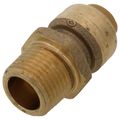
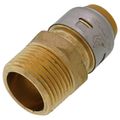
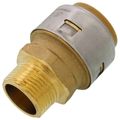
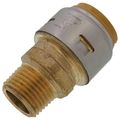
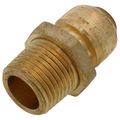


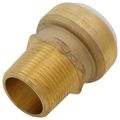
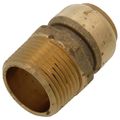


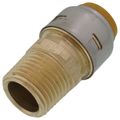
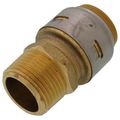
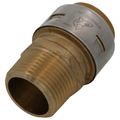
Sharkbite Male Adapters connect PEX, copper, CPVC, or PE-RT pipe to a female NPT fitting without soldering, crimping, or gluing. The Max version carries a pressure rating of 400 psi at 200°F, while earlier-generation SharkBite adapters are rated to 200 psi at the same temperature, so checking which generation is going into a system matters before ordering. Every Max adapter uses a stainless steel retainer paired with a DZR lead-free brass body, giving the fitting strength against pull-out while resisting dezincification in hard water. Installers push the pipe in, and the fitting can be pressure tested immediately, even on wet lines, without waiting for solvent cement or solder joints to cure. Because the connection can be rotated after installation, adapters can be aligned to a fixture or valve after the pipe is already seated, which speeds up rough-in work where alignment shifts during framing or drywall.
Subcategories
- Standard Push Male Adapters: Standard push male adapters use SharkBite's original push-to-connect design to join PEX, copper, or CPVC pipe to a male NPT threaded fitting. They carry a pressure rating of 200 psi at 200°F, which covers most residential potable water and hydronic lines. Installers use these where a quick transition from push-fit tubing to a threaded valve or fixture is needed without soldering or crimping.
- Max Push Male Adapters: Max push male adapters step up the pressure rating to 400 psi at 200°F, giving contractors more margin on commercial jobs or systems that see higher working pressure. A stainless steel retainer and DZR lead-free brass body back that higher rating while resisting dezincification. Crews doing commercial rough-in or repair on higher-pressure systems reach for the Max line over the standard adapter.
- Max Push Slip Male Adapters: Max Push Slip Male Adapters offer the same push-to-connect design as other Max adapters, built with a stainless steel retainer and DZR lead-free brass body rated to 400 psi at 200°F. Plumbers use the slip configuration on repair jobs where pipe positioning is tighter than a standard install allows. The higher pressure rating keeps it usable on the same commercial systems as the standard Max adapter.
- PVC Push-to-Connect Male Adapters: PVC push-to-connect male adapters extend the same tool-free connection to PVC pipe, joining it to a male NPT thread without solvent cement. Installers use them on drain, waste, and vent lines or irrigation runs where PVC is already in place and a threaded transition is needed. The push-fit body still allows the connection to be rotated after installation for final alignment.
Buying Guide
Pressure rating is the first thing to check when picking a push-to-connect adapter for a job. Standard adapters top out at 200 psi at 200°F, which handles most residential water and heating lines, while Max-series adapters push that to 400 psi at 200°F for commercial systems or applications with a higher safety margin requirement. Confirming which rating a system needs before ordering avoids installing an adapter that's undersized for the working pressure it will see.
Pipe material compatibility comes next. Sharkbite Male Adapters connect PEX, copper, CPVC, and PE-RT pipe to a male NPT thread, and a separate line handles PVC pipe specifically, so matching the adapter to the pipe already in the wall or floor keeps the install straightforward. Repair jobs add another variable: standard adapters need full pipe insertion, while slip-style Max adapters give more flexibility when a pipe section is fixed in place and can't be pulled back for a standard connection.
Installation conditions matter too. Adapters approved for use behind walls without an access panel and underground with proper wrapping cover most rough-in scenarios, but confirming that approval for the specific model before burying a joint saves a callback. Because the connection can be rotated into final position after the pipe is fully seated, aligning the adapter to a fixture happens after the push-fit connection is made, not before.
Frequently Asked Questions
What's the pressure rating difference between standard and Max SharkBite male adapters?
Standard SharkBite male adapters are rated to 200 psi at 200°F. Max-series adapters raise that to 400 psi at 200°F, using a stainless steel retainer and DZR lead-free brass body to support the higher rating.
Can these adapters go on copper pipe?
Sharkbite Male Adapters connect PEX, copper, CPVC, and PE-RT pipe to a male NPT thread without soldering or crimping. Copper is one of the standard compatible pipe materials across the adapter line.
Do these fittings need special tools to install?
Installation is tool-free: pipe pushes directly into the fitting without soldering, crimping, or gluing. Pressure testing can happen immediately after install, even on wet lines.
Are these adapters rated for underground or behind-the-wall use?
Sharkbite Male Adapters are approved for behind-the-wall installation without an access panel and for underground use when wrapped as specified. Confirming that approval on the specific model before burying a connection is worth the extra minute.
How does a slip-style Max adapter differ from a standard Max adapter?
Both share the same stainless steel retainer and DZR lead-free brass body rated to 400 psi at 200°F. The slip configuration is built for repair jobs where pipe positioning is tighter than what a standard full-insertion adapter allows.
