


'/%3E%3C/svg%3E)
 --%3E %3Csvg version='1.1' id='Fill' xmlns='http://www.w3.org/2000/svg' xmlns:xlink='http://www.w3.org/1999/xlink' x='0px' y='0px' viewBox='0 0 100 100' enable-background='new 0 0 100 100' xml:space='preserve'%3E %3Cpath fill='%23F15C02' d='M79.44,0.95H20.56C9.78,0.95,0.95,9.78,0.95,20.56v58.87c0,10.79,8.82,19.61,19.61,19.61h58.87 c10.79,0,19.61-8.83,19.61-19.61V20.56C99.05,9.78,90.22,0.95,79.44,0.95z M65.38,58.24l9.38,29.58L49.69,69.78L24.5,87.82 l9.34-29.6L8.8,39.6l30.73-0.17c0,0,6.98-19.61,10-28.93c0.54,1.36,9.88,29.1,9.88,29.1H91.2L65.38,58.24z'/%3E %3C/svg%3E)
' fill='%23F15C02' d='M49 0C21.938 0 0 21.938 0 49s21.938 49 49 49 49-21.938 49-49S76.062 0 49 0m0 82.709a7.54 7.54 0 1 1 0-15.08 7.54 7.54 0 0 1 0 15.08m7.54-28.412a7.541 7.541 0 0 1-15.08 0V22.831a7.54 7.54 0 0 1 15.08 0v31.466z'/%3E%3C/svg%3E)
MANUALS (3)
'/%3E%3C/svg%3E)

 --%3E %3Csvg version='1.1' id='With-RB' xmlns='http://www.w3.org/2000/svg' xmlns:xlink='http://www.w3.org/1999/xlink' x='0px' y='0px' viewBox='0 0 100 100' enable-background='new 0 0 100 100' xml:space='preserve'%3E %3Cpath fill='%23FBC8B4' d='M79.44,0.95H20.56C9.78,0.95,0.95,9.78,0.95,20.56v58.87c0,10.79,8.82,19.61,19.61,19.61h58.87 c10.79,0,19.61-8.83,19.61-19.61V20.56C99.05,9.78,90.22,0.95,79.44,0.95z M65.38,58.24l9.38,29.58L49.69,69.78L24.5,87.82 l9.34-29.6L8.8,39.6l30.73-0.17c0,0,6.98-19.61,10-28.93c0.54,1.36,9.88,29.1,9.88,29.1H91.2L65.38,58.24z'/%3E %3C/svg%3E)

Product Highlights


Description
Please Note:
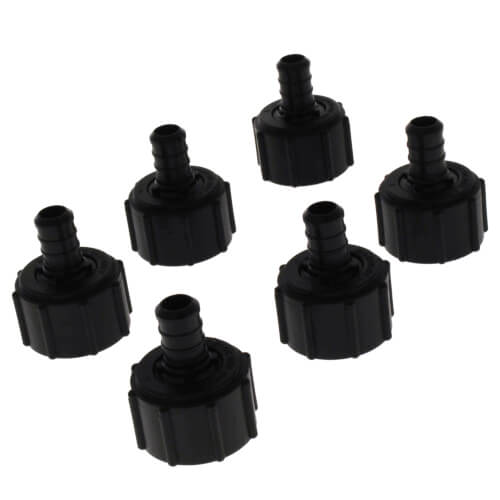
- Supply adapters must be purchased separately and are required to install this product.
- Mounting straps are optional and are sold separately.
- The 10-year warranty only applies if this MANABLOC is installed with all Viega products.
- 53601: MANABLOC Supply End Cap does not come included and must be purchased separately.
**Important**
- The MANABLOC plumbing system carries a maximum pressure/temperature rating of 100 psi @ 180°F. Excessive pressure to the MANABLOC will cause leaks.
- Do not allow chemicals such as PVC glues or solder flux to come into contact with the MANABLOC. They will compromise the integrity of the MANABLOC and cause leaks.
- Please consult the MANABLOC install instructions for a more comprehensive list of chemical materials that will cause harm to the MANABLOC plumbing system.
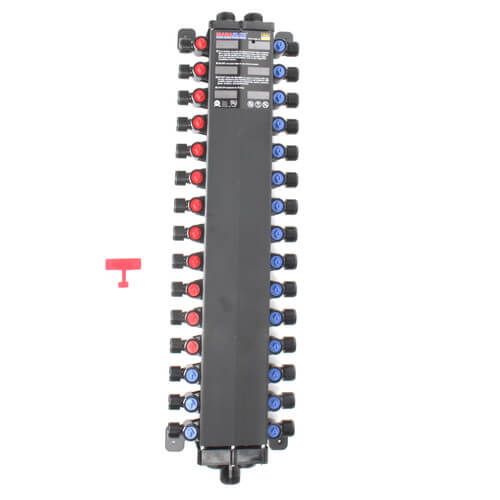
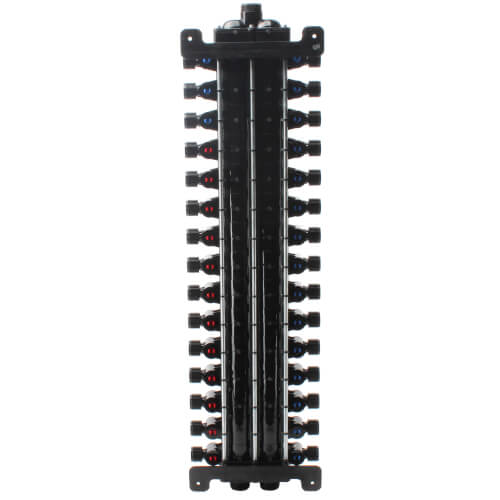
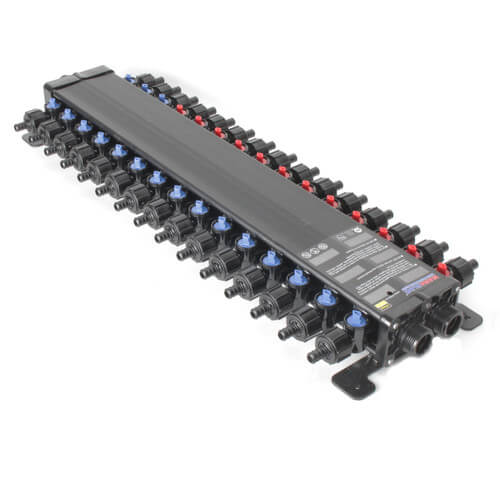
PollyAlloy PEX Crimp MANABLOCs provide a home-run distribution manifold for the plumbing system. These MANABLOCs utilize either 3/8" or 1/2" distribution lines. Each MANABLOC comes factory pre-assembled with color coded hot and cold ports. All PollyAlloy PEX Crimp MANABLOCs include port Crimp connections, drill templates, instruction guide, faceplate and port labels.
Specs
| Port Size: | 1/2" |
|---|---|
| Fitting System Compatibility: | Clamp Crimp |
| Material: | Plastic |
| Application: | Plumbing |
| Outlet Type: | PEX |
| Number of Outlets: | 30 |
| Number of Outlets (Cold): | 18 |
| Number of Outlets (Hot): | 12 |
| Tubing Compatibility: | PEX |
| Warranty: | 10 Year |

Questions?
You May Also Need
2 Replacement Parts

Need help finding a replacement part?
Product Reviews
Most Liked Positive Review
Once a geek always a geek
Most Liked Negative Review
Not rebuildable if broken
Manabloc with PEX x Threaded ends

A quality Product
Just what I ordered. Fast service
Works great so far
Works Great
Not sure.
Amazing costumer service
Beats a branched line install
Great company.
Makes a clean look
Product Q&A
45 QuestionsQ: The manual for the manabloc shows a "divider" plate. Can the user move the divider plate to provide for more hot ports and fewer cold ports?
Asked by OldHouseJunkie 14 years ago
Add your answer
Verified Reply- PexSupply StaffNo, this is not recommended.
No, the plate cannot be moved. Choose a different model for more / less ports.
I would doubt you are able to move it... I think its pretty sealed up... If you need more hot ports just order a larger one and cap the ports you don't use. Sent from my iPhone
No
No. In order to get the number of hot ports you will need, you'll have to buy a manifold with the number you need. The details will show how many of each port is provide with each type of manablock.
Q: In the technical data it says this item is made from polysulfone (PLS) plastic. A typical polysulfone is produced by the reaction of a diphenol and bis(4-chlorophenyl)sulfone, forming a polyether by elimination of sodium chloride. The diphenol is typically bisphenol-A or, 1,4-dihydroxybenzene. This type of plastic can contain BPA biphensol-A. Does this product contain BPA?
Asked by Lou 14 years ago
Add your answer
Verified Reply- PexSupply StaffViegaPEX tubing is BPA free.
https://www.greenbuildingadvisor.com/blogs/dept/qa-spotlight/how-safe-pex-tubing This is the article that I read prior to making my decision. One of the tipping factors was that the mineral leech from galvanic corrosion (copper piping issue) was much more prevalent. The effects of BPA ingestion from water leeching is minimal; however, the ingestion of copper corrosives is not as benign. I switched my basement from copper to Pex and immediately noticed a difference in water quality.
Q: Can the Manabloc Crimp manifold be installed with the water supply line on top and the water heater lines on the bottom? In other words, can it be installed upside down from the way you depict it in your pictures? I want to be able to gravity drain the system for winterizing. Tom
Asked by Tom 14 years ago
Add your answer
Verified Reply- PexSupply StaffYes, you can install the MANABLOC in any direction.
Yes, I had a situation where i needed the water at the bottom. I called Manabloc and it was OK. You also can plug/ cap the hot out and just use the outlet valves
I don't see why you couldn't mount it upside down and add drain valves to the 3/4" supply lines for easy draining of the system. It's a sealed pressurized system so it doesn't rely on gravity. I added a bunch of 1" ball valves on my supply lines so I could shut off one or both of my manifolds easily. You could leave one end of a ball valve open so you can drain the whole system in minutes. Brian
Another follow up to my response - The manifold has two 3/4" inlets on top and one 3/4" inlet on the bottom. The top left is the hot and top right is the cold. The bottom you can use to feed another manifold, but most people cap it off. I don't think you could use that to drain the hot water, though, just the cold water. To accomplish what you want just flip the manifold upside down and add a Tee with ball valves on each supply line that are open for draining (into buckets or route a PEX line to a drain or outside). Then your cap would be on the top and gravity should take care of the draining. On my system the water drained out a lot better than my old copper lines when I was installing and testing. Brian
yes
Yes, you can turn the manabloc in either direction. Good luck with your project. WKM
My dad owns and operates a small plumbing company and uses these products all the time. I have helped install them many times and although we have never needed to do so I can't think of a reason y it can't be done, sounds like a great idea. Ian Sent from my iPhone
No problem, it will work fine either way. I have one mounted "right-side-up" with the supply on the bottom, and have a drain valve in the supply line (on the manifold side of the shutoff) for easy winterizing. But every installation is unique. Go for it. Joe
Q: We are considering replacing our copper plumbing system in a 60+ year old home with an all PEX homerun system using a 24-port Manabloc manifold. Our water is considered mildly "aggressive" which is causing many small pin leaks in the copper. It also corrodes some of our brass fittings over time. Are the Viega brass crimp connectors appropriate in this environment? Would we be better served with the polyalloy crimp fittings? Does Pexsupply.com offer a 24-port Manabloc with polyalloy crimp adapters?
Asked by DBM DIY Homeowner 14 years ago
Add your answer
Verified Reply- PexSupply StaffIf your water corrodes brass fittings, we would recommend that you use the PolyAlloy version of this crimp MANABLOC. We do not stock it, but it is available for special order (part 50243).
Your crimp connectors will not be affected by "aggressive" water, as they will not interact with the water. They slip around the plastic tubing and serve only to hold the tubing to the adapters. As for the brass adapters themselves, they should also fair better in your new Pex system. Much of the corrosion that brass pieces are subject to is known as galvanic corrosion. This occurs when two dissimilar metals come in contact in a fluid system. Since you are changing to a plastic piping system, your brass adapters will last much longer. I have had my Pex system for 2 years now, and have had no troubles since I've installed it.
Good idea replacing copper with PEX. Most corrosion in metallic plumbing is due to electrolysis where water as the electrolyte completes a circuit between two dissimilar metal portions of the plumbing. A standard method of blocking this is to use dielectric unions between the different metals in the system, where a standard union is augmented with an electrically insulating plastic member between the two sides.. PEX tubing does not conduct, so a PEX system provides excellent electrical isolation between the occasional metallic piece in the system, much reducing if not eliminating corrosion. You might also want to have your water tested for pH and install a treatment if needed to bring pH into a reasonable range. Joe
Q: My water main has a connector right at the meter that converts it to 1/2". Should I change that to 3/4" as well as make the connections to my HWH 3/4" as well? Everything is 1/2" right now.
Asked by Woodsy 14 years ago
Add your answer
Verified Reply- PexSupply StaffWe would recommend 3/4" to ensure that each line receives adequate flow.
if you're converting from copper to pex, I would definitly go up to 3/4" for the main supply line. Reason being, the measurement is based on the outside diameter of the pipe... so 1/2" copper is actually larger based on the inside diameter compared to 1/2" pex... then, ontop of that, when you do a "fitting" with copper, the fitting goes on the outside of the copper (so it doesn't effect the inside diameter of the pipe), but with Pex, the fitting goes on the INSIDE of the tube, thus causing an even greater decrease in the inside diameter of the pipe, and a bottleneck at that location. so I would upsize to 3/4" for that reason alone... ontop of that, I'm assuming you're using 1/2" for all the breakouts... so you want your main supply line to be larger than the supply line for each individual sink/tub/toilet... (personally, I went with 1" for the main line in... which was 3/4" copper to begin with, for the reason above... but I also tend to go overkill...)
If you can, do it. You will want that 3/4" main for good pressure to multiple 1/2" outlets.
If the ½” pipe carries enough flow for you now (without excessive pressure drop at full usage), there is little reason to go bigger, other than noise. ¾” pipe holds more water than ½” pipe, so the velocity for any given flow will be less. Less velocity = less noise. If you use ¾ after the water heater, the amount of hot water you have to fill the pipe with before it gets to where you want it will be higher than if you used ½”. But, it will be quieter. If you are running a single fixture off of each valve of the manifold. 3/8” pipe on the hot water side will give a faster hot water response than ½”, but, more noise. It is all a trade off.
Q: Looking to retrofit a manifold system in place of a copper branch set up. I have an oil boiler for heat (radiators) and domestic hot water. Currently it is 1/2 in copper (cold) to the boiler and 1/2 in coming back (hot). I see that the supply fittings are set up for 3/4 pex min, so I am going to need to reduce it somewhere. Any suggestions as to how? Should the reduction be made closer to the manabloc, so that the incoming hot line takes shorter time to purge? Anything else I should be thinking about with this set up?
Asked by Nate 14 years ago
Add your answer
Verified Reply- PexSupply StaffThe exact point of the reduction would not matter too much to our knowledge. If you decide to feed the MANABLOC with 1/2" our only concern would be that you may not be getting enough flow to supply all the lines.
Q: Do you sell an adapter to convert the 3/8" Manabloc ports to use 1/2" pex crimp?
Asked by 14 years ago
Add your answer
Verified Reply- PexSupply StaffYes, part 46634 can be used on any crimp MANABLOC to transition to a 1/2" crimp fittings.
Yes, I just got done using a mix of 1/2 and 3/8 on mine. The 1/2 port adapters are tricky to find on this site though, so here is a link http://www.pexsupply.com/Viega-46634-PEX-Crimp-Port-Adapter-1-2-PEX-Crimp-x-1-2-Port-Zero-Lead
Q: There are two cold water inlet/outlet on the manifold, does it matter which one I use for the supply inlet ?thanks
Asked by 14 years ago
Add your answer
Verified Reply- PexSupply StaffIt does not. Water pressure in the system will be sufficient to allow you to use it either way.
Yes and no. When you buy the manabloc install kit, you get two adapters and a plug for the single inlet. I got a third adaptor and ran soft water into the single inlet which in turn fills the three colds on the hot side as well as the cold side. The "inlet" on the cold side then becomes an outlet to the HWH. The inlet on the hot side comes from the HWH.
Q: I need to run 3 3/4 lines up to the second floor. One to feed a spare bathroom, one for a jetted shower and one for a whirlpool tub/toilet and 2 sinks. Should I branch off the incoming lines to the manabloc?
Asked by 14 years ago
Add your answer
Verified Reply- PexSupply StaffBranching off the main line would be your only option, as you cannot run 3/4" lines from the MANABLOC distribution ports.
Q: I require 26 cold connections and 18 hot connections for my installation. Am I able to connect two mannablocs together to create a larger manilfold allowing only one hot and cold water supply or will i have to run two separate manifolds with hot and cold supplies to both?
Asked by Jason 15 years ago
Add your answer
Verified Reply- PexSupply StaffIt may be easier to install MINIBLOCs in the lines. A part 50355 fitting could, theoretically, connect two MANABLOCs together, but it's really designed to connect MINIBLOCs directly to MANABLOCs. Getting two MANABLOCs to fit together would require them to face in different directions.
i believe you will have to run two but the way they are configured you can mount one just up from the other with minimal connections. btw good luck that sounds like a massive project. Im sure you will do fine.