




Filters
SORT
Product Availability –
Voltage –
Duct Size –
0" Ps –
0.2" Ps –
0.4" Ps –
0.6" Ps –
0.8" Ps –
1.0" Ps –
1.5" Ps –
2.0" Ps –
Review Score –
 --%3E %3Csvg version='1.1' id='Fill' xmlns='http://www.w3.org/2000/svg' xmlns:xlink='http://www.w3.org/1999/xlink' x='0px' y='0px' viewBox='0 0 100 100' enable-background='new 0 0 100 100' xml:space='preserve'%3E %3Cpath fill='%23F15C02' d='M79.44,0.95H20.56C9.78,0.95,0.95,9.78,0.95,20.56v58.87c0,10.79,8.82,19.61,19.61,19.61h58.87 c10.79,0,19.61-8.83,19.61-19.61V20.56C99.05,9.78,90.22,0.95,79.44,0.95z M65.38,58.24l9.38,29.58L49.69,69.78L24.5,87.82 l9.34-29.6L8.8,39.6l30.73-0.17c0,0,6.98-19.61,10-28.93c0.54,1.36,9.88,29.1,9.88,29.1H91.2L65.38,58.24z'/%3E %3C/svg%3E)
 --%3E %3Csvg version='1.1' id='With-RB' xmlns='http://www.w3.org/2000/svg' xmlns:xlink='http://www.w3.org/1999/xlink' x='0px' y='0px' viewBox='0 0 100 100' enable-background='new 0 0 100 100' xml:space='preserve'%3E %3Cpath fill='%23FBC8B4' d='M79.44,0.95H20.56C9.78,0.95,0.95,9.78,0.95,20.56v58.87c0,10.79,8.82,19.61,19.61,19.61h58.87 c10.79,0,19.61-8.83,19.61-19.61V20.56C99.05,9.78,90.22,0.95,79.44,0.95z M65.38,58.24l9.38,29.58L49.69,69.78L24.5,87.82 l9.34-29.6L8.8,39.6l30.73-0.17c0,0,6.98-19.61,10-28.93c0.54,1.36,9.88,29.1,9.88,29.1H91.2L65.38,58.24z'/%3E %3C/svg%3E)
Price Range –
FKD Series Inline Round Mixed Flow Centrifugal Fans


 --%3E %3Csvg version='1.1' id='Half' xmlns='http://www.w3.org/2000/svg' xmlns:xlink='http://www.w3.org/1999/xlink' x='0px' y='0px' viewBox='0 0 100 100' enable-background='new 0 0 100 100' xml:space='preserve'%3E %3Cg%3E %3Cpath fill='%23F15C02' d='M30.05,70.23l3.79-12.01L8.8,39.6l30.73-0.17c0,0,6.98-19.61,10-28.93c0.54,1.36,9.88,29.1,9.88,29.1h1.58 L93.71,7.18c-3.58-3.82-8.66-6.23-14.28-6.23H20.56C9.78,0.95,0.95,9.78,0.95,20.56v58.87c0,5.41,2.22,10.32,5.79,13.88 L30.05,70.23z'/%3E %3C/g%3E %3Cpath fill='%23FBC8B4' d='M93.71,7.18L60.98,39.6H91.2L65.38,58.24l9.38,29.58L49.69,69.78L24.5,87.82l5.55-17.59L6.75,93.32 c3.55,3.54,8.44,5.73,13.82,5.73h58.87c10.79,0,19.61-8.83,19.61-19.61V20.56C99.05,15.4,97.01,10.69,93.71,7.18z'/%3E %3C/svg%3E)



 --%3E %3Csvg version='1.1' id='No-RB' xmlns='http://www.w3.org/2000/svg' xmlns:xlink='http://www.w3.org/1999/xlink' x='0px' y='0px' viewBox='0 0 100 100' enable-background='new 0 0 100 100' xml:space='preserve'%3E %3Cpath fill='%23CECECE' d='M79.44,0.95H20.56C9.78,0.95,0.95,9.78,0.95,20.56v58.87c0,10.79,8.82,19.61,19.61,19.61h58.87 c10.79,0,19.61-8.83,19.61-19.61V20.56C99.05,9.78,90.22,0.95,79.44,0.95z M65.38,58.24l9.38,29.58L49.69,69.78L24.5,87.82 l9.34-29.6L8.8,39.6l30.73-0.17c0,0,6.98-19.61,10-28.93c0.54,1.36,9.88,29.1,9.88,29.1H91.2L65.38,58.24z'/%3E %3C/svg%3E)
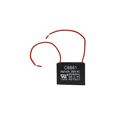
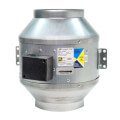

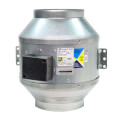
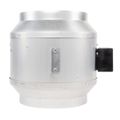


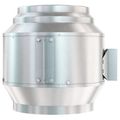

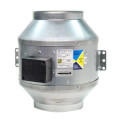

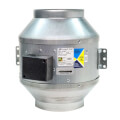

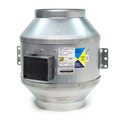
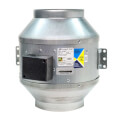


FKD series inline round mixed flow centrifugal fans are ventilation fans installed directly in round ductwork to move air for bathroom exhaust, general ventilation, or light commercial airflow applications. The mixed flow impeller design combines characteristics of both axial and centrifugal fans, giving these units the ability to maintain airflow against higher static pressure than a standard axial inline fan while still fitting into a compact round housing. That makes them a practical fit for duct runs with several bends, transitions, or longer lengths that would otherwise choke off airflow from a basic axial fan.
Installers typically mount these fans mid-run in accessible ceiling or attic space rather than at the grille itself, which keeps fan noise further from occupied rooms. The inline design also means the fan pulls double duty across multiple connected fixtures in some configurations, rather than requiring a separate fan at every exhaust point.
Subcategories
- Standard Duty Inline Fans: Sized for typical residential bathroom exhaust or single-room ventilation runs with moderate duct length. These balance airflow capacity with lower sound output for use near occupied living space. They're the most commonly specified option for straightforward residential jobs.
- High Static Pressure Inline Fans: Built for longer duct runs or systems with multiple bends and transitions where airflow resistance is higher. The mixed flow impeller in this tier is optimized to maintain performance under that added resistance rather than losing significant airflow. Contractors reach for these on jobs where duct routing isn't ideal.
- Multi-Port Inline Fans: Configured with multiple duct connections so a single fan can serve more than one exhaust point, such as a bathroom fan and a separate room vent on the same run. This reduces the number of fans needed in a multi-fixture ventilation layout. Balancing airflow across each port is part of correctly sizing this option for a job.
Buying Guide
Sizing starts with calculating the required airflow for the space being ventilated, typically based on room size and local code minimums for bathroom or general ventilation exhaust. Undersizing a fan for the duct run and fixture count leads to poor airflow at the grille even if the fan itself is rated for adequate output on paper.
Duct length and the number of bends in the run matter as much as room size when selecting a fan. A run with several 90-degree turns or a long horizontal distance to the exterior wall creates more static pressure resistance, and a fan not rated to handle that resistance will underperform regardless of its nameplate airflow rating.
Sound rating is worth checking against the intended installation location. A fan mounted farther from the occupied space in attic or ceiling cavity tolerates a slightly higher sound rating better than one that has to be mounted close to a bedroom or living area.
For jobs serving multiple fixtures off one duct run, confirm whether a multi-port configuration is appropriate versus running separate fans, since combining fixtures onto a single fan changes the airflow calculation for each connected point.
Finally, check electrical requirements and mounting orientation before finalizing an order, since some inline fan models have specific orientation requirements for proper condensate drainage and motor lubrication that affect where in the duct run they can be installed.
Frequently Asked Questions
What's the advantage of a mixed flow fan over a standard axial inline fan?
Mixed flow fans maintain airflow better against higher static pressure from long duct runs or multiple bends, while standard axial fans tend to lose more airflow as resistance increases. This makes mixed flow options a better fit for less-than-ideal duct routing.
Where should an inline fan be mounted in the duct run?
Most installations place the fan mid-run in accessible attic or ceiling space rather than directly at the exhaust grille, which helps keep operating noise further from occupied rooms. Specific orientation requirements should be checked against the fan's installation instructions.
Can one inline fan serve multiple bathroom fixtures?
Multi-port configurations exist specifically for this purpose, but the airflow calculation needs to account for every connected fixture to avoid undersizing the fan for the combined load.
How is fan size determined for a bathroom exhaust application?
Sizing is generally based on room square footage and local code minimum airflow requirements, then adjusted upward to account for duct length and the number of bends in the run.
Do these fans require a specific duct diameter?
Yes, inline fans in this category are built for a specific round duct diameter, so confirming the existing or planned ductwork size before ordering is necessary for a proper fit.
