




Filters
SORT
Product Availability –
Air Flow Capacity (CFM) –
Review Score –
 --%3E %3Csvg version='1.1' id='Fill' xmlns='http://www.w3.org/2000/svg' xmlns:xlink='http://www.w3.org/1999/xlink' x='0px' y='0px' viewBox='0 0 100 100' enable-background='new 0 0 100 100' xml:space='preserve'%3E %3Cpath fill='%23F15C02' d='M79.44,0.95H20.56C9.78,0.95,0.95,9.78,0.95,20.56v58.87c0,10.79,8.82,19.61,19.61,19.61h58.87 c10.79,0,19.61-8.83,19.61-19.61V20.56C99.05,9.78,90.22,0.95,79.44,0.95z M65.38,58.24l9.38,29.58L49.69,69.78L24.5,87.82 l9.34-29.6L8.8,39.6l30.73-0.17c0,0,6.98-19.61,10-28.93c0.54,1.36,9.88,29.1,9.88,29.1H91.2L65.38,58.24z'/%3E %3C/svg%3E)
 --%3E %3Csvg version='1.1' id='With-RB' xmlns='http://www.w3.org/2000/svg' xmlns:xlink='http://www.w3.org/1999/xlink' x='0px' y='0px' viewBox='0 0 100 100' enable-background='new 0 0 100 100' xml:space='preserve'%3E %3Cpath fill='%23FBC8B4' d='M79.44,0.95H20.56C9.78,0.95,0.95,9.78,0.95,20.56v58.87c0,10.79,8.82,19.61,19.61,19.61h58.87 c10.79,0,19.61-8.83,19.61-19.61V20.56C99.05,9.78,90.22,0.95,79.44,0.95z M65.38,58.24l9.38,29.58L49.69,69.78L24.5,87.82 l9.34-29.6L8.8,39.6l30.73-0.17c0,0,6.98-19.61,10-28.93c0.54,1.36,9.88,29.1,9.88,29.1H91.2L65.38,58.24z'/%3E %3C/svg%3E)
Price Range –
Fantech HP Inline Radon Fans





 --%3E %3Csvg version='1.1' id='Half' xmlns='http://www.w3.org/2000/svg' xmlns:xlink='http://www.w3.org/1999/xlink' x='0px' y='0px' viewBox='0 0 100 100' enable-background='new 0 0 100 100' xml:space='preserve'%3E %3Cg%3E %3Cpath fill='%23F15C02' d='M30.05,70.23l3.79-12.01L8.8,39.6l30.73-0.17c0,0,6.98-19.61,10-28.93c0.54,1.36,9.88,29.1,9.88,29.1h1.58 L93.71,7.18c-3.58-3.82-8.66-6.23-14.28-6.23H20.56C9.78,0.95,0.95,9.78,0.95,20.56v58.87c0,5.41,2.22,10.32,5.79,13.88 L30.05,70.23z'/%3E %3C/g%3E %3Cpath fill='%23FBC8B4' d='M93.71,7.18L60.98,39.6H91.2L65.38,58.24l9.38,29.58L49.69,69.78L24.5,87.82l5.55-17.59L6.75,93.32 c3.55,3.54,8.44,5.73,13.82,5.73h58.87c10.79,0,19.61-8.83,19.61-19.61V20.56C99.05,15.4,97.01,10.69,93.71,7.18z'/%3E %3C/svg%3E)


 --%3E %3Csvg version='1.1' id='No-RB' xmlns='http://www.w3.org/2000/svg' xmlns:xlink='http://www.w3.org/1999/xlink' x='0px' y='0px' viewBox='0 0 100 100' enable-background='new 0 0 100 100' xml:space='preserve'%3E %3Cpath fill='%23CECECE' d='M79.44,0.95H20.56C9.78,0.95,0.95,9.78,0.95,20.56v58.87c0,10.79,8.82,19.61,19.61,19.61h58.87 c10.79,0,19.61-8.83,19.61-19.61V20.56C99.05,9.78,90.22,0.95,79.44,0.95z M65.38,58.24l9.38,29.58L49.69,69.78L24.5,87.82 l9.34-29.6L8.8,39.6l30.73-0.17c0,0,6.98-19.61,10-28.93c0.54,1.36,9.88,29.1,9.88,29.1H91.2L65.38,58.24z'/%3E %3C/svg%3E)


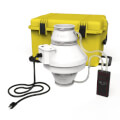
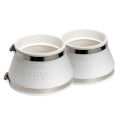


Fantech HP Inline Radon Fans are inline centrifugal fans built specifically for sub-slab depressurization systems that pull radon gas from beneath a foundation and vent it safely outside. They install in the vertical run of PVC pipe that carries soil gas from the sub-slab collection point up through the attic or along an exterior wall, running continuously to maintain negative pressure under the slab. The HP series is built for outdoor or unconditioned-space mounting, with weatherproof housings that hold up to attic heat swings and exterior exposure. Airflow capacity varies across the lineup, so a fan is selected to match the soil permeability and square footage of the slab it is protecting, not just swapped in as a one-size-fits-all part. Radon mitigation contractors rely on this series because continuous, quiet operation over years of service matters more here than in most exhaust applications, since a failed fan can let radon levels climb back up in a home undetected.
Subcategories
- Standard HP Radon Fans: Standard HP models cover the airflow range most residential radon mitigation systems need, typically installed in an attic or on an exterior wall in the vertical vent run. They run on standard household voltage and are rated for continuous duty, since a mitigation system is meant to run around the clock. Contractors size these to the home's slab area and sub-slab soil conditions found during a diagnostic test.
- High-Capacity HP Radon Fans: High-capacity models move greater airflow for larger homes, slabs with poor soil permeability, or systems drawing from more than one suction point. They carry the same continuous-duty and weatherproof construction as the standard line but with a larger motor and housing to handle the added static pressure. Mitigation contractors reach for these when a diagnostic test shows the standard series will not pull enough vacuum across the whole slab.
- Fan Mounting & Accessory Parts: Mounting brackets, couplings, and weatherproof covers round out an HP fan installation, letting a contractor secure the fan in the vent pipe run and protect it from the weather when mounted outside. These parts are matched to the specific fan model's pipe diameter, most commonly 3 inch or 4 inch PVC. Keeping the right coupling and bracket on hand avoids an improvised fix that could loosen over time and let the fan sag in the pipe.
Buying Guide
Sizing a Fantech HP Inline Radon Fan starts with the diagnostic reading taken during the initial radon test, specifically the vacuum and airflow needed to depressurize the slab. A fan sized too small will not pull the sub-slab pressure low enough to keep radon from re-entering the home, while an oversized fan wastes energy and adds unnecessary noise for no added mitigation benefit. Soil type plays a large role here: clay and dense soils resist airflow and often call for a higher-capacity fan than a sandy or gravel base under the same size slab.
Pipe diameter is the next check, since the fan's inlet and outlet need to match the existing or planned vent pipe, most commonly 3 inch or 4 inch PVC. Mounting location matters too. Fans installed in an attic need to tolerate temperature swings across a full year, while an exterior wall mount needs weatherproof housing rated for direct exposure to rain and sun.
Number of suction points is the last major factor. A single-point system pulls from one location under the slab, while a multi-point system uses a manifold to draw from several spots at once and generally needs a higher-capacity fan to maintain vacuum across all of them. Choosing the right Fantech HP inline radon fan for the specific suction configuration keeps the mitigation system running efficiently and avoids a callback for insufficient radon reduction after installation.
Frequently Asked Questions
How is a Fantech HP radon fan sized for a specific home?
Sizing is based on the vacuum and airflow readings taken during the initial diagnostic radon test, along with the slab's soil type and square footage. A fan sized too small will not maintain enough sub-slab pressure to keep radon out of the living space.
Can an HP radon fan be mounted inside a conditioned living space?
No, these fans are designed for attic or exterior mounting outside the conditioned space, both to vent radon safely away from occupied areas and because any leaks in the fan housing need to stay outside the home.
What pipe size works with the HP series?
Most residential systems use 3 inch or 4 inch PVC vent pipe, and the fan's inlet and outlet need to match whatever diameter the mitigation system was designed around.
Do multi-point radon systems need a different fan than single-point systems?
Multi-point systems draw from several suction locations through a manifold and generally need a higher-capacity fan to maintain adequate vacuum across every point, compared to a single-point system pulling from just one spot.
How long does a Fantech HP radon fan typically run?
These fans run continuously, since a mitigation system depends on constant negative pressure under the slab to keep radon from building back up in the home.
