




Self Feed Drill Bits


 --%3E %3Csvg version='1.1' id='No-RB' xmlns='http://www.w3.org/2000/svg' xmlns:xlink='http://www.w3.org/1999/xlink' x='0px' y='0px' viewBox='0 0 100 100' enable-background='new 0 0 100 100' xml:space='preserve'%3E %3Cpath fill='%23CECECE' d='M79.44,0.95H20.56C9.78,0.95,0.95,9.78,0.95,20.56v58.87c0,10.79,8.82,19.61,19.61,19.61h58.87 c10.79,0,19.61-8.83,19.61-19.61V20.56C99.05,9.78,90.22,0.95,79.44,0.95z M65.38,58.24l9.38,29.58L49.69,69.78L24.5,87.82 l9.34-29.6L8.8,39.6l30.73-0.17c0,0,6.98-19.61,10-28.93c0.54,1.36,9.88,29.1,9.88,29.1H91.2L65.38,58.24z'/%3E %3C/svg%3E)



 --%3E %3Csvg version='1.1' id='Fill' xmlns='http://www.w3.org/2000/svg' xmlns:xlink='http://www.w3.org/1999/xlink' x='0px' y='0px' viewBox='0 0 100 100' enable-background='new 0 0 100 100' xml:space='preserve'%3E %3Cpath fill='%23F15C02' d='M79.44,0.95H20.56C9.78,0.95,0.95,9.78,0.95,20.56v58.87c0,10.79,8.82,19.61,19.61,19.61h58.87 c10.79,0,19.61-8.83,19.61-19.61V20.56C99.05,9.78,90.22,0.95,79.44,0.95z M65.38,58.24l9.38,29.58L49.69,69.78L24.5,87.82 l9.34-29.6L8.8,39.6l30.73-0.17c0,0,6.98-19.61,10-28.93c0.54,1.36,9.88,29.1,9.88,29.1H91.2L65.38,58.24z'/%3E %3C/svg%3E)
 --%3E %3Csvg version='1.1' id='With-RB' xmlns='http://www.w3.org/2000/svg' xmlns:xlink='http://www.w3.org/1999/xlink' x='0px' y='0px' viewBox='0 0 100 100' enable-background='new 0 0 100 100' xml:space='preserve'%3E %3Cpath fill='%23FBC8B4' d='M79.44,0.95H20.56C9.78,0.95,0.95,9.78,0.95,20.56v58.87c0,10.79,8.82,19.61,19.61,19.61h58.87 c10.79,0,19.61-8.83,19.61-19.61V20.56C99.05,9.78,90.22,0.95,79.44,0.95z M65.38,58.24l9.38,29.58L49.69,69.78L24.5,87.82 l9.34-29.6L8.8,39.6l30.73-0.17c0,0,6.98-19.61,10-28.93c0.54,1.36,9.88,29.1,9.88,29.1H91.2L65.38,58.24z'/%3E %3C/svg%3E)


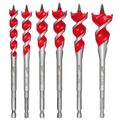




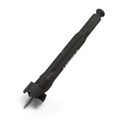



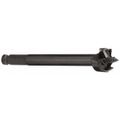
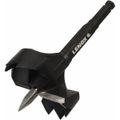

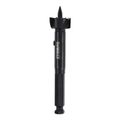

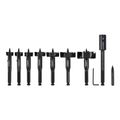
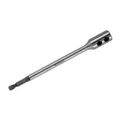
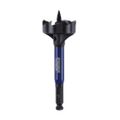
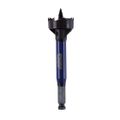

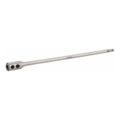

Self Feed Drill Bits bore large, clean holes through wood framing using a threaded center screw that pulls the bit into the material instead of relying on downward hand pressure. Electricians and plumbers use them constantly to run pipe, conduit, and cable through studs, joists, and headers, since the bit clears a full-diameter hole in one pass instead of stepping up through multiple bit sizes. Diameters commonly range from 1 inch up to 4-5/8 inches, covering everything from small conduit runs to large pipe penetrations. Most self feed bits use a 7/16 inch hex shank, which gives the drill chuck three flat gripping surfaces instead of a round shank that can slip under heavy torque. The circular cutting edge removes a clean core rather than chewing through the material, reducing splintering on both sides of the hole. Picking the right bit matters on the job because an undersized hole means re-drilling, while an oversized hole weakens the framing member more than necessary and can fail a rough-in inspection.
Subcategories
- Small-Diameter Self Feed Bits: Small-diameter self feed bits, running from 1 inch up to about 1-1/4 inches, handle the most common electrical conduit and small copper or PEX pipe penetrations. Electricians reach for this range constantly when running individual circuits through wall studs. Like larger sizes, these bits use a 7/16 inch hex shank for a secure grip in high-torque drills. Their smaller cutting diameter means less resistance, so they can run at higher drill speeds without stalling.
- Standard Self Feed Bits: Standard self feed bits cover roughly 1-3/8 inches through 2-1/4 inches, matching the size of most PVC and copper drain and supply lines used in residential plumbing. Plumbers rely on this range for the bulk of rough-in work through floor joists and wall plates. The threaded center screw pulls the bit through dimensional lumber without requiring heavy forward pressure from the operator. A 7/16 inch hex shank keeps the bit secure in the chuck at the higher torque these larger diameters demand.
- Large-Diameter Self Feed Bits: Large-diameter self feed bits span 2-9/16 inches up to 4-5/8 inches, sized for larger DWV pipe, HVAC line sets, and bundled cable runs. General contractors and mechanical installers use this range on new construction where multiple large penetrations are needed through structural members. Cutting a hole this size demands more torque, so most installers pair these bits with a high-torque, low-speed drill setting. The 7/16 inch hex shank standard across the self feed line keeps large bits from slipping under that added load.
Buying Guide
Start with the exact hole diameter required for the pipe, conduit, or cable being run, since self feed bits cut one fixed diameter with no adjustment. Match the bit to the outside diameter of whatever is passing through the hole, not the nominal pipe size, since actual OD often runs larger than the labeled size. Next, check the shank. Most Self Feed Drill Bits use a 7/16 inch hex shank, which needs a chuck or quick-change adapter built for hex bits rather than a standard round-shank chuck. Confirm the drill being used can accept that shank size and deliver enough torque, since large-diameter bits in the 3 inch to 4-5/8 inch range need a high-torque, low-speed drill to avoid stalling or burning out the drill motor. Consider the material being drilled as well. Self feed bits are built for wood framing, so drilling through engineered lumber, laminated beams, or anything with embedded fasteners can dull the cutting rim faster than standard dimensional lumber. Keep a range of diameters on hand rather than a single size, since jobs mixing electrical, plumbing, and HVAC rough-in typically call for at least three or four different hole sizes in a day. Finally, inspect the center feed screw before each use. A worn or damaged screw will not pull the bit into the material properly, leading to wandering or stalled cuts even with a sharp cutting edge.
Frequently Asked Questions
What size self feed drill bit is needed for standard conduit?
Self feed drill bit sizing depends on the actual outside diameter of the conduit or pipe being run, not the nominal size. Common electrical conduit runs typically use bits in the 1 inch to 1-1/4 inch range, while larger plumbing and HVAC penetrations call for bits up to 4-5/8 inches. Checking the manufacturer's OD chart for the specific conduit or pipe avoids an undersized hole.
What shank size do self feed drill bits use?
Most self feed drill bits use a 7/16 inch hex shank across the full diameter range, from 1 inch up to 4-5/8 inches. The hex shape gives the drill chuck three flat gripping surfaces, which resists slipping better than a round shank under the higher torque these bits generate. A hex-compatible chuck or adapter is needed to use them.
Can self feed drill bits be used on engineered lumber?
Self feed drill bits are designed primarily for standard dimensional lumber and can be used on engineered lumber, though the harder material and any embedded fasteners dull the cutting rim faster. Running the drill at a lower speed and checking the bit's center feed screw for wear helps maintain clean cuts. Standard framing lumber remains the ideal use case for these bits.
Why is the self feed drill bit not pulling into the wood?
A self feed drill bit relies on a threaded center screw to pull itself into the material, so a worn, dull, or damaged feed screw is the most common reason a bit stalls or wanders instead of feeding smoothly. Checking the screw before each use and replacing it when the threads round off restores proper feed action. Running the drill at the correct speed and torque setting for the bit's diameter also helps.
What is the largest diameter self feed drill bit available?
Self feed drill bits are commonly available up to 4-5/8 inches in diameter, covering large DWV pipe, HVAC line sets, and bundled cable runs. Bits this size need a high-torque, low-speed drill to cut cleanly without stalling. Smaller diameters starting at 1 inch cover the more common electrical and plumbing rough-in work.
