




Filters
SORT
Product Availability –
Size –
Connection Type –
Connection Method –
Review Score –
 --%3E %3Csvg version='1.1' id='Fill' xmlns='http://www.w3.org/2000/svg' xmlns:xlink='http://www.w3.org/1999/xlink' x='0px' y='0px' viewBox='0 0 100 100' enable-background='new 0 0 100 100' xml:space='preserve'%3E %3Cpath fill='%23F15C02' d='M79.44,0.95H20.56C9.78,0.95,0.95,9.78,0.95,20.56v58.87c0,10.79,8.82,19.61,19.61,19.61h58.87 c10.79,0,19.61-8.83,19.61-19.61V20.56C99.05,9.78,90.22,0.95,79.44,0.95z M65.38,58.24l9.38,29.58L49.69,69.78L24.5,87.82 l9.34-29.6L8.8,39.6l30.73-0.17c0,0,6.98-19.61,10-28.93c0.54,1.36,9.88,29.1,9.88,29.1H91.2L65.38,58.24z'/%3E %3C/svg%3E)
 --%3E %3Csvg version='1.1' id='With-RB' xmlns='http://www.w3.org/2000/svg' xmlns:xlink='http://www.w3.org/1999/xlink' x='0px' y='0px' viewBox='0 0 100 100' enable-background='new 0 0 100 100' xml:space='preserve'%3E %3Cpath fill='%23FBC8B4' d='M79.44,0.95H20.56C9.78,0.95,0.95,9.78,0.95,20.56v58.87c0,10.79,8.82,19.61,19.61,19.61h58.87 c10.79,0,19.61-8.83,19.61-19.61V20.56C99.05,9.78,90.22,0.95,79.44,0.95z M65.38,58.24l9.38,29.58L49.69,69.78L24.5,87.82 l9.34-29.6L8.8,39.6l30.73-0.17c0,0,6.98-19.61,10-28.93c0.54,1.36,9.88,29.1,9.88,29.1H91.2L65.38,58.24z'/%3E %3C/svg%3E)
Price Range –
Watts 1170 Mixing Valves


 --%3E %3Csvg version='1.1' id='Half' xmlns='http://www.w3.org/2000/svg' xmlns:xlink='http://www.w3.org/1999/xlink' x='0px' y='0px' viewBox='0 0 100 100' enable-background='new 0 0 100 100' xml:space='preserve'%3E %3Cg%3E %3Cpath fill='%23F15C02' d='M30.05,70.23l3.79-12.01L8.8,39.6l30.73-0.17c0,0,6.98-19.61,10-28.93c0.54,1.36,9.88,29.1,9.88,29.1h1.58 L93.71,7.18c-3.58-3.82-8.66-6.23-14.28-6.23H20.56C9.78,0.95,0.95,9.78,0.95,20.56v58.87c0,5.41,2.22,10.32,5.79,13.88 L30.05,70.23z'/%3E %3C/g%3E %3Cpath fill='%23FBC8B4' d='M93.71,7.18L60.98,39.6H91.2L65.38,58.24l9.38,29.58L49.69,69.78L24.5,87.82l5.55-17.59L6.75,93.32 c3.55,3.54,8.44,5.73,13.82,5.73h58.87c10.79,0,19.61-8.83,19.61-19.61V20.56C99.05,15.4,97.01,10.69,93.71,7.18z'/%3E %3C/svg%3E)


 --%3E %3Csvg version='1.1' id='No-RB' xmlns='http://www.w3.org/2000/svg' xmlns:xlink='http://www.w3.org/1999/xlink' x='0px' y='0px' viewBox='0 0 100 100' enable-background='new 0 0 100 100' xml:space='preserve'%3E %3Cpath fill='%23CECECE' d='M79.44,0.95H20.56C9.78,0.95,0.95,9.78,0.95,20.56v58.87c0,10.79,8.82,19.61,19.61,19.61h58.87 c10.79,0,19.61-8.83,19.61-19.61V20.56C99.05,9.78,90.22,0.95,79.44,0.95z M65.38,58.24l9.38,29.58L49.69,69.78L24.5,87.82 l9.34-29.6L8.8,39.6l30.73-0.17c0,0,6.98-19.61,10-28.93c0.54,1.36,9.88,29.1,9.88,29.1H91.2L65.38,58.24z'/%3E %3C/svg%3E)


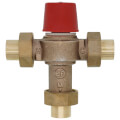







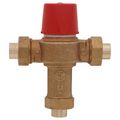
Watts 1170 mixing valves are thermostatic tempering valves that blend hot boiler or storage water with cold supply to deliver a stable, moderated temperature at the point of use. Plumbers and hydronic installers use them on radiant heating loops, indirect water heaters, and domestic hot water systems where the source water runs hotter than what should reach fixtures or floor loops. A wax or liquid-filled thermostatic element inside the valve shifts a piston to adjust the hot-to-cold ratio automatically as inlet temperatures change.
The 1170 series is a common retrofit item because it drops into standard threaded connections without needing a powered control, which matters on jobs where adding electronic mixing controls isn't practical or budgeted. Keeping a stock of these valves and their service kits lets a plumbing contractor turn around a scald-protection or radiant temperature complaint on the same visit rather than special-ordering a part.
Subcategories
- Standard 1170 Mixing Valves: The standard body style covers the most common residential and light commercial installs, typically set inline between a heat source and a distribution manifold. Installers favor this version for straightforward domestic hot water tempering jobs. It uses a field-adjustable thermostatic element so the outlet temperature can be dialed in after installation rather than fixed at the factory. Union connections on most models make future service work easier without cutting pipe.
- High-Capacity 1170 Models: High-capacity versions handle larger flow rates for multi-fixture or light commercial applications where a single standard valve would be undersized. Mechanical contractors spec these on buildings with several bathrooms or a shared hydronic loop feeding multiple zones. The larger valve body accommodates higher flow without a significant pressure drop across the valve. Sizing correctly for the expected flow rate is the main selection consideration here.
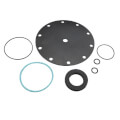
- Repair and Service Kits: Repair kits include the thermostatic cartridge and seals needed to restore a 1170 valve's performance without replacing the entire body. Service plumbers keep these on hand because the internal thermostatic element is the part most likely to wear or foul over years of use. Rebuilding rather than replacing the valve body saves labor time on jobs where the housing and connections are still in good condition. Matching the kit to the exact valve model is necessary since cartridges aren't universal across the line.
Buying Guide
Selecting a Watts 1170 mixing valve starts with confirming the connection size and body style that match the existing piping, since swapping to a different port size means additional fittings or repiping. Flow rate is the next major factor: undersizing a mixing valve for the fixture count or hydronic loop it feeds will show up as inconsistent outlet temperature under load, especially when multiple fixtures draw at once.
Temperature range is worth checking against the specific application. Radiant floor loops typically need a narrower, lower range than a domestic hot water tempering setup feeding fixtures, so confirming the valve's adjustable range covers the target setpoint before ordering avoids a return trip.
Contractors doing service work rather than new installs should also decide between a full valve replacement and a repair kit. If the existing valve body shows no corrosion or physical damage and is the correct size for the application, a repair kit restores performance at a fraction of the material cost of a new Watts 1170 mixing valve.
Union-style end connections are worth prioritizing on any install where future service is likely, since they let a technician pull the valve for repair or replacement without cutting into the surrounding pipework.
Frequently Asked Questions
What's the difference between a mixing valve and a tempering valve?
In practice, the terms are used interchangeably for this type of thermostatic blending valve. Both describe a valve that automatically blends hot and cold water to hold a set outlet temperature, regardless of which term a manufacturer or spec sheet uses.
Can a Watts 1170 mixing valve be adjusted after installation?
Yes, the thermostatic element in most 1170 models is field-adjustable, so the outlet temperature can be fine-tuned once the valve is in service rather than needing to be set precisely before installation.
How often does the thermostatic cartridge need to be replaced?
There's no fixed replacement interval since it depends heavily on water quality and usage. Inconsistent outlet temperature or a valve that no longer holds its setpoint accurately is the usual sign that the cartridge needs attention.
Is a repair kit or a full valve replacement the better choice for an older installation?
If the valve body itself is free of corrosion and correctly sized for the application, a repair kit is typically the more cost-effective route. A full replacement makes more sense when the body shows physical wear or the application has changed enough that the original sizing no longer fits.
Do these valves work on both radiant heating loops and domestic hot water lines?
The 1170 series is used on both, but the valve should be sized and set for the specific application rather than assumed to work identically across them, since radiant loops and domestic hot water systems often call for different target temperatures and flow rates.
